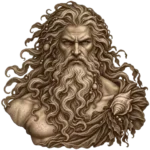
Rhea, mother of the first Olympian generation
Rhea (Greek Ῥέα, Rheia) is a first-generation Titan goddess, daughter of Gaia (Earth) and Uranus (Sky), sister and consort of Cronus, and mother of Hestia, Demeter, Hera, Hades, Poseidon and Zeus. Her distinctive role is not merely to give birth to gods: she breaks the cycle of paternal violence by ensuring that Zeus survives Cronus’s attempt to swallow every child. The decisive account is Hesiod, Theogony 453–506. Rhea belongs to the Titan generation and is not herself one of the twelve Olympians.
The goddess at the turning point of divine kingship
Rhea’s story lies between the rule of Uranus, the reign of Cronus and the emergence of Zeus. Hesiod gives Gaia and Uranus a central role in advising her, while Rhea takes the practical action of hiding her youngest child and substituting a stone. Her intervention allows the swallowed children eventually to be released and the Olympian order to arise. Calling her merely a passive “mother goddess” misses her agency in the succession myth.
A distinct identity despite later assimilation
Greek and Roman writers frequently associate Rhea with the Mother of the Gods, the Anatolian Cybele, and Roman Magna Mater. Such identifications are historically important but not proof that every story or rite of Cybele belongs to the archaic Titaness. An accurate profile distinguishes Rhea’s Hesiodic genealogy from the later, overlapping religious identities of the Great Mother.


Divine motherhood and continuity
Rhea’s chief attribute in the early sources is motherhood within the divine genealogy. Unlike Demeter, whose narrative centers on grain and Persephone, Rhea chiefly safeguards the continuity of the divine family and makes succession possible. Modern claims that she governed every kind of fertility or the entire earth require qualification, since Gaia is explicitly Earth and Rhea’s original mythology is more particular.
Protection of Zeus against Cronus
Her defining action is protective cunning in response to an existential threat to her children. She consults Gaia and Uranus, arranges the hidden birth of Zeus in Crete, and gives Cronus a swaddled stone. This is not a battlefield victory; it is a carefully staged escape that overturns an apparently unavoidable pattern.
Mother of the Gods and later mountain cults
In later worship, Rhea overlaps with the Mother of the Gods and with Cybele, whose cult employed mountain settings, drums, cymbals and sometimes lions. These attributes belong especially to the history of assimilation, rather than serving as evidence that every archaic mention of Rhea involved identical rituals.
Divine order, prophecy and the limits of power
Rhea cannot simply command Cronus to release her children. The prophecy that a child will displace him shapes every choice, and Rhea’s success depends upon concealment and counsel. Her power is expressed by strategy, persistence and the preservation of the next generation.
A mature Titan goddess
Rhea is represented in later visual culture as a dignified maternal goddess, but ancient Greek depictions do not offer a single universal portrait by which every identification can be established. She may appear seated, crowned, veiled or bearing the attributes of the Mother of the Gods. Precise identification relies on archaeological context and inscriptions, not costume alone.
The wrapped stone: her most distinctive narrative object
A stone wrapped in swaddling bands is the unmistakable symbol of Rhea’s deception of Cronus. Pausanias, Description of Greece 9.2.7, describes a sculpture at Plataea of Rhea presenting this disguised stone. That literary testimony supplies a stronger basis for this image than generic modern motifs of earth or fertility.
Lions, tympanum and the Great Mother
Lions and the frame drum (tympanum) are familiar in the iconography of Cybele and the Mother of the Gods, with whom Rhea was later associated. They can be used when a depiction deliberately invokes the syncretic Great Mother, but should not be treated as exclusive symbols of Hesiod’s Rhea.
Mountain and cave settings
Crete’s caves and wooded highlands are linked with the concealment of the infant Zeus. The dramatic setting belongs to the myth of Rhea’s rescue; it does not mean that every cave in Crete was a confirmed sanctuary dedicated specifically to her.
Birth among the Titans
Hesiod, Theogony 132–138, names Rhea among the daughters of Gaia and Uranus. This makes her sister to Cronus and to other Titans, including Oceanus, Hyperion, Themis and Mnemosyne. The early genealogy defines her position before Olympian rule; later religious identifications must not erase it.
The swallowing of the children
After Cronus takes power, he learns that a son will eventually replace him. Hesiod, Theogony 453–467, names the children of Rhea and Cronus: Hestia, Demeter, Hera, Hades, Poseidon and Zeus. Cronus swallows the first five at birth. The text explicitly describes Rhea’s recurring grief, making the episode a family catastrophe rather than merely an abstract succession of kings.
The consultation with Gaia and Uranus
When she is pregnant with Zeus, Rhea appeals to her parents, Gaia and Uranus, for help. In Hesiod, Theogony 468–476, they reveal how she may conceal the birth and allow the prophecy to be fulfilled. Rhea acts with assistance, but the preservation of Zeus depends on her decision and the execution of the plan.
The Cretan birth and the stone
Hesiod’s account places the birth of Zeus in Crete, connects the events with Lyctus and a hidden cave, and says that Gaia helps hide the child. Rhea then hands Cronus a large stone wrapped like a newborn (Theogony 477–491). The detail matters: Cronus himself swallows the stone, believing his control over the succession remains intact.
Curetes, nymphs and variant accounts
The Bibliotheca attributed to Apollodorus (1.1.6–7) gives a more elaborated Cretan account: Zeus is born in a cave of Dicte, is cared for by the nymphs Adrasteia and Ida and the Curetes, while their clashing weapons drown out his cries; Amalthea supplies milk. These narrative details belong to a different textual witness and should not all be presented as if they occur in exactly this form in Hesiod.
Liberation of Zeus’s siblings and the Titanomachy
The adult Zeus compels Cronus to disgorge the children, and the rescued gods support him in the struggle for power. In Apollodorus 1.2.1, Metis gives Cronus an emetic, an elaboration not identical with Hesiod’s presentation. Rhea makes this later liberation possible, but the accounts do not portray her as the principal battlefield commander in the Titanomachy.
The omphalos and the stone’s later story
Hesiod, Theogony 497–500, links the stone with Delphi, where Zeus sets it up as a sign for mortals. In later stories the stone’s identity, location and cultic meaning receive other interpretations. Rhea’s original act is thus attached to sacred geography, although the stone should not be mistaken for her personal cult image.
Later traditions involving the Mother of the Gods
Later authors sometimes place Rhea in the story-world of the Curetes, mountain worship and the Great Mother. Such materials are valuable evidence for the development of Greek religion, but they should be clearly separated from the early account of how Rhea saved Zeus.
Rhea as a goddess who could receive worship
Rhea was not simply a literary name. Pausanias records a temple of Cronus and Rhea in Athens (Description of Greece 1.18.7). This direct testimony is stronger than saying that every sanctuary of the “Mother” automatically belonged to her without qualification.
The Mother of the Gods and syncretism
Greek worship of Meter Theon, the Mother of the Gods, intersects with the interpretation of Rhea as Great Mother and with cults of Cybele. Ancient audiences could identify or overlap these divine figures. For historical accuracy, it is important to say when evidence names Rhea and when it names the Mother of the Gods, who may be identified with her in some contexts.
Ritual music and ecstatic elements
Drums, cymbals and vigorous performance are prominently associated with the Great Mother/Cybele complex and with stories of the Curetes protecting Zeus. Their connection to Rhea is significant in the syncretic religious setting. It is misleading, however, to imply that Hesiod provides a complete ritual handbook for Rhea.
No invented unified ancient cult
There was no single fixed Panhellenic ritual system for Rhea documented across every period. Local practices and interpretive identifications changed. An account of her worship should preserve those limits rather than reconstruct elaborate ceremonies without ancient testimony.
Athens: a shrine to Cronus and Rhea
Pausanias, Description of Greece 1.18.7, explicitly mentions a temple of Cronus and Rhea within the precinct of Olympian Zeus at Athens. It is an important, concrete piece of evidence for her worship outside purely mythic narration.
Crete: Lyctus, Mount Aegeum and the Diktean tradition
Hesiod (Theogony 477–484) associates the concealment of Zeus with Lyctus and a cave on a wooded mountain, whereas Apollodorus (1.1.6) names a cave in Dicte. The variations should remain visible. The Cretan landscape is pivotal to Rhea’s mythology, but a narrated hiding place and an archaeologically attested temple are not the same category.
Olympia: the Metroon
Pausanias, Description of Greece 5.20.9, describes a small Doric Metroon, or temple of the Mother of the Gods, in the Altis at Olympia. It shows the cultic importance of the Mother; its relationship to Rhea should be expressed as an ancient identification or overlap, not automatic equivalence in every ritual context.
Plataea: a memorable sculptural witness
At the temple of Hera in Plataea, Pausanias (9.2.7) reports a statue of Rhea carrying the swaddled stone to Cronus. This attests the strong visibility of her myth in sacred art, without implying that the entire Hera sanctuary was dedicated to Rhea.
Other Mother of the Gods sanctuaries
Pausanias also mentions sanctuaries or images of the Mother of the Gods in various Greek localities. They illuminate the broader Great Mother religious setting, but the evidence must be read site by site rather than casually reassigned to the Titaness.
Gaia and Uranus: parents and advisers
Rhea is a daughter of Gaia and Uranus. In the rescue of Zeus, she asks both for help; they disclose a way to defeat Cronus’s strategy (Hesiod, Theogony 468–476). This makes her parents active participants in the narrative of divine succession.
Cronus: brother, spouse and adversary in the central myth
Rhea is the sister and consort of Cronus. Their union produces six important children, but his fear of displacement leads him to swallow them. Rhea opposes his acts by protecting Zeus, not by personally dethroning him.
Hestia, Demeter and Hera
Rhea’s three daughters eventually become important goddesses of hearth, agriculture and divine marriage. Their more specialized domains are not identical with Rhea’s. They have distinct mythic and religious identities despite shared parentage.
Hades, Poseidon and Zeus
Her three sons hold central places in the post-Titan distribution of divine power: Hades in the realm of the dead, Poseidon in the sea and Zeus as ruler of the Olympian gods. Saving Zeus sets the stage for the release and later sovereignty of all six.
Curetes and nymphs as protectors, not biological children
Later accounts name the Curetes and the nymphs Adrasteia and Ida among Zeus’s protectors. Their narrative relationship to Rhea’s plan is important, but should not be converted into false genealogy.
Siblings among the Titans
Rhea belongs to the first Titan generation, with siblings including Oceanus, Hyperion, Themis and Mnemosyne. Listing every sibling is less important than explaining why this ancestry distinguishes her from her Olympian children.
Cybele and the Mother of the Gods
Rhea’s most historically consequential identification is with the Anatolian and Greco-Roman Great Mother, often called Cybele or Meter Theon. In later Greek religion and literature their images and stories can overlap, particularly in contexts involving mountains, lions and ecstatic music. The names, however, preserve distinct origin histories.
Ops and the Roman context
Roman Ops is sometimes paired with Saturn and can serve as Rhea’s Roman counterpart in comparative summaries. But a strict one-to-one identity can obscure the differences between an older Greek Titan genealogy and the Roman religious functions of Ops. The imported cult of Magna Mater provides another, separate route of identification.
Rhea is not Gaia or Demeter
Rhea is not the Earth herself: in Hesiod her mother Gaia explicitly occupies that role. Nor is she interchangeable with Demeter, her daughter, whose cult and myths of the grain cycle are much more specific. Generic labels such as “fertility goddess” risk collapsing three different divine identities.
Titaness rather than Olympian
Rhea is a Titaness. Being mother of Zeus does not make her an Olympian of the succeeding generation. Her place in the divine family is important for accurate taxonomy and internal links.
Hesiod, Theogony 132–138 and 453–506
The earliest core account used here: Rhea among Gaia and Uranus’s children; the six children of Cronus and Rhea; the swallowing; Rhea’s appeal to her parents; Crete, the disguised stone and Zeus’s rise. Read the poem directly before asserting particular details.
Pseudo-Apollodorus, Bibliotheca 1.1.3–7; 1.2.1
A later mythographic presentation, especially useful for the cave of Dicte, the Curetes’ clashing weapons, the nymphs Adrasteia and Ida, Amalthea and Metis’s emetic. These are not indiscriminately fused with Hesiod.
Pausanias, Description of Greece 1.18.7; 5.20.9; 9.2.7
Primary testimony for the temple of Cronus and Rhea in Athens, the Metroon at Olympia, and the sculptural image of Rhea with the stone at Plataea. The Mother of the Gods designation needs contextual interpretation.
Diodorus Siculus, Library of History 5.65 and 5.68
Later testimony about Cretan traditions and the raising of Zeus. Useful for reception and local narratives, not a substitute for the archaic text.
Editorial distinction
The profile distinguishes early genealogy and the rescue myth, later expansions of the Cretan story, and the historically layered assimilation of Rhea with Cybele or the Mother of the Gods. No claim of a single universal representation, rite or sanctuary is warranted.