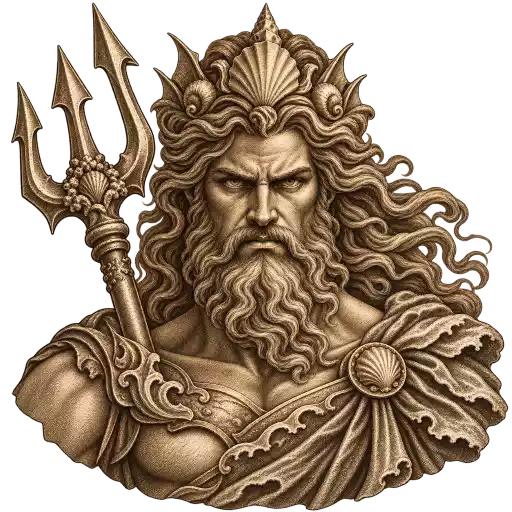
Poseidon is one of the major gods of Greek mythology and the divine ruler most strongly associated with the sea, earthquakes and horses. He is the son of the Titans Cronus and Rhea and the brother of Zeus, Hades, Hera, Demeter and Hestia.
After the defeat of the Titans, Poseidon became ruler of the sea and one of the three divine brothers who divided major regions of the cosmos among themselves.
Origins
Poseidon was born to Cronus and Rhea during the generation preceding the full establishment of the Olympian gods. According to the best-known tradition, Cronus swallowed his children because he feared a prophecy that one of them would overthrow him.
After Zeus escaped this fate and later forced Cronus to release his siblings, Poseidon joined the younger gods in their struggle against the Titans.
The Titanomachy
Poseidon fought alongside Zeus, Hades and their allies during the Titanomachy, the great conflict between the younger gods and the Titans.
During this struggle, the Cyclopes gave supernatural weapons to the three brothers. Zeus received the thunderbolt, Hades received the helmet of invisibility and Poseidon received the trident.
The trident became Poseidon’s most famous symbol and a direct expression of his power over the sea and the earth.
Division of the Cosmos
After the Titans were defeated, Zeus, Poseidon and Hades divided important cosmic realms among themselves. Zeus received the sky, Hades the Underworld and Poseidon the sea.
The earth itself was not simply assigned to one of the brothers, which helped explain why Poseidon could still possess important terrestrial powers, especially those connected with earthquakes and horses.
Lord of the Sea
Poseidon was regarded as the great ruler of the sea. Sailors, coastal communities and cities dependent on maritime trade could seek his favor or fear his anger.
Ancient myths portray him as capable of calming or violently disturbing the waters. Storms, dangerous waves and shipwrecks could all be interpreted within the religious imagination as manifestations of divine hostility.
Earthquakes
Poseidon was also known as a powerful shaker of the earth. Earthquakes were among the most dramatic manifestations associated with him, and several of his ancient epithets emphasize this aspect of his divine identity.
The connection between the sea and seismic power made Poseidon a god capable of threatening both coastal and inland communities.
Horses
Poseidon had a strong association with horses and was sometimes credited with creating or taming them. This aspect of the god may seem different from his maritime identity, but it formed an important and ancient part of his cult.
Horse racing, chariots and equestrian imagery could all become connected with Poseidon in myth and ritual.
Poseidon in Myth
Poseidon appears in numerous myths involving heroes, cities, monsters, sea journeys and rivalries among the gods. He could act as protector, father, ally or dangerous adversary depending on the story.
His conflicts often arise when mortals or other deities challenge his honor, reject his claims or violate obligations connected with divine respect.
Poseidon and Athens
One of the most famous myths involving Poseidon concerns his contest with Athena for the patronage of Athens. Both gods offered gifts to the city, but Athena’s gift was ultimately preferred according to the best-known version of the myth.
The story reflects the importance of both deities in Athenian religious identity and should not be understood as evidence that Poseidon lacked worship in the region.
The Odyssey
Poseidon plays a major role in the Odyssey, where he persecutes Odysseus after the hero blinds Polyphemus, a Cyclops identified as Poseidon’s son.
The god’s anger becomes one of the principal supernatural obstacles delaying Odysseus’s return home.
Poseidon in Greek Religion
Poseidon was one of the most important deities of the ancient Greek world. His worship was particularly significant in maritime regions, ports, islands and communities dependent on the sea.
He was also worshipped in connection with earthquakes, horses and local political identities.
Legacy
Poseidon remained one of the most recognizable gods of classical mythology. Roman religion strongly identified him with Neptune, and the image of the bearded sea god holding a trident became a lasting symbol of maritime power.
The Sea
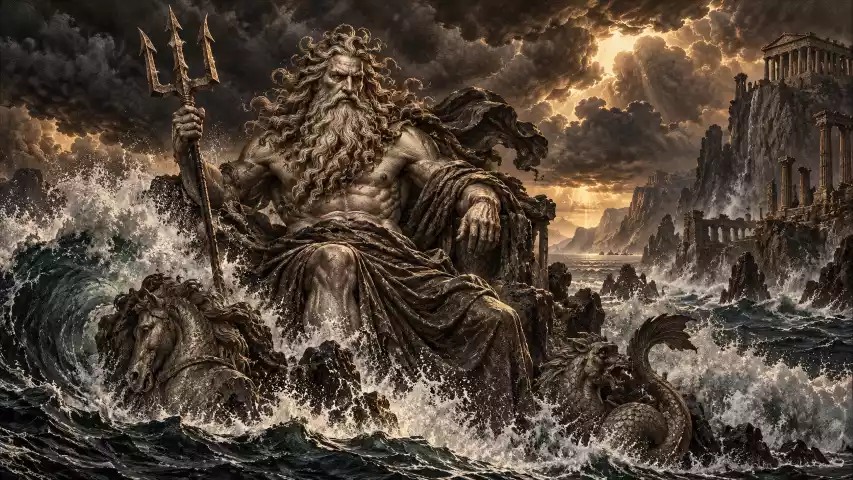
Poseidon's primary domain is the sea. He has authority over marine waters, waves, storms and the dangers faced by sailors. His favor could be associated with safe travel and calm waters, while his anger could bring violent seas and destruction.
Storms and Waves
Poseidon can disturb the sea and unleash powerful waves. Maritime disasters in myth are frequently attributed to his hostility or intervention.
Earthquakes
Poseidon is one of the principal divine powers associated with earthquakes. Ancient Greeks used epithets that described him as the shaker or holder of the earth. This power made him dangerous even far from the coast.
The Trident
The trident is Poseidon's defining divine weapon. By striking with it, he can disturb land or sea, create springs and unleash supernatural effects depending on the myth.
Horses
Poseidon possesses a special connection with horses. Different myths describe him as creator, father or master of extraordinary horses. This association also connects him with chariot racing and equestrian power.
Creation of Springs
Several local myths describe Poseidon causing water to emerge from the earth by striking the ground with his trident. These springs could be fresh or salty depending on the tradition and frequently formed part of myths explaining local sacred landscapes.
Sea Creatures
As ruler of the sea, Poseidon is surrounded by a wide range of marine beings, including dolphins, sea monsters, Tritons and other supernatural creatures associated with the ocean.
Divine Punishment
Poseidon can punish individuals, cities and heroes by unleashing storms, monsters, earthquakes or prolonged misfortune. His punishment often reflects an insult to his divine honor or a violation of obligations owed to him.
Protection
Although many myths emphasize his anger, Poseidon could also protect sailors, cities, horsemen and those who honored him properly.
Immortality and Divine Strength
Like the other major gods, Poseidon is immortal and possesses strength and abilities far beyond those of humans. His power is especially formidable because it is expressed through natural forces capable of affecting entire communities.
Homer
The Iliad and Odyssey are among the most important literary sources for Poseidon. He appears as a major divine power in both epics. The Odyssey is particularly significant because Poseidon's anger toward Odysseus drives much of the poem's supernatural conflict.
Hesiod
Hesiod's Theogony preserves important information about Poseidon's genealogy, his relationship with Cronus and Rhea, and the emergence of the Olympian order.
Homeric Hymns
The Homeric Hymns preserve religious and poetic traditions concerning Poseidon, including his identity as ruler of the sea and tamer of horses.
Greek Tragedy
Poseidon appears or is invoked in Greek tragedy in stories involving Troy, Athens, divine punishment, the sea and heroic families.
Apollodorus
The mythographic tradition attributed to Apollodorus preserves genealogies and myths involving Poseidon, his descendants and his conflicts with gods and mortals.
Pausanias
Pausanias records numerous temples, sanctuaries, local myths and cult practices associated with Poseidon throughout ancient Greece. His work is especially valuable for understanding regional forms of Poseidon that do not always appear prominently in epic literature.
Archaeology and Inscriptions
Temples, inscriptions, votive offerings, coins, sculptures and vase paintings provide important evidence for Poseidon's worship and iconography.
Important Cult Sites
Poseidon was worshipped at many coastal and inland sanctuaries. Important cult centers included Cape Sounion and the sanctuary at Isthmia near Corinth. The Isthmian Games were associated with Poseidon and formed one of the major Panhellenic festival traditions of the ancient Greek world.