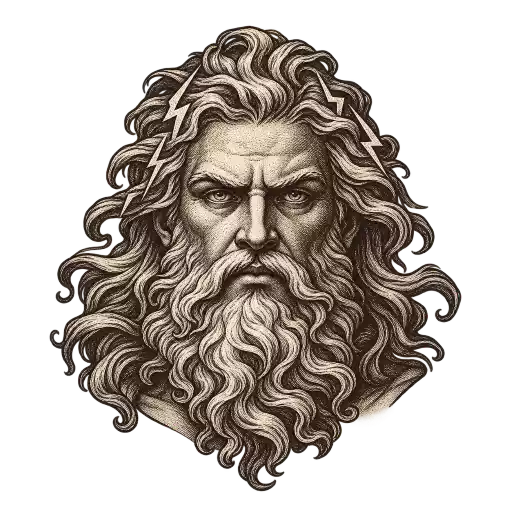
Zeus is one of the principal gods of Greek mythology and the supreme ruler of the Olympian divine order. He is primarily associated with the sky, thunder, lightning, kingship, justice, law, oaths and the maintenance of divine and social order.
In Greek myth, Zeus belongs to the generation of gods that overthrew the Titans and established a new cosmic order. He became king of the gods after the defeat of Cronus and the Titans, ruling from Mount Olympus and presiding over both divine affairs and the lives of mortals.
Origins
Zeus was the son of the Titans Cronus and Rhea. According to the most influential surviving tradition, Cronus had learned that one of his children would eventually overthrow him. In an attempt to prevent this prophecy, he swallowed his children as soon as they were born.
Rhea, unwilling to lose another child, secretly gave birth to Zeus and concealed him. She presented Cronus with a stone wrapped in cloth, which he swallowed believing it to be the newborn god.
Accounts of Zeus’s hidden childhood differ between ancient sources and local traditions. Crete became especially important in later accounts of his infancy, and several locations on the island claimed associations with the young god.
The Overthrow of Cronus
After reaching maturity, Zeus confronted Cronus. Through various versions of the myth, Cronus was compelled to release the children he had swallowed: Hestia, Demeter, Hera, Hades and Poseidon.
The liberation of his siblings set the stage for a conflict between the younger gods and the older generation of Titans.
The Titanomachy
The Titanomachy was the great war between Zeus and his allies and the Titans who represented the previous divine order. Ancient traditions describe the conflict as lasting many years and involving forces of tremendous supernatural power.
Zeus freed powerful beings who had been imprisoned by the Titans, including the Cyclopes and the Hundred-Handed Ones. In gratitude, the Cyclopes gave Zeus his thunderbolt, which became his most famous weapon and one of his defining symbols.
With these allies, Zeus and the younger gods defeated the Titans. Many of the defeated Titans were imprisoned in Tartarus, while a new Olympian order emerged under Zeus’s leadership.
Division of the Cosmos
After the victory, Zeus, Poseidon and Hades divided major realms of the cosmos among themselves. Zeus received sovereignty over the sky, Poseidon became ruler of the sea and Hades governed the realm of the dead.
The earth and Mount Olympus were not simply assigned in the same manner and continued to form spaces in which several divine powers operated.
King of Olympus
As king of the Olympian gods, Zeus occupied a position of supreme authority but was not portrayed as an absolutely unlimited being. Greek myths frequently show other gods challenging, persuading or resisting him, and even Zeus could operate within a cosmic framework in which fate possessed enormous importance.
His authority involved maintaining the divine hierarchy, judging disputes, punishing violations of sacred law and intervening in the affairs of humans when divine order, oaths, hospitality or justice had been broken.
Zeus in Myth
Zeus appears in an enormous number of Greek myths. He participates in stories concerning the origins of humanity, wars among gods, heroic genealogies, divine punishments, transformations, prophecies and the foundation of royal or religious lineages.
Many heroes and important mythological families claimed descent from Zeus. His numerous relationships with goddesses, nymphs and mortal women became a recurring element of Greek mythology and linked him genealogically to many major figures.
Zeus in Ancient Greek Religion
Zeus was not merely a literary or mythological character. He was one of the most widely worshipped gods of ancient Greek religion, with sanctuaries, altars, festivals and local cults distributed throughout the Greek world.
Different communities worshipped Zeus under numerous epithets. These local titles emphasized particular aspects of the god, including his power over weather, his protection of strangers and guests, his guardianship of oaths, his connection with kingship and his role as protector of cities and political communities.
Olympia
One of the most important centers of Zeus’s worship was Olympia. The ancient Olympic Games were celebrated in his honor, making his sanctuary there one of the most famous religious centers of the Greek world.
The Temple of Zeus at Olympia once contained the monumental chryselephantine Statue of Zeus created by the sculptor Phidias. In later tradition it was remembered as one of the Seven Wonders of the Ancient World.
Legacy
Zeus remained an extraordinarily influential figure long after the decline of ancient Greek religion. Greek and Roman writers continued to reinterpret his myths, and Roman culture strongly identified him with Jupiter.
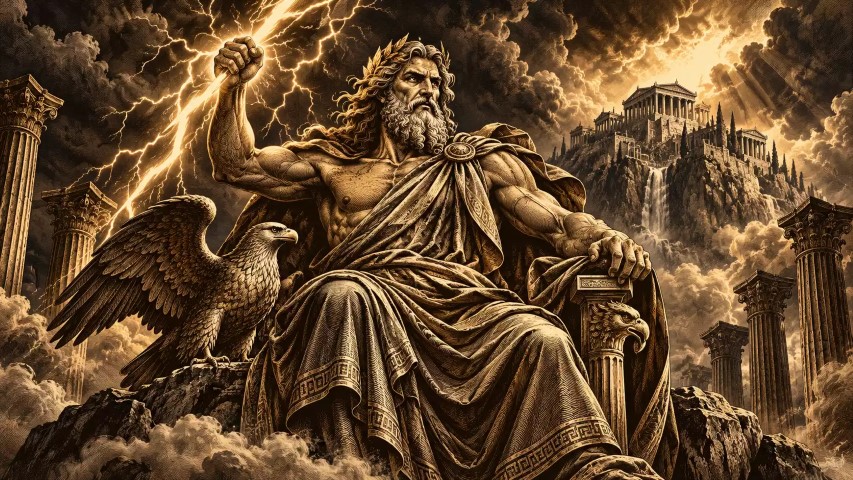
His imagery—the bearded celestial ruler holding the thunderbolt—became one of the most recognizable representations of divine kingship in Western art and continued to influence literature, painting, sculpture, philosophy and modern popular culture.
Sky
Zeus's principal cosmic domain is the sky. As a celestial deity he was associated with atmospheric phenomena and could influence weather affecting both individuals and entire communities.
Thunder and Lightning
Thunder and lightning are the powers most strongly identified with Zeus. His thunderbolt functions both as a weapon and as a visible expression of divine authority. Myths describe Zeus using the thunderbolt against divine enemies, monstrous opponents and mortals who violated sacred boundaries.
Storms and Rain
Zeus could be associated not only with destructive storms but also with life-giving rain. Agricultural societies depended heavily on favorable weather, making the celestial aspect of Zeus important far beyond dramatic myths of thunder and warfare.
Divine Kingship
Zeus possesses authority over the Olympian divine hierarchy. His kingship includes the power to summon assemblies, issue decisions, settle disputes and impose punishment. His authority provided a mythological model for concepts of sovereignty, although Greek stories also frequently explored the limits and complications of power.
Justice and Law
Zeus was strongly connected with justice, lawful order and the punishment of serious violations. Myths sometimes present disasters or divine interventions as consequences of communities or rulers abandoning justice.
Oaths
Oaths had sacred significance in Greek society, and Zeus could act as their divine guardian. Breaking a solemn oath was therefore not merely a social offense but potentially an act against divine order.
Hospitality
Under titles such as Zeus Xenios, Zeus protected the relationship between guest and host. The laws of hospitality formed an important religious and social obligation, and myths repeatedly depict terrible consequences when strangers or guests are mistreated.
Protection of Political Order
Several cult titles connected Zeus with cities, assemblies, rulers and civic stability. His authority therefore extended beyond the natural world into political and communal life.
Prophecy and Signs
Zeus could communicate his will through omens, dreams, weather phenomena and sacred sites. Dodona became particularly famous as an oracle of Zeus.
Transformation
Greek myths frequently attribute supernatural transformations to Zeus. He assumes different forms in various narratives, including animals, natural phenomena and human appearances.
Immortality and Divine Power
Like the other major Olympians, Zeus is immortal and possesses strength and abilities beyond those of mortals. Nevertheless, Greek mythology does not consistently portray divine power as unlimited. Prophecy, fate and the actions of other supernatural beings can create constraints even for the king of the gods.
Hesiod
Hesiod's Theogony is one of the principal surviving sources for the genealogy of the Greek gods, the birth of Zeus, the overthrow of Cronus and the establishment of the Olympian order. Hesiod's Works and Days also preserves traditions concerning Zeus, justice, human behavior and the relationship between divine authority and mortal life.
Homer
The Iliad and the Odyssey provide some of the most influential literary portrayals of Zeus. In these poems he appears as ruler of the gods, guardian of cosmic authority and an active participant in the destinies of heroes and cities.
Homeric Hymns
The collection known as the Homeric Hymns preserves religious and mythological traditions concerning the Olympian gods and provides important evidence for the divine family and cultic environment surrounding Zeus.
Greek Tragedy
Aeschylus, Sophocles and Euripides frequently invoke or discuss Zeus in surviving tragedies. These works explore themes including divine justice, political authority, fate, punishment and conflict between human and divine law.
Apollodorus
The mythographic work traditionally attributed to Apollodorus preserves systematic accounts of Greek divine genealogies and heroic legends, including numerous traditions involving Zeus.
Pausanias
Pausanias's Description of Greece is particularly valuable for understanding the cult of Zeus. It records temples, statues, sanctuaries, local myths, rituals and regional traditions from across the Greek world.
Archaeology and Inscriptions
Literary mythology represents only part of the evidence. Sanctuaries, votive offerings, inscriptions, coins, vase paintings, sculptures and archaeological remains provide essential information about how Zeus was actually represented and worshipped in different periods and regions.
Important Cult Sites
Major locations associated with the worship of Zeus include Olympia and Dodona, although numerous cities and sanctuaries throughout the ancient Greek world maintained their own cults and local forms of the god.