
Gaia, the primordial Earth
Gaia (Γαῖα), also called Gē or Gaea, is the primordial Earth in Greek cosmogony: the ground on which gods and mortals live and a generative goddess whose descendants form much of the divine world. She is not merely a later patroness of crops or a poetic name for scenery. In Hesiod’s Theogony, Gaia emerges near the beginning of the cosmos, after Chaos and before the later generations of Titans and Olympians. She provides a stable foundation while also taking decisive action in struggles over sovereignty.
The Earth as place and person
Greek texts can use gē to mean physical earth, land or soil, and also invoke Earth as a goddess capable of acting, suffering, planning and receiving honors. The two registers coexist. A passage describing something arising from Earth does not always require a literal human-shaped mother; conversely, Gaia’s role in the castration of Uranus and the birth of Typhon is unmistakably mythological agency. Reading both dimensions together avoids reducing her to modern environmental symbolism.
Primordial, not Olympian
Gaia predates the Olympian regime. She generates Uranus, the Mountains and Pontus in the oldest Hesiodic sequence; with Uranus she bears the Titans, Cyclopes and Hundred-Handers. She is mother, grandmother and great-grandmother to powers that later rule the universe. Her authority does not depend on a throne on Olympus, and she must not be confused with Demeter, a different goddess especially associated with grain, agriculture and the Eleusinian mysteries.
Power through generations
A recurring theme in Gaia’s myths is conflict between a ruling father and the children he confines. Uranus suppresses his offspring; Gaia equips Cronus to oppose him. Later, the Olympian order takes shape amid the defeat of the Titans and struggles with beings born from Earth. Gaia cannot be summarized as exclusively gentle or destructive: her generative power is vast enough to support both cultivation and cosmic upheaval.

Foundation of the inhabited world
Gaia embodies the stable earth on which existence unfolds. Hesiod calls her the secure seat of the immortals, making her a necessary condition for cosmic space rather than one more participant within a fully formed universe. Her domain includes plains, soil and the material ground; she is not identical with the sky, sea or underworld even when those regions arise through her genealogy.
Generation and inexhaustible fertility
As a primordial parent, Gaia produces divine beings and supports living creatures. Homeric Hymn 30 to Earth praises her as nourisher of creatures that walk, swim and fly. It connects her favor with children, harvests, grazing herds and flourishing homes. These claims belong to an ancient devotional poem and are stronger evidence for her religious significance than invented lists of supernatural “earth powers.”
Prophetic insight and counsel
Gaia can know or disclose consequential aspects of divine fate. Hesiod’s account of the swallowing of Metis has Gaia and Uranus advising Zeus; in the conflict with Cronus, Gaia’s counsel helps Rea save the infant Zeus. Earth therefore embodies ancient wisdom and strategic knowledge, but she is not universally the sole source of every Greek oracle.
Constraint and resistance
Gaia suffers when Uranus forces their children back into her depths. She then devises a way to end his oppression, producing the sickle that Cronus uses. The episode gives her a distinctive role as a divine parent who resists a cosmic ruler, not just a passive womb from which gods emerge.
Birth beyond orderly genealogy
Earth’s fertility is not automatically benevolent. From her arise formidable beings; after the defeat of earlier powers, some traditions place Typhon within her family. The same ground that feeds humanity can generate adversaries to divine kingship. Ancient cosmogony portrays fertility as overwhelming generative potential, not as a guarantee of harmony.
Earth emerging from the ground
Classical art may depict Gaia as a mature woman rising out of the earth, sometimes with only her upper body visible. This composition gives visual expression to the goddess as the very terrain beneath other figures, rather than simply placing a conventional Olympian goddess on the landscape. Her emergence is especially recognizable in scenes connected with the birth of Erichthonius.
Maternal and sovereign features
Gaia can be shown as a dignified motherly figure offering or presenting a child. Such imagery expresses generative authority, not merely gentleness. There is no single universally mandatory ancient portrait: clothing, hair and accompanying figures vary by period, place and narrative context.
Soil, plants and abundance
Vegetation and the fertile ground naturally convey Gaia’s nourishing role. Yet the modern globe of the planet, green-and-blue ecological logos or generic fantasy “nature magic” are not reliable ancient attributes. Artists should distinguish evidence from later metaphor when depicting the Greek goddess.
The sickle of Cronus
The adamantine sickle appears in the Theogony as Gaia’s crafted instrument against Uranus. It belongs to a precise cosmic episode rather than being her everyday identifying staff or weapon. Showing Gaia with the sickle can be justified when illustrating the overthrow of Uranus, but not as a fixed symbol used in every cult image.
The earth beneath the gods
Gaia’s artistic symbolism often comes from her spatial position. When she rises from the soil below Athena or other gods, the composition highlights a boundary between primordial ground and later divine actors. The scene should be identified from its specific iconographic setting rather than assuming every reclining woman represents Gaia.
Emergence at the beginning
Hesiod, Theogony 116–122, places Gaia after Chaos and before the later divine generations. The opening is not a scientific account of the Earth’s geological formation. It is a sacred genealogy explaining the emergence of ordered cosmic regions and powers.
Uranus, Mountains and Pontus
In Theogony 126–132 Gaia generates starry Uranus, the Mountains and Pontus. With Uranus she subsequently begets the Titans, the Cyclopes and the Hundred-Handers. This succession establishes Earth as both the ground of the cosmos and a prolific mother of distinct regions and divine beings.
The overthrow of Uranus
Hesiod, Theogony 154–187, tells how Uranus hides his children within Gaia, bringing her pain. She fashions an adamantine sickle and challenges the children to act. Cronus accepts, ambushes Uranus and severs his genitals. From the blood falling upon Gaia come the Erinyes, Giants and Meliae; from the severed organ in the sea comes the foam associated with Aphrodite’s birth. The myth marks a violent transition in sovereignty; Gaia is the instigator, not a bystander.
Rea, Cronus and the infant Zeus
Theogony 453–506 recounts Cronus swallowing his children for fear of overthrow. Rea seeks help from Gaia and Uranus, who provide a plan to hide the newborn Zeus on Crete and give Cronus a stone in his place. Gaia thus helps secure the birth of the Olympian order, even though her earlier counsel aided Cronus against Uranus.
The Titanomachy and its aftermath
Gaia is the mother of many Titans; later generations fight over cosmic rule. Accounts of the Titanomachy differ in emphasis, but her genealogy makes her foundational to both sides. The Hundred-Handers, originally among her children, become vital to Zeus’s eventual victory after their release. Gaia’s role should not be flattened into allegiance to a single faction in every version.
Typhon and the challenge to Zeus
Hesiod, Theogony 820–868, describes Gaia joining with Tartarus after Zeus has driven the Titans from heaven, producing Typhon. The monstrous offspring threatens Olympian rule and is defeated by Zeus. Versions of Typhon’s parentage vary in later sources; this Hesiodic passage is the appropriate basis for naming Gaia as his mother.
Erichthonius and Athenian earthborn identity
In important Attic narratives, the earth produces Erichthonius, who is presented to Athena. The details involving Hephaestus, Athena and the Earth vary across authors and images. The story links Gaia to autochthony—the claim that the Athenians were born from their own land—and thus to civic identity, not merely to universal natural fertility.
Delphi and older prophetic traditions
Later Greek writers sometimes describe an early oracle of Earth at Delphi, before Apollo. Aeschylus, Eumenides 1–8, has the Pythia name Earth as the first prophetic power; Pausanias preserves additional local traditions. This is evidence for a remembered sacred succession, not proof that every Delphi tradition agreed upon one historical sequence.
An ancient recipient of reverence
Gaia was worshipped as Earth herself as well as personified in cosmogony. Homeric Hymn 30 is an explicit prayer asking the goddess for a prosperous life. Its images of fertile fields, children, herds and stable households show how cosmological power could enter devotional concerns.
Offerings to the Earth
Greek rites could address Earth in conjunction with chthonic or ancestral divinities, and local customs varied. It is misleading to present one universal ritual manual for Gaia. Accounts of sacrifice and dedication must be anchored to a particular city, sanctuary or literary source.
Oracle traditions
Both Delphi and Olympia preserve traditions associating Earth with prophecy. These associations do not turn Gaia into a universally dominant oracular goddess across all periods. They do demonstrate that her antiquity could be expressed through claims of earlier religious authority.
Civic and agrarian meanings
Earth is where households, fields and cities exist. Honoring her could express gratitude for the conditions of life and an acknowledgement of the land on which a community depends. These meanings overlap with other divinities’ spheres but do not erase their separate cults.
No invented universal priesthood
There is no basis for describing Gaia as presiding over a single standardized Greek church, worldwide priesthood or secret initiation rite. Local evidence and literary prayers are sufficient to establish worship without importing modern ceremonial systems into ancient religion.
Olympia: the Gaeum
Pausanias, Description of Greece 5.14.10, describes an altar of Earth made of ashes at the place called Gaeum. He adds that older accounts remembered an oracle of Earth there. This is valuable location-specific evidence and should not be confused with a generic claim that every Olympian altar belonged to Gaia.
Delphi: prophetic precedence
At Delphi, traditions of prophetic succession place Gaia before later divinities. Aeschylus opens Eumenides with the Pythia naming Earth first in a chain of prophetic authority. Such testimony illuminates sacred memory but is not a neutral record of a recoverable prehistoric priesthood.
Athens and the Athenian earthborn tradition
Attic representations of Gaia in the Erichthonius myth connect her with the sacred identity of Athens and Athena. Her visual presence expresses birth from the soil, ancestry and the land’s relation to the city. Athenian myth should be distinguished from evidence of a dedicated temple or recurring civic festival for Gaia.
The whole inhabited earth
Gaia has a sacred scope that transcends a single sanctuary because she is the Earth. Nonetheless, a symbolic domain is not itself evidence of physical shrines in every region. A responsible gazetteer separates attested sites like Olympia from literary and cosmic locations.
Cult evidence and its limits
Ancient testimony for Earth’s cult is scattered across literary passages, altars and local accounts. We can identify meaningful points of worship without claiming one paramount sanctuary comparable to Delphi for Apollo or Eleusis for Demeter.
Origins and self-generation
In Hesiod’s opening cosmogony, Gaia emerges after Chaos without an identified mother and father. She then generates Uranus, the Mountains and Pontus without a named male consort. This is primordial generation, and it should not be altered to give her ordinary human parentage.
Uranus and the Titans
Gaia and Uranus are parents of the twelve Titans, including Oceanus, Hyperion, Themis, Rhea and Cronus. The children’s fates drive the drama of divine succession. The same union also produces the Cyclopes and Hundred-Handers according to Hesiod.
Cronus and Rhea
Cronus is a son who acts on Gaia’s instructions against Uranus. Later Gaia helps Rhea preserve Zeus from Cronus. This generational tension is vital: Gaia is grandmother of Zeus, and her decisions shape the movement from the primordial world toward Olympian rule.
Pontus and the sea lineage
Gaia also joins with Pontus, producing marine beings including Nereus, Thaumas, Phorcys, Ceto and Eurybia in Hesiod’s sequence. These genealogies explain how the earth’s primordial family extends into the sea and its creatures.
Tartarus and Typhon
In the Hesiodic account, Gaia joins with Tartarus to bear Typhon after Zeus’s victory over the Titans. Typhon becomes an opponent of Zeus. This relation illustrates her creative reach into dangerous and monstrous powers as well as benign ones.
Zeus, Athena and Erichthonius
Zeus is Gaia’s descendant and frequent beneficiary or opponent of her cosmic interventions. Athena features in the Athenian Erichthonius tradition, in which Gaia is involved as the Earth from which the child appears. This is a specific mythic connection, not a reason to invent a biological mother-daughter bond between Gaia and Athena.
Roman Terra and Tellus
Roman writers and later interpreters often associate Greek Gaia with Terra or Tellus, divine Earth in Roman religion. These are useful cultural counterparts but not evidence that the two societies had identical rites or genealogies. Names and cult histories should remain distinguishable.
Gaia, Gaea and Ge
Gaia and Gaea are alternate Latin-letter renderings of the same Greek name; Gē is a Greek form referring to Earth. They are not separate Greek goddesses who need duplicate encyclopedia entries.
Not Demeter
Demeter has her own genealogy, myths and major agricultural cult, especially associated with Persephone and Eleusis. Gaia is an older primordial Earth and cosmic ancestor. Both touch fertility, but treating them as interchangeable strips away their historical and theological differences.
Modern Gaia language
Modern environmental writing, philosophy and science sometimes reuse Gaia’s name to represent Earth as a living or self-regulating system. These later metaphors are reception history, not ancient Greek doctrines. They should be identified as modern rather than retrojected into Hesiod.
Hesiod, Theogony 116–153
Gaia’s emergence after Chaos; her generation of Uranus, Mountains and Pontus; the Titans and other children of Uranus. Use this passage for the central cosmogony and standard earliest genealogy.
Hesiod, Theogony 154–210
Uranus conceals his children, Gaia makes the sickle, Cronus attacks, and the subsequent births follow. Specific blood-born beings and the sea-foam account must not be conflated.
Hesiod, Theogony 453–506 and 820–868
Gaia’s counsel in saving Zeus, and her union with Tartarus producing Typhon. These passages anchor her later role in divine succession and conflict.
Homeric Hymn 30, To Earth, Mother of All, lines 1–19
A compact devotional testimony praising Earth as nourisher of animals and people, giver of harvests and prosperity, and recipient of prayer.
Aeschylus, Eumenides 1–8; Pausanias, Description of Greece 5.14.10
The first gives Earth precedence in the prophetic succession at Delphi; the second records an altar and remembered oracle of Earth at Olympia. They support local cult and sacred-memory statements, not universal claims.
Reading guidance
Ancient sources disagree and emphasize different functions. Distinguish Hesiodic genealogy, Attic autochthony, cult testimony and later Roman identifications; do not blend them into one unsupported continuous biography.
 UranusSon and consort in Hesiod
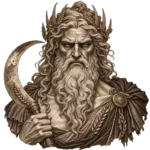 CronusSon who overthrows Uranus
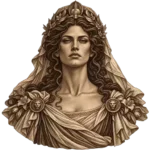 RheaDaughter who saves Zeus with her help
 ZeusGrandson she helps preserve
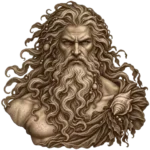 OceanusTitan son
 HyperionTitan son
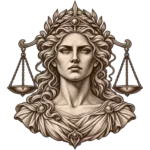 ThemisTitan daughter
 TethysTitan daughter
 AthenaConnected to Erichthonius in Attic myth
 HephaestusConnected to Erichthonius in Attic myth