Athena: Wisdom, Skill and the Defense of Cities
Athena (Greek Ἀθηνᾶ, also Athene) was an Olympian goddess of intelligent action: strategic warfare, practical skill, weaving, craftsmanship and the protection of cities. Her authority was not limited to an abstract modern idea of wisdom. She acted through counsel, disciplined force and the knowledge needed to preserve a household or polis. Her position as patron of Athens was particularly prominent, although her worship extended across the Greek world.
Birth from Zeus and the role of Metis
Hesiod, Theogony 886–900, names Metis as the first partner of Zeus and the mother of Athena. Zeus swallowed pregnant Metis after learning that a later child could supplant him. The goddess Athena subsequently emerged from Zeus. Pseudo-Apollodorus, Library 1.3.6, recounts her armed emergence through his split skull and attributes the blow to Prometheus or, in another version, Hephaestus. The familiar image of a goddess born exclusively of a father thus conceals a crucial maternal figure, Metis, whose name itself denotes cunning intelligence.
Name, epithets and the city
The linguistic relationship between Athena and the name Athens is ancient, but which name came first remains debated. One should not confidently present the goddess as being named after the city or the city after the goddess. Athena Polias signifies her role as guardian of the city; Athena Parthenos emphasizes her maiden identity; Athena Ergane her association with work and crafts; and Athena Nike the victory-bearing aspect honored in Athens. These names express worship contexts rather than separate universal biographies.
A deity beyond simplified oppositions
Ancient poems often contrast Athena with Ares: she favors timing, planning and coordinated action, while he evokes battle fury. Yet Athena also carries weapons and can be terrifying; the distinction is not between peace and war or good and evil. She also punishes arrogance and protects favored heroes. The tensions in her character reflect a goddess who makes knowledge effective in the world, sometimes through lethal force.
Strategy and disciplined warfare
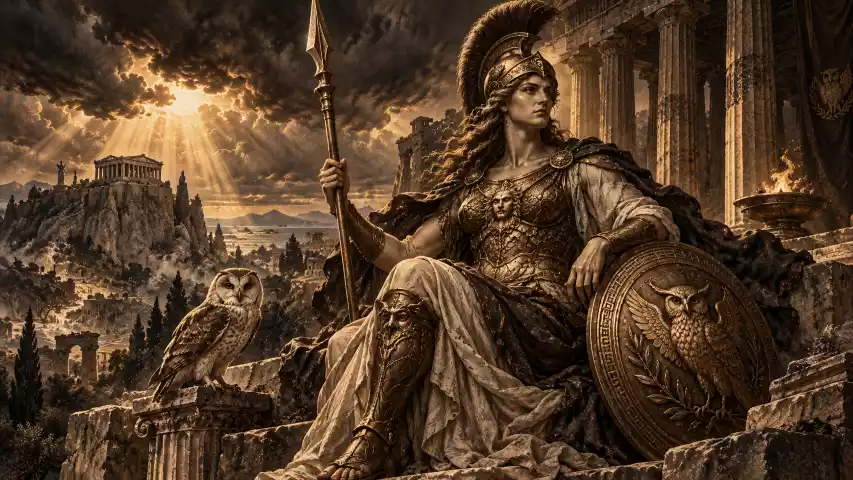
In Homeric epic Athena repeatedly guides warriors through planning, courage and tactical perception. In Iliad 5 she helps Diomedes confront Ares; in Odyssey 13–24 she devises and coordinates Odysseus’ return. These stories represent divine intervention in poetic warfare, not evidence of a single formal Greek military doctrine.
Wisdom as practical intelligence
Athena embodies deliberation and metis, the capacity to choose effective means in difficult circumstances. Odysseus’ disguises, measured speech and well-timed actions illustrate her preferred type of competence. Her link to Metis through Hesiodic genealogy deepens this theme, though the goddess should not be reduced to an allegory of reason.
Weaving and skilled work
Textiles were both household necessities and prestigious ritual offerings. Athena Ergane received recognition as patroness of crafts and skill; the ceremonial peplos offered to Athena at the Panathenaea linked work, women’s labor and civic devotion. Myths about weaving, especially the later story of Arachne in Ovid, dramatize the hazards of rivalry with divine artistry.
Guardianship of the polis
As Athena Polias, the goddess protected civic institutions, territory and shared memory. Her cult image on the Acropolis stood at the center of collective ritual life. The epithet Polias refers to the polis, a community of citizens and its sacred center, rather than a vague modern idea of an urban goddess.
Virginity and autonomy
Athena Parthenos is a goddess who does not marry or produce children in the normal Olympian pattern. Her status signals independence rather than inactivity: myths of Erichthonius present her as guardian and fosterer without making her his biological mother. This distinction matters for accurate genealogical entries.
Helmet, spear and shield
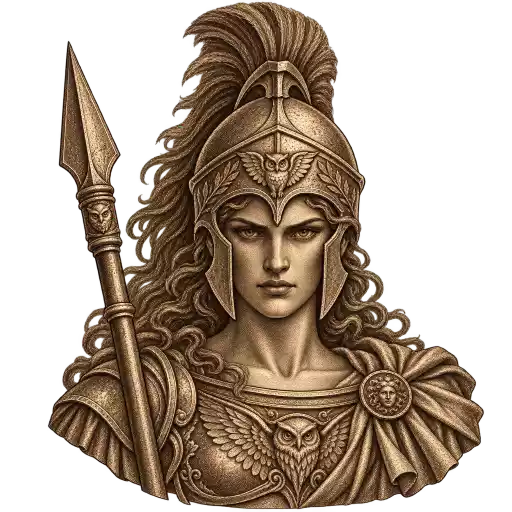
Athena appears armed in early Greek art, frequently with crested helmet, spear and shield. The equipment announces vigilance and competence. It is not evidence that she was interchangeable with Ares: Greek viewers could recognize martial attributes while also seeing a patron of counsel and civic order.
The aegis and Gorgon face
The aegis is a protective or fearsome divine garment or shield-like attribute often associated with Athena and Zeus. Depictions commonly attach the Gorgoneion, the frontal face of a Gorgon, to it. Literary myths connect the Gorgon Medusa with Perseus, whom Athena assists; different accounts explain how her head became a divine emblem.
Owl and olive
The little owl became a familiar symbol of Athena and of Athens, famously appearing on Athenian coinage. The olive tree belongs to the city-patronage legend in which Athena offers the Athenians a prized resource in competition with Poseidon. These symbols communicate local history and civic identity as much as abstract wisdom.
Athena Parthenos and monumental art
Pheidias’ celebrated Athena Parthenos in the Parthenon was a monumental cult statue, known through ancient testimony and later reproductions, rather than a surviving intact original. Athena Promachos and Athena Nike represent other important visual and cultic conceptions. The modern single-image stereotype hides this variety.
Birth from the head of Zeus
Zeus swallows pregnant Metis to prevent a future succession crisis in Hesiod, Theogony 886–900. Pseudo-Apollodorus, Library 1.3.6, adds Athena’s armed leap from Zeus’ head after the skull is opened and records competing agents for the blow. The myth binds political succession and intelligent counsel: Zeus tries to internalize Metis, yet the daughter’s agency remains unmistakable.
The contest with Poseidon
Pseudo-Apollodorus, Library 3.14.1, describes the rivalry between Athena and Poseidon for Attica and divine witnesses to the claims. Athena is associated with the olive tree while Poseidon makes a sea-water sign or strikes the ground, depending on the telling. Pausanias 1.24.3 and 1.26.5 preserves local sacred objects and traditions. It is inaccurate to insist that every version simply stages a popular vote choosing the most useful gift.
Athena and Odysseus
In the Odyssey Athena repeatedly assists Odysseus, often through disguise and carefully timed revelation. She appeals to Zeus for his return, helps Telemachus gain confidence, and ultimately coordinates the hero’s homecoming and the resolution of violence in Ithaca. Their partnership is one of the clearest expressions of her affinity with cunning intelligence.
Perseus and Medusa
Pseudo-Apollodorus, Library 2.4.2, includes Athena among Perseus’ divine helpers, and later images place Medusa’s head on Athena’s aegis. The familiar modern claim that Athena turned Medusa into a monster as punishment for a temple assault comes especially from the Roman poet Ovid, Metamorphoses 4.794–803, and must not be projected as the only or earliest Greek account.
Arachne and the contest of weaving
The famous detailed narrative of Arachne challenging Athena comes from Ovid, Metamorphoses 6.1–145. Arachne’s superb weaving, the images she chooses and the goddess’ reaction make the tale more complicated than a warning against bad craftsmanship. Its source and Roman-period literary context should be stated clearly instead of assuming an unbroken archaic Greek version.
Erichthonius and the daughters of Cecrops
Athena becomes guardian of Erichthonius in mythic accounts of his extraordinary birth involving Hephaestus and Gaia; see Pseudo-Apollodorus, Library 3.14.6. She entrusts the concealed child to the daughters of Cecrops, and their breach of instructions leads to disaster. She is not straightforwardly the boy’s biological mother: guardianship is the key relationship.
Diomedes, Ares and the Trojan War
Iliad 5 portrays Athena strengthening Diomedes and helping him strike Ares, an extraordinary confrontation between mortal and immortal. Across the epic she supports Greek fighters while remaining part of a divine community whose plans may conflict. Literary rivalry with Ares highlights contrasted modes of warfare but cannot be equated with universally opposed civic cults.
Athena Polias and civic identity
Athena’s most important Athenian identity was Polias, protectress of the polis. Rituals, sacred image, priesthoods and calendar festivals articulated the bond between goddess and community. Although the monumental Parthenon dominates modern perception, older sacred traditions on the Acropolis were indispensable to the city’s religious identity.
Panathenaea and the woven peplos
The Panathenaea celebrated Athena with processions, sacrifices and competitions; the Greater Panathenaea took place on a four-year cycle. The offering of a woven peplos connected craftsmanship with public devotion. Exact festival arrangements evolved historically, so accounts should distinguish archaic, classical and later practices when possible.
Ergane, Nike and specific cult titles
Athena Ergane belonged to the world of skilled work and textiles; Athena Nike expressed victory and received worship on the Athenian Acropolis. Distinct epithets are not interchangeable labels. They mark particular ritual settings and concerns of worshippers, and the same goddess could encompass many of them without being divided into separate beings.
Ritual washing and sacred objects
The Plynteria and related rites involved cleansing or covering the ancient image and its garments. Such practices show that Greek cult cared for a concrete sacred presence, not just for myths. Surviving details are incomplete, and reconstructions of who performed every action require caution.
Worship across the Greek world
Athena had major sanctuaries outside Athens, including at Lindos on Rhodes and at Tegea in Arcadia. In different communities she could be a martial protectress, civic patron, patron of crafts or a deity associated with local heroic memory. Pausanias records many such traditions, demonstrating that the Athenian perspective was influential but not exhaustive.
The Acropolis of Athens
The Acropolis was Athena’s premier sacred landscape. It held buildings, altars, statues and mythic signs connected with the city’s foundation and continuity. Rather than a single temple serving every aspect of her cult, it was a complex sacred ensemble with overlapping functions.
The Parthenon
Constructed in the fifth century BCE, the Parthenon housed Pheidias’ immense statue of Athena Parthenos and expressed Athenian wealth and civic power. Its architectural and sculptural program belongs to the Classical era. It must not be confused with the older cult of Athena Polias centered on another sacred image.
Erechtheion and the sacred olive
The Erechtheion and neighboring sacred sites were associated with Athena Polias, Poseidon-Erechtheus and the material signs of their rivalry. Pausanias 1.26.5 describes the sacred olive and the sea-water sign inside the local cult landscape. These features illuminate how myth and religious practice coexisted.
Temple of Athena Nike
The small temple of Athena Nike on the Acropolis celebrated her victory-bearing aspect. Its prominent location makes clear that Athena could be petitioned for military and civic success without collapsing her into a purely aggressive war deity.
Lindos and Tegea
Athena Lindia was honored in a notable Rhodian sanctuary at Lindos, while Athena Alea had an important sanctuary in Tegea in Arcadia. Pausanias describes Athena Alea and its famous temple (8.45–47). These local centers warn against presenting all worship of the goddess as a copy of Athens.
Zeus, Metis and an unusual birth
Hesiod names Zeus and Metis as Athena’s parents. The divine father swallows her pregnant mother, and Athena subsequently emerges from Zeus. Pseudo-Apollodorus adds alternate traditions about the opening of Zeus’ skull. Her genealogy should therefore list Metis as mother even when popular retellings omit her.
Hephaestus and Erichthonius
In Athenian narratives Hephaestus’ pursuit of Athena leads indirectly to the birth of Erichthonius from Earth (Gaia). Athena protects and raises the child in some accounts but does not conceive him in the ordinary sense. Careful relationship labels must distinguish rejected suitor, guardian and biological parent.
Divine associates and rivals
Poseidon is her competitor for Attica and also a participant in the Acropolis’ cultic landscape. Ares is a literary adversary in scenes of the Iliad. Nike is a victory-associated deity linked with Athena in cult and iconography. None of these associations proves straightforward kinship.
Favored heroes and protégés
Athena assists Odysseus, Telemachus, Perseus, Diomedes and Heracles in different traditions. Her protection often rewards ingenuity, courage or perseverance, but she is not a neutral patron who automatically supports every hero. Accounts of her help must be tied to specific texts.
No husband or biological children in the usual tradition
Athena’s status as Parthenos means the standard Olympian accounts do not assign her a husband. The guardianship of Erichthonius must not be silently converted into biological motherhood. This distinction is particularly important when presenting a visual family tree.
Minerva in Roman religion
Romans identified Athena with Minerva, who had her own Italic history and was central to the Capitoline Triad alongside Jupiter and Juno. Their artistic and intellectual spheres overlap, but Greek stories should not be presented as if they all originated within Roman cult.
Athena and the meaning of wisdom
The English word “athenaeum” (and related cultural names) invokes Athena as patron of learning; it is a later honorific use of the goddess’ name, not a classical Greek job title. Modern museums, schools and cultural institutions often use her owl or helmet to signal knowledge. Such reception should be distinguished from evidence for ancient worship.
The owl as cultural symbol
Athenian coin types spread the figure of the owl far beyond the city. In the modern imagination owls are often said to mean wisdom because of Athena, yet the symbol has multiple historical layers. It is safer to identify the ancient civic association than to invent a single origin story for every modern owl emblem.
Caution about universal identifications
Comparisons with other wisdom or war goddesses from different cultures may be useful typologically, but they do not establish identical identities or shared ancestry. Athena is a specific historical goddess of Greek religion, with regional and chronological variation.
Archaic genealogy and epic
Hesiod, Theogony 886–900 and 924–926, for Metis, the succession prophecy and Athena’s birth; Homer, Iliad 5 and 21, for Athena in divine combat; Homer, Odyssey 1–2, 13 and 22–24, for her assistance to Odysseus and Telemachus. Each source reflects literary choices rather than one unanimous Greek creed.
Mythography, cult and local history
Pseudo-Apollodorus, Library 1.3.6 (birth), 2.4.2 (Perseus), 3.14.1 (contest for Attica), 3.14.6 (Erichthonius); Pausanias, Description of Greece 1.24–27 (Athenian sacred landscape) and 8.45–47 (Athena Alea at Tegea). These works preserve specific, sometimes late, reports about older traditions.
Later literature and reception
Ovid, Metamorphoses 4.794–803 (Medusa) and 6.1–145 (Arachne), is a Roman-period literary witness whose versions should be labeled accordingly. The Panathenaic peplos, temple remains, sculptures and Athenian coinage provide different kinds of evidence from narrative poems. Comparing sources and material remains helps distinguish cult history from influential retellings.
 ZeusFather
 PoseidonRival for Attica
 AresDivine rival in epic
 HephaestusRejected suitor; Erichthonius narrative
 GaiaMother of Erichthonius in Athenian myth
 NikeVictory-associated figure
 HeraclesHero she assists in some traditions
 HermesDivine associate in some myths