
Hermes: Messenger, Guide and Master of Boundaries
Identity and religious character
Hermes (Ἑρμῆς) was one of the most versatile gods of ancient Greek religion. He is widely known as the messenger of the Olympians, but that title captures only part of his significance. Greek worship associated him with roads, boundaries, trade, exchange, eloquence, cunning, herds, athletic spaces, thieves and the movement of souls to the underworld. Hermes is not merely a cheerful courier. He is a god of transitions and crossings, someone who makes communication and movement possible between worlds that would otherwise remain separated.
Birth and early identity
In the Homeric Hymn to Hermes, he is the son of Zeus and Maia, born in a cave on Mount Cyllene in Arcadia. Maia is one of the daughters of Atlas, which gives Hermes an interesting genealogical position: he belongs fully to the Olympian order through Zeus, but his maternal line links him to an older generation. The Hymn presents him as precociously intelligent from the day of his birth. He escapes his cradle, invents the lyre from a tortoise shell, steals Apollo’s cattle and then negotiates a settlement. This does not mean all Greek communities understood Hermes only through this literary portrait, but it became one of the most influential accounts of his divine personality.
Boundary god and mediator
Hermes presides over thresholds. He moves between Olympus and the mortal world, between city and countryside, between lawful exchange and trickery, and between life and death when he guides souls. This mediating role explains why he appears in such different contexts: at roadsides, in marketplaces, in gymnasia, in pastoral landscapes and in underworld scenes. His apparent contradictions are best understood as expressions of one central religious logic: Hermes governs passage, contact and negotiation.
Name and etymology
The etymology of the name Hermes is uncertain. Ancient and modern scholars have often linked it with herma, the stone heap or boundary marker, because herm pillars were a major feature of his cult. That association is valuable for understanding his functions even if the linguistic derivation is not proven with absolute certainty. A careful account should distinguish secure cultic connections from speculative etymology.
A god who resists simplification
Modern summaries often reduce Hermes to a messenger god or treat him as a simple equivalent of the Roman Mercury. In reality he combines movement, profit, language, deception, protection and ritual mediation. He can help heroes, escort souls, protect flocks and also delight in theft. His importance lies not in a single domain but in the network of transitions he governs.
Messenger and herald
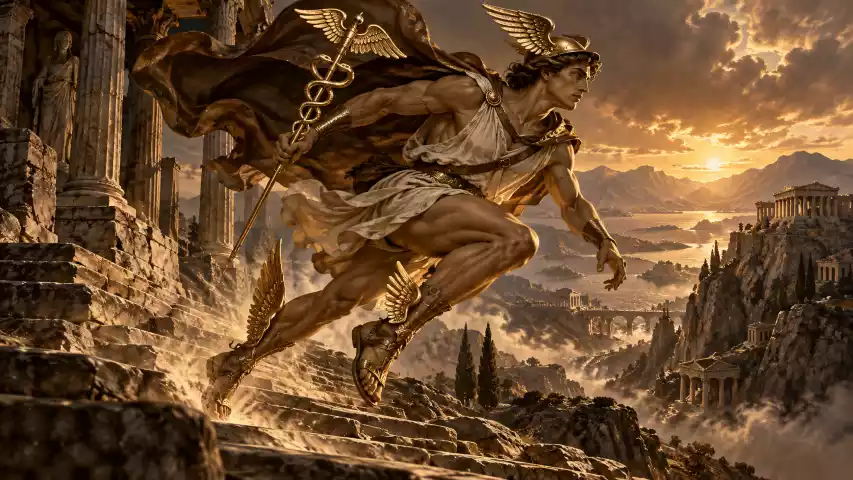
Hermes serves as divine herald and intermediary. He carries Zeus’ commands, summons gods or mortals and enables communication between distant parties. This role is reflected in epithets such as Diaktoros and in his iconic staff. The heraldic aspect involves not merely speed but legitimate transmission, diplomacy and ordered communication.
Travel, roads and safe passage
Hermes protects travellers and oversees roads, crossroads and thresholds. Stone markers, herms and roadside dedications embody this function. His care for movement helps explain why he could be invoked by merchants, envoys and those entering uncertain territory.
Trade, profit and clever exchange
Commercial exchange falls naturally within Hermes’ sphere because trade depends on travel, negotiation, weighing value and crossing social boundaries. He is not only a patron of honest merchants. Greek imagination also connected him with cunning profit and theft. Rather than seeing this as moral inconsistency, it is better to recognize that commerce and trickery both belong to a god who governs transactions and improvisation.
Psychopomp and guide of souls
One of Hermes’ most significant religious roles is that of psychopomp, the guide who escorts souls to the underworld. This does not make him a god of death in the same sense as Hades or Thanatos. He functions as conductor and escort, ensuring transition rather than ruling the dead. In literature this role gives him a calm but eerie presence at the threshold between worlds.
Language, skill and cunning intelligence
Hermes is a god of speech, persuasion and quick intelligence. His myths emphasize invention, tactical lying, improvisation and the ability to resolve conflict through wit. This intelligence is not identical to Athena’s strategic wisdom. Hermes specializes in flexibility, negotiation and opportunistic intelligence rather than ordered planning or war strategy.
Canonical appearance
Greek art often depicts Hermes as a youthful, beardless male, agile rather than heavily armed, though some archaic images show a mature beard. He is typically shown in movement, with an alert and balanced posture suitable for a travelling or heralding god.
Caduceus and heraldic staff
The kerykeion, later called the caduceus, is Hermes’ best-known symbol. It identifies him as herald and mediator. Later iconographic conventions with entwined serpents became highly influential, but one must distinguish later familiar forms from the range of earlier Greek representations.
Winged sandals and traveller’s attire
Hermes may wear winged sandals and sometimes a traveller’s cap or petasos. These details emphasize speed and travel, though not every ancient image includes them. A light cloak and a purse can further suggest his association with movement and exchange.
Herm pillars and boundary signs
One of the most distinctive elements of Hermes’ cult is the herm: a pillar, usually with the god’s head and an explicit phallic form, set at boundaries, doorways or public places. Herms were not mere decorations. They marked space, invoked protection and represented Hermes’ power over passages and territorial definition.
Animals and associated objects
The ram, tortoise and sometimes the rooster can be associated with Hermes. The tortoise is especially important because of the myth in which the infant god makes the first lyre from its shell. This connection links his visual symbolism with his creative intelligence.
The Homeric Hymn and the theft of Apollo’s cattle
The Homeric Hymn to Hermes is the foundational literary portrait of the god. On the very day of his birth Hermes escapes his cradle, encounters a tortoise, makes the lyre, steals Apollo’s cattle and cleverly conceals the tracks. When confronted, he lies with dazzling confidence. Zeus ultimately laughs, Apollo receives the lyre, and Hermes gains recognition as a legitimate Olympian power. The myth is not just comic entertainment. It defines Hermes as inventor, thief, negotiator and future mediator of divine exchange.
Argus and Io
Hermes earns the epithet Argeiphontes, usually interpreted as Argus-slayer, from the story in which Zeus sends him to kill or outwit Argus Panoptes, the many-eyed guardian set over Io. Versions differ on details, but Hermes’ success further illustrates his ability to use cunning rather than brute force.
Guide and helper of heroes
Hermes aids several important heroes. In some traditions he provides Perseus with help or equipment for confronting Medusa. In the Odyssey he gives Odysseus the herb moly so that Circe’s magic will not overpower him. These episodes show Hermes as a benefactor whose intelligence can be shared with select mortals.
Underworld escort
Hermes appears in underworld scenes as guide of souls. In Odyssey 24 he leads the souls of the slain suitors to Hades. This role became one of his most enduring religious identities and strongly influenced later art and thought.
Pan and other descendants
Various traditions name Hermes as father of Pan, often through different mothers depending on the source. The instability of these genealogies is important. Greek myth does not always preserve one authoritative list of divine descendants. When multiple traditions exist, they should be reported as such.
The mutilation of the herms
Although not a myth about Hermes in the heroic age, the mutilation of the herms at Athens in 415 BCE shows how politically and religiously powerful his symbols remained. The scandal was treated as a grave act against civic and sacred order, revealing the continuing importance of Hermes in public life.
Widespread and practical worship
Hermes was worshipped across the Greek world in ways deeply tied to everyday movement and exchange. Unlike gods whose cult centered mainly on one dramatic sanctuary, Hermes often appeared in practical and distributed forms: at roads, gates, gymnasia, marketplaces and rural spaces.
Arcadia and pastoral dimensions
Arcadia was especially important in Hermes’ cult and myth. Mount Cyllene, his birthplace in the Hymn, contributed to his Arcadian identity. In pastoral and rustic settings Hermes could protect flocks, herds and the movement of shepherds through liminal terrain.
Gymnasia and civic spaces
Hermes was closely associated with athletic and civic training environments. His presence in gymnasia reflects movement, bodily agility, youth and competition, but also disciplined social interaction. The god of roads and exchange thus also becomes a god of civic formation.
Marketplace and commerce
As patron of exchange Hermes naturally belonged to the agora. Dedications and invocations connected with buying, selling and negotiation reflect the economic side of his worship. This should not be flattened into the modern cliché of Hermes as simply “god of money.” Greek cultic evidence suggests a more complex patronage of circulation and contact.
Herms as cult objects
Herms themselves were major cultic presences. Set before homes, at crossroads or in public areas, they protected spaces and marked transitions. Their religious role helps explain the shock caused by their mutilation in classical Athens.
Mount Cyllene in Arcadia
Mount Cyllene was famed as Hermes’ birthplace through the Homeric Hymn. Arcadia as a whole preserved strong connections to the god, making this landscape one of the most important sacred points for his mythic identity.
The Athenian Agora and herms
Athens did not rely on one overwhelming sanctuary of Hermes in the way Delphi defined Apollo, but the city’s public spaces, roads and herms show how integrated he was into civic life. The Agora was especially appropriate to Hermes because of its traffic, commerce and communication.
Gymnasia and palaestrae
Many cultic presences of Hermes were attached to gymnasia and training grounds rather than monumental temples alone. These spaces are sacred sites in a broader functional sense and reveal the god’s civic importance.
Roads, boundaries and crossroads
Hermes’ sacred geography is unusually diffuse. Boundaries, gate areas and crossroads often carried his markers and dedications. A profile of Hermes should therefore not define sacred space too narrowly. His power is visible wherever transition is ritually acknowledged.
Tanagra and Kriophoros traditions
Pausanias records local traditions such as Hermes Kriophoros at Tanagra, where the god bore a ram. Such epithets and local legends show the flexibility of Hermes’ cult and the importance of regional forms.
Zeus and Maia
Hermes is the son of Zeus and Maia. Maia is usually identified as one of the Pleiades and a daughter of Atlas. This genealogy combines Olympian authority with an older cosmic lineage.
Apollo as brother, rival and partner
Apollo becomes one of Hermes’ most important divine counterparts through the cattle-stealing myth. Their conflict ends in exchange and mutual recognition, making Apollo both rival and partner in Hermes’ rise. This relationship is a key to Hermes’ theological personality.
Links with nymphs and descendants
Hermes is given various lovers and descendants in Greek mythology. Pan is often the most famous child attributed to him, but traditions differ about the mother. Other lineages may connect Hermes to Autolycus and to descendants linked with cunning or theft.
Relations with mortals and heroes
Hermes stands in unusually close relation to heroes and travellers. He aids Perseus and Odysseus, escorts Priam in some contexts, and appears to mortals as a divine helper whose intervention is practical rather than merely ceremonial.
Underworld associations
Because Hermes guides souls, he relates closely to Hades, Persephone and the underworld realm, though he does not rule it. His family network is therefore broader than bloodline alone: it includes functional relations that shape divine interaction across realms.
Hermes and Mercury
The standard Roman equivalent of Hermes is Mercury. The identification is ancient and important, especially in literature and comparative iconography. Even so, Roman Mercury developed in his own civic and economic context, and Greek evidence should not be collapsed into a purely Roman frame.
Hermes and Hermes Trismegistus
Later antiquity created the figure of Hermes Trismegistus by combining Greek Hermes with Egyptian wisdom traditions. This figure became central in Hermetic literature, alchemy and esoteric history, but he should not be projected backward into every archaic or classical cult of Hermes.
Egyptian comparisons
Greek authors sometimes compared Hermes with Egyptian Thoth because both could be linked with writing, mediation and knowledge. Such identifications are historically important, but they belong to interpretive and syncretic contexts rather than to the earliest layers of Greek worship.
Caution with modern symbolism
Modern readers often know the caduceus from medicine or commerce, but those modern uses do not by themselves define ancient Greek Hermes. His ancient identity is broader and more complex than any one modern emblematic survival.
Primary ancient sources
Homer, Iliad and Odyssey; Homeric Hymn to Hermes; Hesiod, Theogony; Pseudo-Apollodorus, Library; Pausanias, Description of Greece; Herodotus for comparative observations and cult remarks; Thucydides for the mutilation of the herms in Athenian civic history.
Interpretive note
Hermes is a god of functions spread across many domains: heraldry, trade, boundaries, athletics, pastoral life, underworld guidance and trickery. Literary myth, civic history, local cult and later syncretic interpretation do not always align perfectly. A reliable profile should preserve those distinctions rather than force the evidence into one simplified portrait.
 ZeusFather
 AtlasMaternal grandfather
 ApolloBrother-like counterpart; rival and exchange partner
 PanSon in many traditions
 HadesUnderworld ruler whose realm he enters as psychopomp
 PersephoneUnderworld queen associated with his escort role
 AphroditeMother of Hermaphroditus in later traditions involving his line