
A Titan at the boundary of the world
Atlas (Ἄτλας) is a second-generation Titan of Greek mythology, a son of Iapetus and the Oceanid Clymene in Hesiod’s Theogony. He is famous for bearing the vault of the sky at the far edge of the earth. His punishment followed the conflict that placed Zeus and the Olympians in power. Atlas belongs to the defeated Titanic order, yet his labor performs an enduring cosmic function: maintaining the separation of heaven and earth. His story is not primarily about a map, an ordinary mountain, or holding a terrestrial globe.
What Atlas really carries
The distinction between sky and earth is essential. Hesiod states that Atlas holds up broad heaven with his head and tireless hands near the Hesperides. Later images of a man carrying Earth are familiar, especially in modern popular culture, but they should not replace the ancient text. The load is the sky, the celestial dome or cosmic heavens—not the planet on which humans live. Some later representations use a celestial sphere, which is easier to confuse with a globe of the Earth.
The cost of the divine succession
Atlas embodies the consequences of the succession from the Titans to Zeus. Unlike his brother Prometheus, whose best-known punishment concerns the theft of fire, Atlas receives a vast physical task. Their different stories show how the children of Iapetus became attached to cosmic punishment, human origins and endurance. No ancient source requires Atlas to be a god of geography or navigation in the later professional sense.

Endurance and celestial support
Atlas is characterized above all by enormous strength and unrelenting endurance. His burden is not an occasional feat performed for applause but an imposed and continuous responsibility. The image of his arms and shoulders resisting the heavens became one of the most memorable symbols of labor in Greek myth. He does not control the weather or rule the sky as Zeus does: he supports its weight under an obligation set by Zeus.
The edge of the inhabited world
The western margins of the world frequently frame traditions about Atlas. Hesiod locates him near the Hesperides at earth’s limit, whereas later authors rearrange elements of the geography, sometimes placing the golden apples in far northern lands. These disagreements show that mythic geography was flexible. The outer world is an evocative boundary where familiar routes end and impossible tasks begin.
Punishment, strength and cosmic order
Atlas expresses a paradox: someone punished by Zeus helps sustain the stability of the very cosmos ruled by Zeus. His burden is punitive yet structurally indispensable within the story. This tension makes Atlas more than a figure of muscular power. He is also a symbol of necessity, obedience under compulsion and the weight of a settled order after divine conflict.
A myth, not a technical astronomy manual
Astronomical and cartographic traditions later adopted Atlas as an emblem, but the myth itself does not describe him calculating star positions or inventing a mathematical model of the universe. Ancient and later writers offered several explanations for Atlas and the stars; those should be identified as interpretations rather than conflated with the earliest account.
A powerful figure beneath the vault
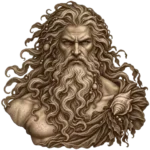
Atlas is most readily represented as an imposing, mature male figure bent or braced beneath an overwhelming celestial weight. His arms extend upward; his stance conveys strain rather than triumph. This matches the ancient description in Hesiod of heaven being supported by his head and tireless hands. A visually faithful portrayal should make the difference between the sky and the Earth clear.
Celestial sphere and the Farnese Atlas
One of the most famous ancient images is the so-called Farnese Atlas, a Roman sculpture depicting a straining figure supporting a celestial globe marked with constellations. It preserves the idea of heavenly, rather than terrestrial, weight. The globe is not evidence that archaic poets imagined the modern planet Earth in Atlas’s hands. The sculpture is an invaluable later witness to the long iconographic life of the myth.
Pillars, mountains and horizon
Pillars, distant mountains and the horizon are associated with Atlas in various representations and interpretations. They evoke the cosmic separation of earth and heaven and the limit of human travel. Not every column or mountain in Greek art is literally an attribute of Atlas, however; the association depends on context and source.
No fixed Olympian regalia
Unlike Zeus with his thunderbolt or Poseidon with his trident, Atlas possesses no equally universal handheld emblem. His defining sign is the task itself. A representation that emphasizes restraint, age, enormous strength and a heavy sky is more historically informative than inventing weapons or a royal insignia for him.
The punishment described by Hesiod
In the Theogony 507–520, Hesiod names Iapetus and Clymene as the parents of Atlas, Menoetius, Prometheus and Epimetheus. He then says Atlas bears broad heaven near the Hesperides, constrained by necessity and assigned this lot by Zeus. The passage establishes the burden but does not provide an elaborate scene of Atlas personally commanding troops in the Titanomachy. Later accounts connect his punishment more explicitly to the fall of the Titans.
Heracles and the golden apples
In the Bibliotheca 2.5.11 attributed to Apollodorus, Heracles must obtain the golden apples of the Hesperides. Prometheus advises him to send Atlas rather than take the apples himself. Heracles temporarily relieves the Titan of the celestial burden, and Atlas retrieves the fruit. Seeing a chance to escape his endless duty, Atlas offers to deliver the apples while Heracles continues holding up heaven. The hero agrees in appearance, then asks Atlas to hold the sky for a moment so he can adjust a cushion on his head. Atlas accepts, and Heracles departs with the apples.
Variants of the eleventh labor
Ancient accounts do not agree on every detail of the apples episode. The Bibliotheca preserves an alternative in which Heracles takes the apples himself after killing the guardian serpent. The location of the garden also varies. This matters because a reliable article should not present every element as if all ancient authors agreed.
Atlas and Perseus in Roman poetry
In Ovid’s Metamorphoses 4.627–662, the wandering Perseus encounters Atlas, who is warned against a son of Zeus. Atlas refuses hospitality, and Perseus displays Medusa’s head; the Titan is transformed into a mountain mass. This is a Roman literary version, not a detail that should be silently inserted into Hesiod’s older account. The coexistence of mountain-Atlas and sky-bearing Atlas is part of the evolving mythic tradition.
The Hesperides and the western edge
Atlas belongs to the same distant mythic landscape as the Hesperides, guardians of marvelous fruit. Ancient authors provide differing genealogies for the Hesperides; some traditions connect them with Atlas as daughters, while Hesiod names them among the offspring of Night. This ambiguity should be preserved instead of giving an exclusive paternal genealogy without qualification.
A mythic Titan, not a major civic cult god
Atlas has enormous mythological and symbolic prominence, but the evidence for an independent widespread civic cult to Atlas is limited. There is no securely established network of major panhellenic sanctuaries centered on him comparable to the cults of Apollo, Athena or Zeus. His main role survives through storytelling, visual art and literary geography.
The difference between representation and worship
Ancient depictions of Atlas do not automatically establish temples or formal rites in his honor. An image on a building, sculpture or vessel may serve a decorative, allegorical or narrative purpose. GRIMORIUM should distinguish archaeological representation from evidence of actual worship.
The religious meaning of punishment
Atlas belongs to the mythology of divine order after the defeat of the Titans. His prescribed labor dramatizes Zeus’s authority and the stability of the heavens. In that sense the story has religious significance even where direct worship of the Titan is not documented.
Later reception beyond religion
Artists, poets, astronomers and cartographers kept Atlas alive as a figure of responsibility, burden and the heavens. These cultural uses are valuable, but they belong to distinct historical contexts. Naming a book of maps an “atlas” does not establish that ancient Greeks revered him as a god of maps.
The limit of the earth
Hesiod situates Atlas near the Hesperides at the outer boundary of the earth. This is mythic geography rather than an address for a securely identified temple. The place expresses remoteness and the boundary between human experience and the cosmic exterior.
The Atlas Mountains and North Africa
Later Greek and Roman accounts associated Atlas with northwestern Africa, including a mountain setting. Ovid’s transformation story gives poetic force to the identification of the Titan with a great mountain range. Yet modern geographic use of “Atlas Mountains” and the oldest Greek cosmological story are not identical evidence.
The garden of the Hesperides
The garden and its golden fruit are central to Atlas’s encounter with Heracles. Depending on the author, the distant place can be western or northern. Its mythic function remains the same: it lies beyond the ordinary world and requires heroic travel or divine assistance to reach.
No securely attested exclusive temple
No celebrated temple built exclusively for Atlas is established by the principal narratives that describe his burden. Mythological location should not be mistaken for an archaeological record. The safest formulation is to identify the western boundary and mountain traditions as narrative locations, not to invent cult centers.
Iapetus and Clymene
Hesiod identifies Iapetus as Atlas’s father and Clymene, an Oceanid daughter of Oceanus, as his mother. Other ancient genealogies vary, sometimes naming Asia instead of Clymene. These variations should be documented rather than forced into a single universal family tree.
Prometheus, Epimetheus and Menoetius
Atlas’s brothers in the Hesiodic genealogy are Prometheus, Epimetheus and Menoetius. Their fates emphasize different aspects of the defeated Titanic family: Prometheus is bound for the theft of fire, Epimetheus accepts Pandora and Menoetius is struck down by Zeus. Atlas alone bears heaven.
The Pleiades and Pleione
One widespread later genealogy makes Atlas and the Oceanid Pleione parents of the seven Pleiades: Maia, Electra, Taygete, Alcyone, Celaeno, Sterope and Merope. The details vary between authors, and the names should be treated as individuals when GRIMORIUM eventually gives each a separate profile.
The Hesperides as variant descendants
Some traditions also call the Hesperides daughters of Atlas, but this is not the only account. Hesiod instead places the Hesperides among the children of Nyx. Atlas’s close association with their garden is certain within the myths about Heracles; his paternity of every Hesperid is not.
Zeus, Heracles and Perseus
Zeus assigns Atlas’s burden in Hesiod. Heracles encounters him in the apples episode according to Apollodorus. Perseus is linked to his transformation in Ovid’s later Latin poem. These figures have different types of relationships with Atlas and should not be presented as if they belonged to one unbroken narrative.
Atlas in Greek and Roman literature
The name Atlas is generally retained in Latin literature rather than replaced by a major separate Roman god. Roman writers reinterpret his punishment and landscape, but the mythological identity remains broadly continuous. The Roman Ovid is especially important for the mountain transformation story.
Atlas and the celestial globe
An image of Atlas carrying a globe often refers to the sphere of the fixed stars or heavens, not the planet Earth. This distinction is essential when explaining classical art to modern readers. A globe can depict a celestial framework even if its shape resembles a modern terrestrial globe.
Atlas, geography and map books
The term “atlas” for a collection of maps owes much to early modern publishing history, especially Gerardus Mercator’s atlas project and its associated imagery. This naming belongs to the reception of classical myth. It should not be rewritten as an ancient Greek tradition in which Atlas invented maps.
Distinct from Atlantis and other names
Atlas the Titan should not automatically be equated with Atlantis, the philosophical island described by Plato, or with every historical person called Atlas. Ancient and later writers reused mythic names widely, and similar names do not prove identical figures.
Hesiod, Theogony 507–520
The central archaic text identifies Atlas as a son of Iapetus and Clymene and states that he bears heaven near the Hesperides by Zeus’s decree. This is the starting point for his punishment and for the crucial sky-versus-Earth distinction.
Pseudo-Apollodorus, Bibliotheca 2.5.11
This account tells of Heracles’s eleventh labor and the golden apples, describes the temporary exchange of the celestial burden with Atlas and preserves variant methods of obtaining the apples. Details should be attributed to this mythographic source rather than projected backward into Hesiod.
Ovid, Metamorphoses 4.627–662
The Latin poet gives the story in which Perseus shows Medusa’s head to Atlas and turns him into a mountain. Because this belongs to a distinct literary phase, the episode should be signaled as Roman poetic tradition.
Genealogy and iconography
For broader family traditions, compare ancient passages on the Pleiades and Hesperides rather than assuming complete agreement. The Roman Farnese Atlas illustrates the celestial-sphere tradition. Later maps and modern iconography should be treated as reception history, not primary proof for archaic theology.
 IapetusFather
 GaiaPaternal grandmother
 UranusPaternal grandfather
 OceanusMaternal grandfather
 PrometheusBrother
 EpimetheusBrother
 ZeusImposed the celestial burden
 HeraclesTemporarily carried his burden during the golden apples labor