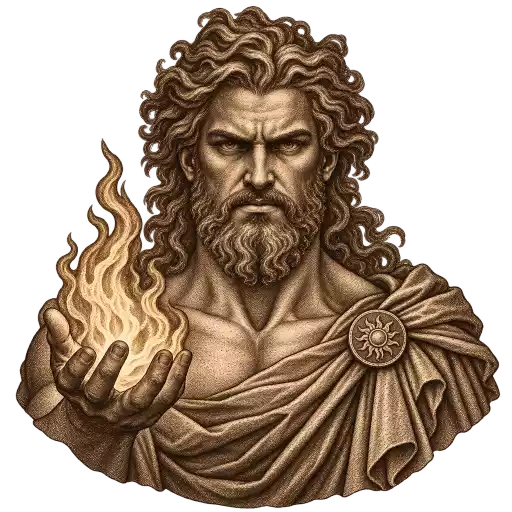
The Titan who challenged Zeus
Prometheus (Greek Προμηθεύς, commonly understood as “Forethought”) belongs to the second generation of Titans. In the genealogy of Hesiod, he is a son of Iapetus and the Oceanid Clymene, brother of Atlas, Epimetheus and Menoetius. His fame does not derive from ruling a great natural realm. He is known for intelligence, foresight, resourcefulness, dangerous opposition to Zeus and an abiding connection with the fate of mortals. His myths ask who controls sacrifice, technology, fire and knowledge, and what happens when a divine figure intervenes on behalf of humans.
A complicated benefactor
Prometheus should not be described simply as a flawless liberator or an enemy of all gods. Hesiod depicts an exceedingly clever challenger whose deception triggers divine retaliation with lasting human consequences. The tragedy Prometheus Bound, traditionally attributed to Aeschylus, instead gives the captive Titan a sustained voice and portrays his gifts as foundations of civilization. These differences are part of his importance: Prometheus changes according to the moral and literary purposes of each author.
Titanic family and Olympian order
The son of Iapetus is closely linked to the transition from older gods to Zeus’s reign. Unlike his brother Atlas, who bears the heavens, Prometheus is chiefly punished for challenging the allocation of authority between Zeus and humanity. His brother Epimetheus, whose name suggests “Afterthought,” serves as a pointed counterpart: both become involved in the chain of events leading to Pandora and the difficult human world described in early Greek poetry.
Fire, craft and the human condition
Fire is the most recognizable emblem of Prometheus because it makes cooking, metalworking and many crafts possible. Yet the story is not simply about handing humanity a match. In its ancient context it concerns a fundamental dispute about divine privilege, mortal vulnerability and the means by which humans sustain life. The Titan’s gift becomes a symbol of the ambivalence of progress: powerful and beneficial, but acquired at an immense cost.
Creation and cultural memory
The popular story that Prometheus sculpted the first humans out of clay is not the central plot of Hesiod’s Prometheus episode. The creation from earth and water is explicitly attested in Pseudo-Apollodorus, Library 1.7.1, and is developed in later traditions. This distinction matters for a historically responsible profile. Prometheus is both a culture-bringer in early Greek poetry and, in certain later accounts, an artisan of humanity itself.
Forethought, intelligence and strategy
The contrast between Prometheus and Epimetheus expresses the difference between acting with foresight and understanding too late. Prometheus often anticipates consequences, deploys cunning and interprets conditions before others. Foresight does not make him omnipotent: his acts still provoke the king of the gods, and his body becomes the site of prolonged punishment.
Fire and mortal arts
Fire is Prometheus’s central gift in Hesiod. Prometheus Bound expands his gifts into counting, writing, animal domestication, seafaring, medicine, divination, mining and the practical means of civilized living (approximately lines 436–506). The dramatic speaker’s list is not identical to the earlier Hesiodic narrative and should be identified as its own literary development.
Sacrifice and negotiation between gods and humans
At Mecone, Prometheus arranges the divided portions of an ox so that the gods and humans receive different shares. In Hesiod this episode explains the practice of burning bones wrapped in fat for divine recipients while humans consume the flesh. His intelligence acts not as abstract philosophy but as a concrete intervention in religious custom and food distribution.
Resistance and suffering
Prometheus possesses resilience: bound in chains and subjected to the eagle, he endures an exceptionally cruel punishment. In the tragedy he refuses to concede divine authority on Zeus’s terms. These qualities explain why later literature adopted him as a figure of principled defiance, though such readings should not be projected without qualification back onto every ancient author.
Prophetic knowledge and limits of power
The dramatic Prometheus claims knowledge of a danger facing Zeus through a future marriage; the secret is connected in later explanations to the prophecy concerning Thetis and a son stronger than his father. His prophetic advantage and his inability to free himself form a deliberate tension: he can foresee an altered divine future but cannot escape present suffering alone.
Flame and fennel stalk
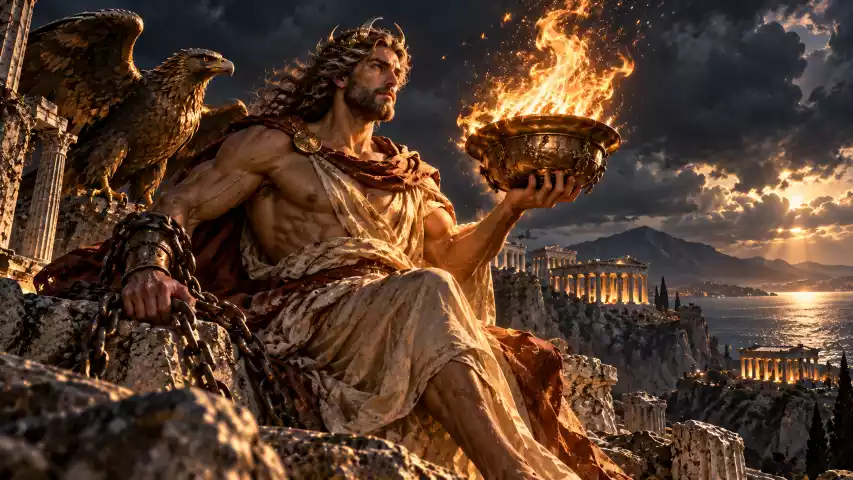
The unmistakable visual sign of Prometheus is stolen fire. Pseudo-Apollodorus says that he concealed it in a hollow fennel stalk, a distinctive detail more precise than the vague modern picture of stealing a torch. The enclosed ember symbolizes intelligence put to use, hidden action and the transfer of a divine resource into human hands.
Chains, cliff and eagle
Another defining scene shows the Titan fastened to a rocky height, traditionally in the Caucasus, while an eagle feeds on his ever-renewing liver. The chains represent punishment, the rock isolation, and the eagle the relentless enforcement of Zeus’s judgment. This is narrative iconography rather than proof of a standardized cult statue type.
Titan as thinker and craftsman
Images may show Prometheus as a mature bearded figure, a thoughtful artisan, or a bound sufferer. Scenes in which he models humanity from clay belong to a strand of reception attested especially in later sources. His precise facial features or costume were never uniformly fixed across the ancient Mediterranean.
Heracles and liberation
When Heracles destroys the eagle, the visual emphasis shifts from torment to release. The hero’s bow, the dying bird and the Titan’s chains represent a new relationship with Olympian authority; Hesiod explicitly states that this occurred with Zeus’s consent, which is an important qualification to the popular tale.
What is not an ancient fixed attribute
A hammer, workshop, scroll or a modern “torch of enlightenment” may communicate later artistic interpretation, but these are not uniformly attested personal insignia. In GRIMORIUM imagery, fire, the hollow stalk and the rocky imprisonment provide the most textually grounded subjects.
The four sons of Iapetus
Hesiod, Theogony 507–520, names Prometheus among the sons of Iapetus and Clymene with Atlas, Menoetius and Epimetheus. This family is marked by extraordinary punishment and consequential actions: Menoetius is struck down, Atlas supports the sky, Epimetheus accepts Pandora and Prometheus suffers for his defiance.
The deception at Mecone
At the division of a sacrificial ox, Prometheus hides the valuable meat and entrails under an unappealing covering while presenting bones covered with attractive fat. Zeus chooses the conspicuous portion, and the account explains why Greek worshippers burn bones for the gods. Hesiod’s narration leaves room for Zeus’s awareness and intentional anger; the story is not a simple modern trickster victory (Theogony 535–557).
The theft of fire
In retaliation Zeus keeps fire from mortals; Prometheus steals it and restores it to them, provoking a more severe punishment. The stolen flame belongs to the same chain of causation as the Mecone dispute, not to an unrelated adventure. Hesiod relates the withholding and theft in Theogony 560–567 and Works and Days 42–59.
Pandora and the human price
Zeus orders the creation of the first woman as a countermeasure in Hesiodic poetry. Pandora’s appearance leads into an account of the hardships borne by humankind. Works and Days 60–105 develops the vessel that releases evils; it is a jar (pithos), not originally a box. Prometheus warns Epimetheus not to accept Zeus’s gift, but Epimetheus does not heed the warning. Pandora belongs to the retaliatory logic of the myth, and interpretations of it must distinguish ancient gender ideology from modern historical fact.
Chains and the regenerating liver
Zeus has Prometheus bound and sends an eagle to eat his liver daily. Because it grows back, suffering continues without ordinary mortal closure. Hesiod, Theogony 520–534, recounts the torment and Heracles’s intervention; Prometheus Bound dramatizes the binding through Hephaestus, Power and Force in its opening scene.
Civilization in Prometheus Bound
In Prometheus Bound, the Titan tells the Oceanids that he gave mortals ways to count, write, build, sail, heal and interpret signs. He is portrayed as the source of skills that transform helpless humans into communities capable of foresight. The passage is powerful evidence for the literary development of the myth, but it should not be silently ascribed to Hesiod (roughly 436–506).
Io, prophecy and the threatened kingship of Zeus
The tragic Prometheus encounters Io and describes her wanderings; he knows that a future marriage may threaten Zeus’s sovereignty. Later accounts associate the danger with Thetis, whose son is destined to be mightier than his father. The resulting myth of divine foresight and negotiation does not have exactly the same shape in every ancient source (Prometheus Bound 700–930; Pseudo-Apollodorus 3.13.5).
Heracles frees Prometheus
Heracles eventually kills the eagle and releases Prometheus. Hesiod stresses that Zeus allowed the rescue so that his son Heracles might gain greater renown (Theogony 526–534). Pseudo-Apollodorus places the rescue among events surrounding the golden apples of the Hesperides (Library 2.5.11). The Chiron-related exchange of immortality belongs to further mythographic explanations and must not be conflated with the earliest text.
Shaping people from clay and the flood of Deucalion
Pseudo-Apollodorus, Library 1.7.1–2, tells how Prometheus formed humans from water and earth; his son Deucalion survives a flood, linking the Titan to later stories of human regeneration. This makes Prometheus both a craftsman of humans in some traditions and a forefather within the flood myth. Neither episode should be treated as an uncontested detail from every Greek version.
A distinctive Athenian cult
Prometheus was not merely a literary rebel. At Athens his worship had a concrete connection with fire and crafts. Pausanias describes an altar of Prometheus in the Academy, from which runners began a torch race (Description of Greece 1.30.2). This is stronger evidence than vague claims of universal shrines throughout Greece.
Torch races and communal fire
The torch race, or lampadedromia, symbolically linked the proper preservation and transfer of flame to collective ritual action. A relay involving runners and torches fits Prometheus’s role as transmitter of fire, while its civic form differs from the mythic act of stealing it from Zeus.
Prometheia and the artisans
Attic festival traditions associate Prometheus with fire-bearing competitions and the world of artisans, including the craft sphere shared in Athens with Hephaestus and Athena. The precise details of the festival vary with evidence and period, so a responsible account should not invent an elaborate fixed ritual calendar.
Mythic suffering and cultic recognition
His punishment did not prevent reverence. Greek religious practice could honor a figure involved in conflict with Zeus without translating mythic opposition into a permanent moral or religious rebellion. Prometheus’s cult setting focuses on the benefits of fire and technical skill.
Limits and distribution
There is no evidence that Prometheus had the same density of monumental public worship as Zeus or Athena across the Greek world. Nonetheless, the Athenian altar and torch race clearly refute the absolute statement that he lacked any ancient cult.
The Academy at Athens
The Academy, a sanctuary landscape outside ancient Athens, is the most securely attested setting for Prometheus’s altar and an associated torch race. Pausanias (1.30.2) records the relevant custom. The place connects a remembered Titan not just to mythology, but to observable Greek ritual.
The Caucasus as a place of punishment
The Caucasus is the traditional setting for the rock on which Prometheus is bound in the dramatized and mythographic accounts. The mountain range is a mythic landscape of suffering and distance from Olympus rather than evidence of a principal Greek temple devoted to him.
Mecone and the origin of sacrificial portions
Mecone is the setting of the sacrificial division in Hesiod. It serves as an explanatory place where the relation between gods and mortals is symbolically negotiated. Its role should not be confused with the later Athenian ritual center.
Olympus and the divine confrontation
Olympus represents the seat of Zeus’s rule against which Prometheus’s acts are measured. The myth contrasts divine power, the deprivation of humans and the Titan’s attempt to secure a resource for mortals.
The Hesperides and routes of Heracles
The narrative of Heracles’s search for the golden apples provides the setting for one later version of the Titan’s liberation. It links Atlas, Heracles and Prometheus, though geographical descriptions in different ancient works should not be harmonized into one precise itinerary.
Iapetus and Clymene
Hesiod makes Iapetus and the Oceanid Clymene the parents of Prometheus. Other genealogical traditions sometimes vary the mother; the Hesiodic account is an appropriate baseline for GRIMORIUM, while acknowledging that Greek genealogy was not universally fixed.
Brothers: Atlas, Epimetheus and Menoetius
Atlas carries the heavens by Zeus’s command; Epimetheus fails to heed his brother’s warning about gifts from Zeus and accepts Pandora; Menoetius is struck down for overbearing violence. Their stories form a cluster of differing responses to divine supremacy.
Zeus as antagonist and eventual authorizer of release
Prometheus’s relation to Zeus is defined by contested power, deception, withholding of fire and punishment. It is not static: Hesiod says that Heracles rescues the Titan with Zeus’s approval. This prevents the story from becoming a simplistic account of eternal hostility.
Heracles as liberator
Heracles is the hero who destroys the eagle and ends Prometheus’s torment in major versions. His act connects the Titan’s myth to the hero cycle, especially to the journey for the apples of the Hesperides in Pseudo-Apollodorus.
Pandora and Epimetheus
Pandora is associated directly with Prometheus’s consequences and with Epimetheus’s failure to heed a warning. She should be treated as a distinct mythical figure, rather than as simply “Prometheus’s wife” or child.
Deucalion and Pyrrha
In later genealogical accounts Deucalion is Prometheus’s son and survives the great flood with Pyrrha, connecting the Titan with a story of human renewal. The version and exact family relationships depend on the author.
Themis, Thetis and the dangerous prophecy
The tragic and mythographic tradition ties Prometheus’s foresight to Zeus’s potential downfall through a marriage. Thetis is central to the better-known formulation that her son would surpass his father; Themis is named as a prophetic source in some accounts. Their roles are related but should not be turned into an invented single immutable narrative.
Greek Prometheus and Roman reception
Roman authors usually preserve the Greek-derived name Prometheus (Latin Prometheus) rather than assigning him a wholly distinct major Roman counterpart. In Roman and later art his stories of making humans and suffering under Zeus/Jupiter continued to evolve.
Prometheus versus Epimetheus
Forethought and Afterthought offer the clearest paired interpretive contrast. Their names express different relationships to consequence and knowledge; their actions in the fire-and-Pandora cycle show how the contrast matters in myth.
Culture hero, not an Olympian god
Prometheus is a Titan, not an Olympian deity or a merely mortal hero. His standing also differs from Hephaestus, the Olympian divine smith: both are associated with craft and fire, but their myths, generations and functions are distinct.
Later interpretations of rebellion and progress
Literature from late antiquity to modernity has read Prometheus as a symbol of enlightenment, defiance, invention and sometimes human emancipation. These are meaningful receptions, but they must be separated from the specific narratives and theological assumptions of Hesiod and Prometheus Bound.
Name and astronomical afterlife
Prometheus’s ancient name is associated with foresight; later astronomical and cultural uses draw prestige from the Titan. Such reuse does not add new ancient powers or genealogies to the original deity.
Hesiod, Theogony 507–616
The Titan family appears at 507–520; Prometheus’s bondage and Heracles’s rescue at 520–534; the division of the sacrificial ox at Mecone at 535–557; the theft of fire and Pandora’s origin in the following verses. These are foundational archaic sources and should be distinguished from later variations.
Hesiod, Works and Days 42–105
The poem revisits the concealment of fire, the gift of Pandora to Epimetheus, and the release of hardships from the jar. It is crucial for the link between Prometheus and the mortal condition, including the detail that the famous container is a jar rather than a modern “box.”
Prometheus Bound, traditionally attributed to Aeschylus
The play dramatizes the Titan’s punishment, his account of the arts he gave mortals (approximately 436–506), his encounter with Io and his knowledge of a danger to Zeus. Ancient attribution is traditionally to Aeschylus, though modern scholarship has debated authorship and date.
Pseudo-Apollodorus, Library 1.7.1–2; 2.5.4; 2.5.11; 3.13.5
These sections record the formation of people from earth and water, the flood tradition of Deucalion, aspects of Chiron’s exchange, the release of Prometheus by Heracles and variants of the Thetis prophecy.
Pausanias, Description of Greece 1.30.2
Evidence for an altar of Prometheus at the Academy in Athens and the customary torch race. This is particularly important when evaluating claims that the Titan had no attested cult.
Research caution
The sources disagree about details and emphases. GRIMORIUM should not treat the clay-creation motif as a verbatim passage of Hesiod, assert that Zeus never permitted Prometheus’s release or collapse all versions of the prophecy and Chiron exchange into a single fixed ancient story.
 IapetusFather
 AtlasBrother
 EpimetheusBrother
 ZeusOpposing ruler who authorizes release in Hesiod
 HeraclesLiberator
 ThemisAssociated with prophecy in variants
 HephaestusForges shackles in the dramatic version
 AthenaDivine crafts and fire-associated traditions