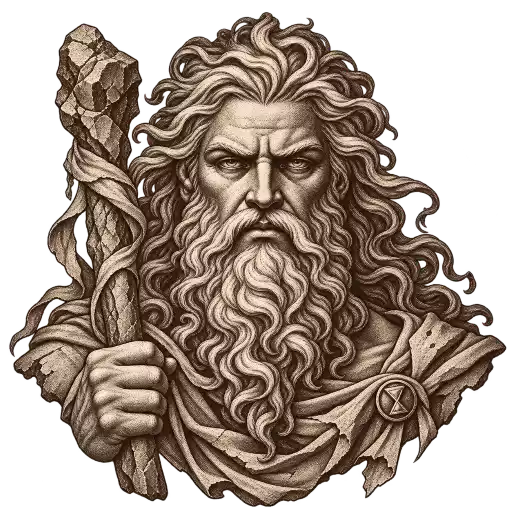
Iapetus: Titan of Mortality, Lineage and the Ancestral Burden of Humanity
Identity and place among the Titans
Iapetus is one of the first-generation Titans in Greek mythology, born from Gaia and Uranus and belonging to the divine generation that precedes Zeus and the Olympian order. He is not among the Titans most frequently dramatized in popular retellings, yet he is one of the most important genealogically. His significance lies less in a long series of heroic episodes and more in his place within the structure of Greek myth: he stands at the head of a lineage that includes Atlas, Prometheus, Epimetheus and Menoetius, figures whose stories touch cosmic rebellion, human creation, suffering, foresight, punishment and endurance.
A Titan defined by descendants
Many primordial or Titanic figures matter because of what they rule directly; Iapetus matters especially because of what comes through him. His sons embody some of the most enduring themes in Greek myth. Atlas bears the heavens, Prometheus shapes or aids humanity and steals fire, Epimetheus becomes associated with afterthought and the acceptance of Pandora, and Menoetius represents reckless force punished by Zeus. Through them, Iapetus becomes a crucial ancestor in the mythic explanation of the human condition.
Why Iapetus matters
Although Iapetus does not dominate the narrative imagination in the same way Cronus or Zeus do, he occupies an important middle ground between primal cosmic order and the later world of mortals and culture. Greek mythographers and later interpreters sometimes saw him as especially connected to the mortal lot because his descendants stand so near the origins, trials and limits of humanity. Even when ancient sources do not state that idea in a systematic doctrine, the pattern is unmistakable.
Not a simple sky-bearer or culture-god
It is important not to flatten Iapetus into one symbolic role alone. He is not identical with Atlas, nor with Prometheus. He is the father of those figures and a Titan of an earlier order. His identity therefore belongs to genealogy, succession, ancestral causation and the transmission of burden from one divine age into another.
Archaic and foundational presence
Iapetus should be read as a foundational background power within Greek myth. He belongs to the deep architecture of the Titan generation, and his importance becomes visible most clearly when one follows the lines of descent that lead from him to stories about the heavens, civilization, foresight, punishment and the fate of humankind.

Titanic generation and succession
Iapetus belongs to the Titan order that rules between the earliest primordial beings and the Olympian dispensation. His primary domain is therefore not a sharply specialized civic portfolio like war or harvest, but a place within the cosmic succession of divine generations.
Lineage, inheritance and ancestral consequence
The most meaningful attribute of Iapetus is lineage. Through him, Greek myth traces a family line deeply involved in the human world and in cosmic punishment. He embodies ancestral transmission: traits, burdens and destinies do not appear from nowhere, but descend through genealogical channels.
Nearness to humanity’s condition
Later interpretation often associates Iapetus with mortality or the human lot because of Prometheus and Epimetheus in particular. Prometheus becomes bound up with human craft, fire and suffering; Epimetheus with error and the acceptance of Pandora; Atlas with endurance; Menoetius with violent overreach. As their father, Iapetus stands close to the mythic matrix from which human difficulty and culture emerge.
Strength, endurance and punishment
The stories connected with Iapetus’ sons repeatedly involve force, endurance and punishment. Atlas endures a cosmic burden; Prometheus endures torment; Menoetius is cast down; Epimetheus participates in consequences that affect all mortals. Iapetus thus occupies a symbolic field marked by the costs of defiance and the weight of existence.
Not a narrowly cultic specialty
Unlike major Olympians, Iapetus does not have a richly defined cultic specialty preserved in abundant evidence. His importance is mythological and genealogical rather than practical or civic. He belongs to the explanatory structure of Greek myth more than to a widely attested ritual sphere.
Titanic elder imagery
When imagined visually, Iapetus is best understood as a powerful elder Titan: mature, imposing and severe rather than youthful or ornamental. Ancient art does not preserve one overwhelmingly standardized iconography for him, so reconstruction depends on his status and associations.
Ancestral dignity
Because his role is genealogical, Iapetus is well suited to imagery of authority, gravity and ancestry. He may be envisioned as a bearded primordial ruler or patriarchal figure, embodying the old divine order from which later dramas emerge.
Association through descendants
Some of the symbolic world around Iapetus comes indirectly from his children. Atlas suggests cosmic burden and endurance; Prometheus suggests fire, craft and foresight; Epimetheus suggests aftermath and consequence. These are not Iapetus’ personal emblems in a strict sense, but they shape how his family line is imagined.
Titanic severity
Iapetus belongs to a generation associated with vast scale and grave consequence. Severe expression, primordial stature and archaic dignity fit him better than elaborate decorative symbolism. He is a father-Titan, not a later god of refined iconographic specialization.
Limited iconographic certainty
It is important to admit the limits of evidence. Unlike Zeus, Athena or Apollo, Iapetus does not enjoy a highly developed iconographic tradition that can always be described with certainty. His visual identity is therefore reconstructed from mythic function, family role and Titan status.
Birth among the Titans
In Hesiod’s Theogony, Iapetus is one of the Titans born to Gaia and Uranus. He belongs to the twelve principal Titans of the earliest divine generations. This gives him an essential place in the chain of succession that leads from primordial beginnings to Titan rule and then to Olympian sovereignty.
Union with Clymene or Asia
Ancient sources vary regarding the mother of Iapetus’ sons. In Hesiod, Clymene—an Oceanid—is named as the mother of Atlas, Menoetius, Prometheus and Epimetheus. Other traditions can connect this role with Asia. This variation is important and should be handled carefully rather than erased.
Father of Atlas, Prometheus, Epimetheus and Menoetius
Iapetus’ greatest mythological importance lies in fathering four major figures. Atlas becomes the bearer of the heavens after the Titan defeat. Prometheus becomes the most famous benefactor and trickster figure related to humanity, fire and suffering. Epimetheus becomes associated with afterthought and the acceptance of Pandora. Menoetius is cast down by Zeus for destructive arrogance or reckless strength. Few Titans have such a consequential set of descendants.
Iapetus and the Titanomachy
Iapetus belongs to the Titan generation that stands opposed to Zeus in the broad conflict known as the Titanomachy. Ancient sources do not always elaborate his personal actions in detail, but he is counted among the older order defeated when the Olympians secure power. This places him firmly in the losing but foundational divine generation.
After the Titan defeat
Later mythic summaries often assume that the defeated Titans, including Iapetus, share the fate of imprisonment or displacement associated with Titan defeat, though specific details are not always equally developed for every Titan. Here again caution matters: Iapetus’ profile is significant, but not every source narrates his punishment individually at length.
The Iapetid line and humanity
Through Prometheus and Epimetheus especially, the line of Iapetus becomes bound to the story of humankind. Fire, craft, suffering, toil, feminine creation in the form of Pandora, foresight and error all cluster around his descendants. This is why later readers often perceive Iapetus as standing unusually close to the mythic explanation of mortal life.
Limited evidence of direct cult
There is little evidence for a broad and independent cult of Iapetus comparable to that of major Olympian gods. This is consistent with his mythic profile. He is crucial in genealogy and cosmology, but not strongly attested as a major focus of public worship.
Mythological prominence over cultic prominence
Iapetus matters more as an explanatory and ancestral figure than as a deity frequently approached in surviving civic ritual evidence. Greek religion often preserves this pattern: a being may be indispensable to mythology without standing at the center of communal cult.
Indirect religious importance through descendants
Although Iapetus himself is not strongly documented in cult, his descendants—especially Prometheus—become much more significant in ritual, drama and civic memory. This gives Iapetus a kind of indirect religious afterlife, because his line helps structure divine and human relations.
Titanic reverence and archaic memory
The Titans as a group could retain mythic reverence as part of the ancient order even where their individual cults were faint or absent. Iapetus belongs to this older stratum of divine memory, carrying seriousness and antiquity rather than intimate ritual familiarity.
Importance for interpretation, not daily invocation
Iapetus is one of the figures who matter deeply for reading Greek myth well, even if they were not among the deities most frequently invoked in daily practice. His presence helps explain where some of the most important mythic problems come from.
No major panhellenic sanctuary clearly centered on Iapetus
There is no famous panhellenic sanctuary definitively identified as the central cult place of Iapetus. This fits his status as a Titan of genealogical significance rather than a major civic deity with a widespread temple network.
Titanic landscapes and archaic memory
Iapetus belongs symbolically to the broad landscapes of Titan memory: mountains, primordial regions and the cosmic spaces associated with divine succession and defeat. These are often more mythic than archaeological, but they suit his identity.
Western associations through Atlas
Because Atlas, his son, becomes associated with the far west and the boundary of the world, some readers connect the Iapetid line with the edges of the cosmos. This is more a family resonance than a fixed sacred geography unique to Iapetus himself.
Tartarus and the defeated Titans
In the larger logic of Titan defeat, Tartarus becomes relevant as the place of imprisonment or containment for the defeated older order. Even where Iapetus is not narrated in isolation, that underworld-cosmic geography forms part of the backdrop for understanding his fate.
Sacred place through genealogy rather than shrine
More than many deities, Iapetus is “located” through the sacred narratives of family descent and Titan history. His meaningful places are the places where his lineage unfolds: the Titan realm, the field of divine war and the cosmic locations bound to his sons’ punishments and labors.
Gaia and Uranus
Iapetus is a son of Gaia and Uranus, placing him among the first-generation Titans. This parentage anchors him firmly in the earliest structure of Greek divine genealogy.
Cronus and the Titan generation
Iapetus is a brother of Cronus and belongs to the same Titan generation that briefly dominates the cosmos before the rise of Zeus. This shared Titan identity situates him within the great succession struggle of Greek myth.
Clymene or Asia
Ancient tradition differs regarding Iapetus’ consort. Hesiod names the Oceanid Clymene, while some later genealogical traditions use Asia. This variation should be preserved because it illustrates the fluidity of mythic transmission.
Atlas
Atlas is one of Iapetus’ most famous sons, condemned after the Titan defeat to bear the heavens. Through Atlas, Iapetus becomes linked to endurance, burden and the western edge of the world.
Prometheus
Prometheus is perhaps the most consequential of Iapetus’ sons in later mythic imagination. Through him, Iapetus’ line becomes central to the stories of fire, trickery, sacrifice, human benefit and divine punishment.
Epimetheus and Menoetius
Epimetheus and Menoetius complete the classic quartet of Iapetid sons. Epimetheus embodies afterthought and fatal acceptance, while Menoetius exemplifies destructive excess punished by Zeus. Together they show the diverse symbolic range of Iapetus’ descendants.
No major popular Roman counterpart
Iapetus does not enjoy the same strong popular Roman profile as Cronus/Saturn or Zeus/Jupiter. In many cases the Greek name is retained in learned mythographic use, and his significance remains primarily genealogical and literary.
Iapetus and the Iapetid line
More important than any simple equivalence is the concept of the Iapetids—the descendants of Iapetus. This family idea helps explain why he matters so much despite his relatively limited narrative individuality.
Possible link to later ideas of human ancestry
Because Prometheus and Epimetheus become so closely connected to humanity, later readers sometimes understood Iapetus as a remote ancestor of the human condition itself. This should be treated as an interpretive consequence of mythic structure, not as a rigid doctrinal formula found identically in every source.
Not to be confused with later astronomical or purely symbolic uses
The name Iapetus appears in later cultural contexts, including astronomy, but the mythological figure remains the Titan ancestor of the Iapetid line. Modern reuse should not obscure the ancient genealogical role at his core.
Primary ancient sources
Hesiod’s Theogony for Iapetus as a Titan son of Gaia and Uranus, for his union with Clymene and for his four principal sons; later mythographic traditions for variant maternal lineages such as Asia; and broader sources on the Titanomachy and the punishments or roles of Atlas, Prometheus, Epimetheus and Menoetius.
Interpretive note
Iapetus should be approached as a Titan of genealogy, transmission and ancestral consequence. He is not one of the most theatrically elaborated figures in Greek myth, but he stands behind some of the most important myths about endurance, foresight, error, punishment and humanity. Through his lineage, he becomes one of the most consequential ancestors in the Greek mythological imagination.
 GaiaMother and primordial source of the Titan generation
 UranusFather and first sky-god of the primordial order
 CronusBrother within the ruling Titan generation
 AtlasSon condemned to bear the heavens after the Titan defeat
 PrometheusSon associated with humanity, fire and divine punishment
 EpimetheusSon associated with afterthought and the Pandora tradition
 ZeusOlympian ruler whose victory ends Titan supremacy