
Cronus, the Titan who ruled before Zeus
Cronus (Greek Kronos, Κρόνος) is the youngest of the twelve Titans born to Gaia (Earth) and Uranus (Sky) in Hesiod’s Theogony. He dethrones Uranus, rules the divine world with his sister-consort Rhea, and is in turn overthrown by his youngest son Zeus. His significance is not simply that he was an early king: he embodies the central Greek succession myth, in which each generation fears the next and divine power passes through conflict. The story provides an origin for the order eventually governed by Olympus.
The identity of the Titan
Cronus is a Titan, not an Olympian. Greek sources describe him as clever, formidable, and associated with a violent change of sovereignty. His epithet “crooked-counselled” in Hesiod points to the combination of intelligence, fear and deception that defines his actions. The sickle with which he attacks Uranus, the stone he swallows in place of Zeus, and his devouring of his offspring form a coherent story of a ruler who secures power by force but cannot make it permanent.
Cronus and Chronos are not automatically the same being
A persistent source of confusion is the resemblance of Kronos (Κρόνος) and Chronos (Χρόνος), the Greek word or personification for Time. Later philosophical, allegorical and Orphic traditions could identify or interpret them together, particularly when explaining the devouring father as time that consumes its children. However, the Titan in Hesiod’s genealogy is Cronus, son of Gaia and Uranus; he should not simply be called the primordial god of Time. Likewise, a Roman identification with Saturn is historically important but requires its own context.
Why his story matters
Cronus is one of the essential links between the primordial universe and the familiar Olympian pantheon. The authority of Zeus is intelligible only after the violence against Uranus, the seizure of power by Cronus, the concealment of the infant Zeus, and the conflict called the Titanomachy. These stories also explore why fear of losing authority can drive a ruler to reproduce precisely the violence he once used to gain it.


Kingship and divine succession
The principal mythic function of Cronus is kingship over the divine order before Zeus. He takes power when Uranus is incapacitated, but the prophecy that a child will overthrow him makes his sovereignty unstable. Cronus thus represents a stage in cosmic rule rather than eternal government over all gods. The succession pattern from Uranus through Cronus to Zeus is one of the organizing principles of Hesiodic mythology.
Sickle, strategy and irreversible violence
Cronus does not defeat his father through a straightforward open duel. Gaia supplies a sickle and devises an ambush. Cronus alone among the children is willing to act. The cutting of Uranus creates a new separation between the generations and has consequences for the birth of further divine powers. His characteristic weapon is therefore a sign of seizure, separation and the risk built into sovereignty.
Fear of succession and swallowing his children
Once told that his own child will overthrow him, Cronus consumes Hestia, Demeter, Hera, Hades and Poseidon as Rhea gives birth to them. This should be described as a mythic act of containment, not mistaken for an ordinary attribute or an annual cult practice. The attempt to keep the next generation literally inside himself fails because Rhea, Gaia and Uranus arrange the survival of Zeus.
Agriculture and the later Saturn connection
Cronus becomes associated in Greek and Roman reception with agricultural abundance, harvest symbolism and a lost age of prosperity. The Roman Saturn—closely connected with sowing, agricultural prosperity and the Saturnalia—strongly influences later pictures of the Titan. These associations should be presented as developments in cult, interpretation and equivalence, rather than projected without qualification onto every early Greek passage.
Time as later symbolism, not the basic genealogy
The interpretation of Cronus as Time devouring everything is a meaningful later allegory, but it is not a substitute for the ancient narrative. In early genealogy, he is the Titan king who swallows his literal divine offspring. A strong historical account keeps this distinction clear while explaining why the resemblance to Chronos helped shape later art and popular understanding.
The adamantine sickle
The curved sickle is Cronus’s defining mythic instrument. Gaia fashions it for the attack on Uranus in Hesiod. In later depictions it may become a scythe, especially after Greek Cronus was fused in European visual traditions with Roman Saturn and the personification of Time. The agricultural scythe and the mythic sickle overlap in reception but have different primary stories.
Mature ruler and Titan imagery
There is no single stable early Greek portrait type for Cronus comparable to the unmistakable attributes of Athena or Poseidon. Later artists often render him as a bearded and imposing older male figure. This conveys ancient kingship and later associations with age, but must not be mistaken for a rigorously uniform archaic cult image.
The swallowed stone
The stone wrapped in infant clothing is among the most important objects in the story. Rhea places it before Cronus as though it were newborn Zeus; he swallows it without noticing the deception. In later traditions the stone is disgorged and associated with Delphi. Its significance is the failure of total control: Cronus consumes a substitute while the true challenger grows elsewhere.
Devouring as a narrative image
The image of Cronus swallowing children is one of the most disturbing and memorable scenes of Greek mythology. It stands for fear of a rival generation and the attempt to prevent history from moving forward. Famous modern artworks amplify its horror, but the myth should be understood through Hesiod and ancient mythographers before introducing modern artistic interpretations.
Distinguishing him from Father Time
A hooded elder with an hourglass, wings or an enormous scythe may belong primarily to later Father Time imagery, not necessarily to an ancient image of Cronus. The distinction matters for historically grounded illustration. The Titan’s strongest textual attributes are his genealogy, cunning, reign, sickle, swallowing and defeat.
Gaia’s plot against Uranus
Uranus oppresses his children by hiding them within Gaia. Distressed by this burden, Gaia makes an adamantine sickle and asks her children to resist. Cronus volunteers. As Uranus approaches, Cronus attacks and castrates him, becoming the agent of the first great revolution in the divine succession. Hesiod narrates these events in Theogony 154–187, including the blood and sea-foam consequences of the violence.
The rule of Cronus and Rhea
After the overthrow of Uranus, Cronus takes the place of ruler among the divine generation and joins with his sister Rhea. Their children are the future central Olympian powers: Hestia, Demeter, Hera, Hades, Poseidon and Zeus. The divine family created by their union is the bridge between the old Titan regime and the new Olympian order (Hesiod, Theogony 453–458).
The prophecy and the five swallowed children
Cronus learns from Gaia and Uranus that he will be overthrown by a son. To escape the prophecy, he swallows each newborn child of Rhea, beginning with Hestia, followed by Demeter, Hera, Hades and Poseidon. This is the critical transformation in his character: the son who once opposed an oppressive father becomes an oppressive father himself. Hesiod tells the story at Theogony 459–467; Apollodorus gives a connected mythographic account in Library 1.1.5.
Rhea saves Zeus
When Rhea is pregnant with Zeus she turns to Gaia and Uranus for help. Zeus is concealed in Crete, while Cronus is given a stone wrapped in swaddling clothes. He swallows the stone as if it were the infant. The source traditions vary in location and the details of the attendants and caretakers; this variation should be reported rather than merged into one invented definitive version (Hesiod, Theogony 468–491; Apollodorus, Library 1.1.6–7).
The return of the children and the Titanomachy
Zeus grows to adulthood and forces the return of the swallowed siblings. In Apollodorus, Metis gives Cronus a drug that makes him disgorge the stone and children (Library 1.2.1). The restored gods join Zeus against Cronus and the Titans. The conflict lasts ten years in that account, and victory comes when Zeus frees the Cyclopes and Hundred-Handers and receives the thunderbolt. Hesiod narrates the wider Titan conflict in Theogony 617–735.
Punishment and later divergent destinies
After the Titanomachy, Cronus loses sovereignty. In one prominent version the defeated Titans are confined in Tartarus. Other traditions, especially poetic accounts connecting Cronus with the Isles of the Blessed, imagine a different later role for him. These are alternate receptions, not a single seamless biography. The main archaic political message remains that Zeus replaces Cronus and secures the Olympian order.
The Golden Age under Cronus
Hesiod’s Works and Days 109–126 describes a race of gold who lived when Cronus ruled in heaven. Their life is free from the severe hardships of later humanity, and the earth provides generously. This is not the same text or scene as the swallowing myth, and a responsible biography should preserve the distinction. Cronus can be a fearful mythic father and, in another ancient genre, the ruler associated with a vanished prosperous era.
Cronus in Greek religious practice
Cronus did receive religious recognition, but his Greek cult was not equivalent in scope to that of Zeus, Apollo or Athena. Evidence points to local observances and specific sanctuaries rather than one uniform panhellenic system. Mythic prominence and cultic scale are not the same thing; Cronus is highly important in cosmic narrative while much of the surviving public worship centers on other gods.
The Kronia
The Athenian festival called Kronia, associated with Cronus and harvest-time relaxation of ordinary social distinctions, is an especially important piece of Greek cult evidence. Ancient reports emphasize shared meals and a temporary inversion or loosening of status between masters and slaves. The festival must be distinguished from Rome’s Saturnalia even though later writers compared the two celebrations.
The cult and myth do different work
A festival associated with Cronus does not mean Greek worshippers reenacted his swallowing of the children. The old succession story explains cosmic rule, while festival practice could emphasize agricultural transition, abundance or communal respite. Treating these as different religious registers prevents a misleading literalism.
Saturn and the Roman reception
Roman Saturn has a well-documented festival, Saturnalia, and agricultural significance. His interpretation through Cronus deepened similarities in later Greco-Roman literature, but Roman ritual developments should not be described as if they belonged without change to early Greek cult.
Why ancient evidence matters
A reliable profile should distinguish literary myth, cult testimony and later comparative symbolism. When the evidence for a temple or rite is limited, the absence of certainty should be acknowledged rather than compensated for with imagined ceremonies or modern devotional prescriptions.
Olympia and the hill of Cronus
At Olympia the hill called Kronion or Cronion preserved the Titan’s name within a major sacred landscape. Ancient descriptions and local traditions connect the place with Cronus, although the chief sanctuary of Olympia is devoted to Zeus. This is an important example of his presence within a wider religious geography rather than proof that he ruled the sanctuary.
Athens and the Kronia
Athens is important because of the Kronia and its civic and agricultural setting. Rather than inventing one universal temple of Cronus, the profile should identify a real festival and then explain how local ritual evidence differs from the better-known literary myths.
Crete and the concealed birth of Zeus
Crete is central to the episode in which Rhea protects Zeus from Cronus. The location belongs primarily to the mythic geography of Zeus’s upbringing, not to a major independently documented Cronus sanctuary. Hesiod and Apollodorus vary in their details, including named sites and guardians; their testimony is best considered comparatively.
Tartarus as punishment, not sanctuary
Tartarus is the cosmic prison associated in some sources with defeated Titans. Its role in the Cronus narrative is not the same as a sanctuary where worshippers visited him. Keeping mythological geography distinct from archaeological cult places is necessary for an accurate entry.
The Isles of the Blessed in later poetry
Some later and alternate literary traditions make Cronus a ruler in the realm of the Blessed. This image is strikingly different from his defeat and confinement in other accounts. It shows how Greek poets and later commentators could reimagine the Titan king without eliminating the older succession myth.
Gaia and Uranus
Gaia (Earth) and Uranus (Sky) are the parents of Cronus in the standard Hesiodic genealogy. Gaia equips and encourages Cronus in the attack on Uranus, then later helps Rhea preserve Zeus. The repeated role of Gaia is crucial: the same primordial mother participates in two successive transfers of divine sovereignty.
Rhea
Rhea is both Cronus’s sister, as a Titan daughter of Gaia and Uranus, and his consort. Their union produces the six major divine children. Her effort to save Zeus is the turning point of the second succession myth, making Rhea an active figure of resistance rather than a passive mother.
Hestia, Demeter and Hera
The three daughters swallowed by Cronus are Hestia, Demeter and Hera. Each later occupies a distinct role in Olympian religion, associated respectively with hearth and domestic continuity, agricultural fertility, and sovereignty and marriage. Their later identities should not be collapsed into an undifferentiated group of “children”.
Hades, Poseidon and Zeus
The three sons are Hades, Poseidon and Zeus. Zeus survives the swallowing and becomes the principal opponent of Cronus. After the victory, the brothers divide major realms in a mythic ordering detailed by Apollodorus, Library 1.2.1. Cronus’s fatherhood thus directly structures the major divine powers of the later cosmos.
His Titan siblings
The Titans include Oceanus, Coeus, Crius, Hyperion, Iapetus, Rhea, Themis, Mnemosyne, Phoebe, Tethys and Theia alongside Cronus. Not all share identical roles in the attack or later war; ancient accounts vary, and Oceanus is a notable exception in Apollodorus’s account of the initial action against Uranus.
Metis and the release of the swallowed gods
Metis is not a family member of Cronus but a significant figure in Apollodorus’s version of his downfall. She provides the drug that compels Cronus to disgorge the swallowed children. This is an important narrative link, but it should not be misrepresented as a genealogical connection.
Roman Saturn
The principal Roman counterpart of Cronus is Saturn. The identification becomes powerful in literature, religion and art, especially through agriculture, the memory of an old age of prosperity, and festive reversals of ordinary hierarchy. Saturn has his own Roman religious history, however, and is not merely Cronus with a Latin spelling.
Cronus versus Chronos
Kronos and Chronos are visually and phonetically similar Greek names but are not interchangeable in the earliest mythic genealogy. Chronos can mean Time and appears as a cosmic figure in some Orphic and later traditions; Cronus is the Titan who overthrows Uranus and is dethroned by Zeus. The identification of the two belongs mainly to later allegorical and syncretic reception.
The image of devouring time
Later readers interpreted Cronus eating his children as Time consuming everything it generates. The reading is powerful and historically influential, but it should be presented as interpretation, not as a quotation from Hesiod defining Cronus’s original domain.
Saturnalia and Kronia
The Roman Saturnalia and Greek Kronia share broad themes of social relaxation and temporary reversals, but differ in setting, historical documentation and practice. Neither festival is a license to invent rites for an undifferentiated “god of time”.
Modern paintings and historical evidence
Artists such as Francisco Goya made the devouring Titan an enduring image of fear and paternal violence. This modern reception can illustrate the myth’s impact, but it is not evidence that early Greek worshippers depicted Cronus in precisely that manner.
Hesiod, Theogony
Theogony 132–138 provides Cronus’s place among the Titans; 154–187 narrates Gaia’s sickle, the attack on Uranus and its consequences; 453–491 sets out the children of Rhea and Cronus, their swallowing and Zeus’s rescue; 617–735 narrates the cosmic war and the overthrow of Titan power. These passages establish the principal archaic account.
Hesiod, Works and Days
Works and Days 109–126 describes the golden race living under the reign of Cronus. It is an important and distinct testimony: a poem about human ages and moral decline, rather than another detailed sequence of Cronus’s family conflict.
Apollodorus, Library
Library 1.1.1–7 summarizes the Titans, the attack on Uranus, the reign of Cronus and Rhea’s concealment of Zeus. Library 1.2.1 describes Metis’s emetic, the release of the children, the ten-year struggle and the eventual defeat of the Titans. The work is a later mythographic compilation and should be identified as such.
Cult and reception testimony
Pausanias, Description of Greece 5.7.6–10 and 6.20.1, preserves Olympia traditions associated with Cronus and the hill called Kronion; ancient discussion of the Kronia should be treated as localized festival testimony. Roman sources concerning Saturn and Saturnalia document reception rather than erase the distinction between Greek and Roman religion.
Editorial assessment
The decisive historical task is to keep a clear boundary between early genealogical myth, ancient Greek festival evidence, Roman Saturn and later Time allegory. The Titan Cronus can be described rigorously without declaring him simply a primordial god of Time or attributing speculative temples, rites and powers to him.
 GaiaMother; devised the attack on Uranus
 UranusFather; overthrown by Cronus
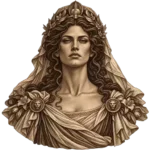 RheaSister and consort
 DemeterDaughter swallowed by Cronus
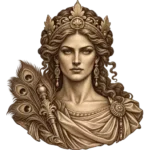 HeraDaughter swallowed by Cronus
 HadesSon swallowed by Cronus
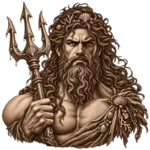 PoseidonSon swallowed by Cronus
 ZeusYoungest son and successor
 HyperionBrother among the Titans
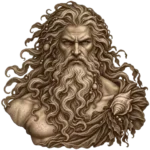 OceanusBrother among the Titans