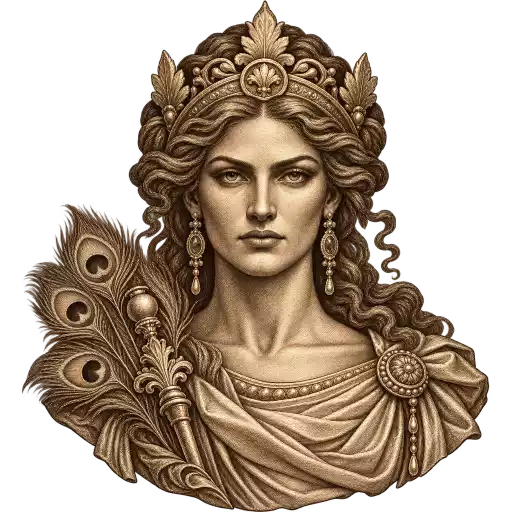
Hera is one of the principal goddesses of Greek mythology and the queen of the Olympian gods. She is the daughter of Cronus and Rhea, sister and wife of Zeus, and a major deity associated with marriage, legitimate unions, queenship and the protection of women within the institution of marriage.
Origins
Hera belongs to the generation of gods born to the Titans Cronus and Rhea. According to the dominant mythological tradition, Cronus swallowed Hera and several of her siblings because he feared a prophecy that one of his children would overthrow him.
After Zeus forced Cronus to release the swallowed children, Hera became part of the divine generation that replaced the Titans and established the Olympian order.
Queen of the Gods
As the wife of Zeus, Hera holds the position of queen among the Olympians. Her authority is strongly connected with marriage and legitimate social order, making her one of the most important female deities in ancient Greek religion.
Although later popular culture often emphasizes her jealousy, ancient Greek religion treated Hera as a powerful sovereign goddess with major cults, temples and festivals of her own.
Marriage to Zeus
The marriage of Hera and Zeus represents one of the central divine unions of Greek mythology. At the same time, myths repeatedly portray conflict between them because of Zeus’s numerous relationships with other goddesses, nymphs and mortal women.
These stories often place Hera in opposition to Zeus’s lovers or descendants, although different ancient sources vary considerably in tone and detail.
Hera in Myth
Hera appears throughout Greek mythology as a defender of marriage and royal dignity but also as a powerful adversary when she believes her status has been insulted.
She plays important roles in myths involving Heracles, Io, Leto, the Trojan War and the Judgment of Paris.
The Trojan War
Hera became one of the principal divine supporters of the Greeks during the Trojan War. According to the myth of the Judgment of Paris, Paris awarded the golden apple to Aphrodite rather than Hera or Athena.
This insult contributed to Hera’s hostility toward Troy and influenced her actions throughout the war as described in epic poetry.
Worship
Hera possessed major sanctuaries throughout the Greek world. Argos and Samos were especially important centers of her worship, and both regions developed strong local traditions concerning the goddess.
Her cult could emphasize marriage, fertility, political identity, divine sovereignty and the transition of women through different stages of life.