Why Cronus did not fall in a single duel
Zeus's defeat of Cronus is among the decisive episodes of ancient Greek mythology. It was more than a son challenging his father: it marked a change in divine sovereignty, as the rule associated with the Titans gave way to an order led by the Olympian gods. In the tradition preserved by Hesiod, Zeus prevailed through a combination of deception, the recovery of his imprisoned siblings, alliances with ancient powers, and a prolonged war between generations of gods.
The question of how Zeus defeated Cronus therefore has two answers that belong together. First, Cronus lost control of the children he had swallowed in an attempt to prevent his overthrow. Then Zeus organized the opposition to the Titans and led his allies in the Titanomachy. Victory was collective even though Zeus emerged as the chief ruler of the divine community.
Ancient accounts differ in their details. Hesiod's Theogony is central to the narrative, while the later mythographical Library traditionally attributed to Apollodorus supplies particulars that are not explicitly present in Hesiod. Distinguishing these witnesses matters more than combining their stories into a seemingly seamless modern version.
The prophecy that frightened Cronus
Before the Olympians ruled, Cronus had seized authority from his own father, Uranus. His rise was itself an act of generational rebellion. Gaia, the Earth, had opposed Uranus's treatment of their offspring, and Cronus became the instrument of his downfall. Yet the new ruler encountered a warning that resembled the threat he had once embodied.
Hestia, Demeter, Hera, Hades, and Poseidon disappeared into their father's body. They were not described as simply dying; their captivity prevented them from acting against him. In trying to secure his position, Cronus turned his household into the source of the conflict that would destroy his supremacy. The prophecy established the threat, but the god's desperate response gave that threat its particular form.
Rhea's deception and the hidden child
Rhea refused to sacrifice her youngest child to the same fate. When she was expecting Zeus, she appealed to Gaia and Uranus for a plan that could conceal the birth. The survival of the future ruler was therefore dependent on others before he had the strength or opportunity to challenge Cronus himself.
The Library adds elements associated with the Cretan setting. It places the birth in a cave on Mount Dicte and describes attendants such as the nymphs who nursed the child and the Curetes who clashed their weapons to mask his cries. These details belong to a wider tradition of Zeus's infancy, but they should not be treated as though every early account contained precisely the same scene.
How Zeus recovered his brothers and sisters
When Zeus had grown, the first great challenge was to free the children Cronus had swallowed. Hesiod explains the event through the counsels of Gaia and the cleverness and force of Zeus. Cronus brought up his offspring and also expelled the stone that he had swallowed in Zeus's place. Hesiod describes the stone being set at Pytho beneath Mount Parnassus as a visible memorial to the deception.
The return of the siblings transformed Zeus's position. He no longer stood alone against the ruler who had tried to erase an entire generation. Poseidon and Hades would become central to the subsequent division of the cosmos, while Hera, Demeter, and Hestia recovered their places among the gods. The liberation did not by itself bring the Titans' rule to an end, but it made organized resistance possible.
The Titanomachy and ten years of conflict

The war between Zeus's allies and the Titans is known as the Titanomachy. Hesiod places the Titans on Mount Othrys and the gods gathered around Zeus on Olympus. Their confrontation concerned the government of the cosmos, not merely a private quarrel between two members of a family. Cronus's authority was sustained by an older distribution of divine power that could not be displaced through one act of deception alone.
Not every Titan should be imagined as having fought on precisely the same side. Greek genealogies and later stories preserve complicated kinship relationships, shifting alliances, and powers that remain significant after Zeus's victory. The familiar picture of every Titan battling every Olympian is convenient, but it conceals much of the complexity of the mythological tradition.
Gaia's counsel and the imprisoned allies
The balance changed when Zeus secured the help of ancient beings whose powers Cronus's order had excluded. Gaia directed attention toward the Cyclopes and the Hundred-Handers, also called Hecatoncheires. The latter, Briareus, Cottus, and Gyges, were children of Gaia and Uranus. Their extraordinary hundred arms and fifty heads signified a physical force beyond the scale of ordinary divine combatants.
Hesiod relates that Zeus freed his father's brothers from the bonds that held them and won their gratitude. Later in the poem, the Hundred-Handers enter the conflict after being nourished with divine food and encouraged to fight. The Library offers an additional episode: Zeus kills Campe, the guardian of the prisoners in Tartarus, before releasing them. Campe's appearance in this narrative should not be silently inserted into Hesiod's version as though it occurred there in the same form.
Both accounts place exceptional weight on the liberation of these allies. Zeus succeeds partly because he recognizes value in powers that an earlier ruler had tried to suppress. The military victory becomes inseparable from a change in relationships among the divine generations, with former prisoners now taking part in determining the cosmos's future.
Why Zeus received the thunderbolt
The Cyclopes provided Zeus with the weapons most closely associated with his later identity. In Hesiod's account they gave him thunder, lightning, and the thunderbolt. These were not merely emblems used by artists to identify a god already established in power. Within the myth, they helped make his victory possible, and afterward they became expressions of his authority over gods and mortals.
Cronus had tried to preserve supremacy by swallowing possible challengers and binding powerful relatives. Zeus instead formed alliances and rewarded assistance. This contrast does not mean that every later story depicts Zeus as an untroubled or consistently benevolent ruler. It explains why cooperation with other divine powers is essential to the ancient account of his rise.
The decisive battle and the Hundred-Handers
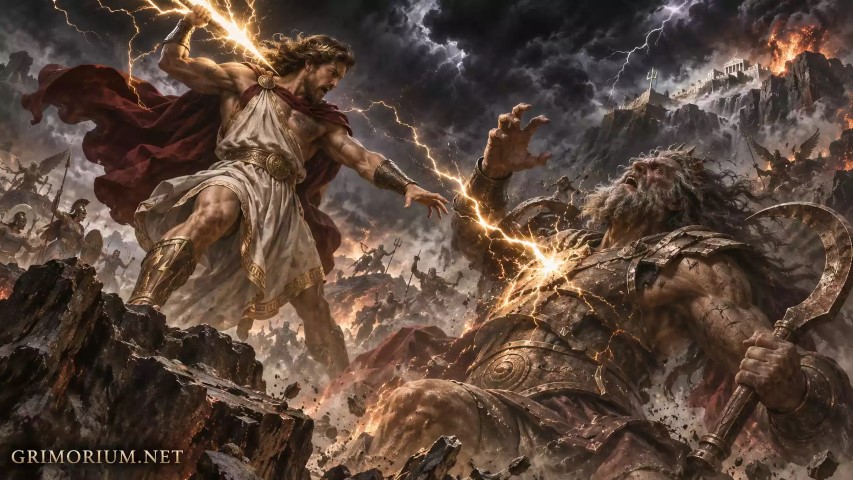
At the climax of the Titanomachy, Zeus unleashed the destructive brilliance of his thunderbolts. Hesiod's description fills the cosmos with heat, light, noise, and violent movement. The ground seems to burn beneath the fighting gods. The Hundred-Handers joined the assault by hurling tremendous numbers of rocks, taking advantage of their extraordinary arms. Together these forces overwhelmed the resistance of the Titans.
The principal sources do not provide a single detailed scene in which Zeus personally kills Cronus in a duel. Although the myth is frequently described as Zeus fighting his father, Hesiod recounts a wider conflict in which Zeus and his allies defeat a coalition defending the older order. Cronus loses his sovereignty, but the moment is not narrated as one universally accepted lethal blow delivered by his son.
This distinction is especially relevant when interpreting paintings, films, and modern illustrations. A scene of Zeus striking Cronus directly may offer a compelling visual summary of their opposition. It is not, however, an exact transcription of the event as described in the Theogony. The essential outcome is the defeat of the Titans and the removal of Cronus from supreme authority.
What happened to Cronus after his defeat?

In Hesiod's account the defeated Titans are confined to Tartarus, a dark and remote region whose distance from the familiar world is described in extraordinary terms. Gates, barriers, and the watch of the Hundred-Handers emphasize the separation of the imprisoned powers from the new divine order. The imprisonment does more than punish the losers: it establishes that the previous regime can no longer readily challenge Zeus.
It is also misleading to say that Zeus necessarily murdered his father. The account most relevant to his victory concerns overthrow, the defeat of hostile powers, and imprisonment. Being killed, losing divine office, and being held in Tartarus are different outcomes, and the distinctions help preserve the meaning of the ancient narrative.
The division of the world after victory
Once Cronus had been defeated, the victors had to establish a workable order. The Library states that Zeus, Poseidon, and Hades drew lots for their realms. Zeus obtained the sky, Poseidon the sea, and Hades the underworld. The division identifies spheres of jurisdiction rather than suggesting that the brothers created those regions at the moment of the drawing.
The conclusion explains why the Titanomachy mattered to Greek accounts of the gods. It establishes the preconditions for the relationships, disputes, sacred functions, and genealogies found throughout later literature. Zeus's achievement is measured by the lasting framework of the Olympian order as much as by the destruction unleashed during the fighting.
What the struggle between father and son means
The conflict between Zeus and Cronus belongs to a recurring pattern of divine succession. Uranus was displaced by Cronus, and Cronus was in turn displaced by Zeus. Each ruler attempts to preserve power, while the next generation becomes the agent of change. The pattern offers a mythic exploration of kinship, fear, authority, and the uncertain durability of supremacy.
The contributions of Rhea, Gaia, Metis in the later version, the Cyclopes, and the Hundred-Handers make an exclusively individual interpretation impossible. One figure saves the child, another counsels the overthrow, others enable the siblings' release or supply weapons, and still others determine the battle's outcome. Zeus's leadership is central, but the myth repeatedly shows his victory depending on cooperation.
Hesiod, the Library, and the limits of a single version
The Theogony is a major early source because it arranges the births and successions of the gods into a larger poetic genealogy. It is not a chronicle of events that can be independently verified as historical facts. It preserves religious and narrative ideas that mattered to ancient Greek audiences and gives the struggle between divine generations a distinctive poetic shape.
One further distinction prevents a common misunderstanding: Cronus, father of Zeus and a Titan, should not automatically be identified with Chronos, the personification of time in certain traditions. Later associations and the resemblance of the names encouraged interpretations that blended them, but those developments do not erase their differences across ancient sources.
So how did Zeus defeat Cronus?
Zeus defeated Cronus through a sequence of connected actions. Rhea's deception kept him alive when his father tried to swallow him. As an adult he recovered his brothers and sisters, gathered allies, and obtained the aid of the Cyclopes and Hundred-Handers. Armed with the thunderbolt and supported by formidable companions, he ultimately defeated the Titans in a prolonged war. The weapon was crucial to the poetic image of victory, but it was not the entire explanation.
Cronus's fall fulfilled a prophecy while transforming the distribution of divine power. It brought the Olympian generation to prominence and shaped the framework within which so many other Greek myths unfold. Understanding the story means attending not only to the actions of Zeus, but also to the ancient authors who preserved different versions and to the allies without whom his triumph would have been impossible.
Related Entities

Sources and references
- Hesiod, Theogony, 453–506, 617–735 View source
- Pseudo-Apollodorus, Library, 1.1.5–1.2.1 View source