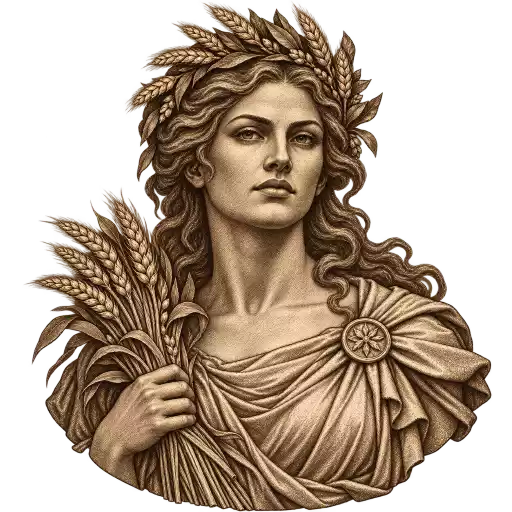
Demeter and the sustenance of human communities
Demeter (Greek Δημήτηρ, Dēmētēr) is the Greek goddess associated with grain, cultivated land, nourishment, and the survival of households through the agricultural year. Her importance extends beyond a simple personification of a harvest. Greek communities depended upon sowing, the storage of grain, seasonal labor, and the rituals by which cultivators expressed hope that fields would yield food again. In epic and cult she could withhold that fertility, demonstrating how completely mortal life depended upon the food-producing earth. Her most celebrated relationship is with her daughter Persephone, who also bears the name Kore, the Maiden.
Hesiod names Demeter among the children of Cronus and Rhea in Theogony 453–458. She belongs to the same divine generation as Hestia, Hera, Hades, Poseidon, and Zeus. Hesiod later names Persephone as the daughter of Demeter and Zeus (Theogony 912–914), placing the central mother–daughter story within the genealogy of the ruling Olympians. The gods do not form a family without disagreement: Zeus consents to Hades taking Persephone in the Homeric Hymn to Demeter, and the mother challenges the consequences of that arrangement through her power over the fields.
The Homeric Hymn to Demeter, a substantial archaic poem of approximately five hundred lines, is the indispensable early literary witness for Demeter’s search, her arrival at Eleusis, her refusal to permit crops to grow, and the restoration of a negotiated relationship between her daughter and the world below. The hymn also explains the establishment of sacred rites at Eleusis. Its account of a mother refusing to accept the loss of her child is both personal and cosmic: the crisis threatens offerings to the gods because mortals cannot harvest the grain needed to live.
Demeter’s worship took many forms across the Greek world. The Eleusinian Mysteries became particularly famous, but agrarian and women’s festivals, local sanctuaries, and regional cult titles carried their own histories. The Thesmophoria associated Demeter and Kore with cultivated fertility and women’s ritual communities; Arcadian cults preserved striking narratives involving a horse-shaped Poseidon and Demeter Erinys. These settings demonstrate the range of the goddess without assuming every locality followed an identical calendar or sacred story.

Grain, fertility and the limits of divine power
The cultivated cereal field is the clearest domain of Demeter. Wheat and barley supported Greek diets, and their successful cultivation required both human labor and conditions that farmers could not control. Ancient hymns therefore honor Demeter as giver of food and of the seasons favorable to growth. Her power is not confined to a single grain variety. She stands for the precarious passage from seed to harvested crop, the capacity to store food, and the renewal of production after a barren period. The Homeric Hymn depicts the full force of this function when she prevents the earth from sending up seed.
Demeter’s withholding of growth is not an ordinary local drought anecdote. In the hymn the gods face a wider emergency: starving humans will no longer provide customary offerings, and Zeus eventually must intervene. The pressure succeeds because the agricultural sphere, although assigned to a specific goddess, is essential to the shared divine order. Her authority is thus both nurturing and formidable. She does not destroy crops as a random act of violence; she uses the universal dependence on food to compel an answer concerning Persephone.
Demeter also presides over religious practices associated with fertility, the household and civic continuity. The Thesmophoria, celebrated in a variety of Greek cities, brought married women together for rites connected with the productive capacities of land and human families. Specific practices and festival dates varied by city. The participation of women was a defining feature, while modern reconstructions of every ritual stage depend on fragmentary literary and archaeological evidence. The goddess was not exclusively worshipped by women: her sanctuaries and Eleusinian initiations involved broader communities.
The title Thesmophoros, often rendered “bringer of established customs” or linked to sacred ordinances, associates Demeter with socially regulated life as well as growth. Ancient explanations of divine epithets are not always consistent, and the Thesmophoria belonged to specific civic and ritual settings; the festival does not establish a tradition in which Demeter authored every Greek law. Other titles, including Chloe, connected with young green shoots, and Sito, reflecting grain and nourishment, reveal distinct emphases. The epithets register the variety of petitions offered to her.
The seasonal return of Persephone is linked to the revival of fertility, although the hymn gives a specific division of time rather than a modern astronomical explanation of four seasons. Persephone spends one part of the year below and the rest reunited with her mother; different ancient tellings vary on precise proportions. The myth’s association with agricultural cycles is fundamental, but its temporal details belong to ancient narratives, not an exact scientific calendar.
The goddess with grain and torchlight
In Greek visual culture Demeter often appears as a mature, dignified woman, clothed in a long garment and marked by the signs of cultivated fertility. Ears of grain and sheaves make her agricultural identity visible. A torch, sometimes carried in pairs, recalls the nocturnal search for Persephone and the processional imagery of the Eleusinian cult. Artists could combine these attributes with a veil, a wreath, a scepter, or a vessel, depending on the composition. No single object forms an obligatory uniform across all centuries and places.
Pausanias describes cult images and sanctuaries in which local traditions determined the appearance of the goddess. At Phigalia in Arcadia he reports the tradition of a remarkable ancient image of Demeter Melaina, or Black Demeter, represented with a horse’s head and other extraordinary features (Description of Greece 8.42). That reported image belonged to a distinctive Arcadian tradition, markedly different from the customary human form of Demeter in Attic reliefs. The traveler describes traditions remembered by local worshippers; the survival of a particular image and the date of its creation present separate historical questions.
The Great Eleusinian Relief, known through its classical original and Roman copies, places Demeter beside Persephone in an encounter with a youthful figure conventionally identified as Triptolemus. The composition illustrates the goddess’s relationship to cultivated abundance and Eleusinian tradition. The exact gestures and objects vary in descriptions of different versions, so the relief’s secure importance lies in the linked divine and heroic figures and its sacred provenance. Museum collections preserve copies that show how the Eleusinian imagery traveled beyond its original sanctuary.
Poppies, grain ears and baskets of agricultural produce occur in later art associated with Demeter or the Roman Ceres. Some pairings gained particular prominence in Hellenistic and Roman decorative imagery. In the Homeric Hymn, the pomegranate is the food Hades gives Persephone, binding her to a periodic return to the underworld; Demeter’s torches, by contrast, belong to the imagery of her search for her daughter. Demeter’s identity is established by multiple textual and artistic witnesses rather than by a fixed palette of colors or a single standardized emblem.
The abduction and the long search
In the Homeric Hymn to Demeter, Persephone is gathering flowers when the earth opens and Hades carries her away with the permission of Zeus. The girl cries out, and Demeter hears her distress, but does not initially know who has taken her. The mother wanders with burning torches, refusing the comfort of the gods. Hecate, who heard Persephone’s voice without seeing the abductor, meets her; together they question Helios. The sun god reveals Hades’s role and Zeus’s consent. This sequence makes the goddess’s grief a conflict involving the rulers of heaven and the underworld, rather than an ordinary disappearance.
In anger Demeter leaves Olympus and travels among humans in disguise. At Eleusis she sits near a well, is welcomed into the household of Celeus and Metaneira, and becomes nurse to their son Demophoon. She neither behaves nor receives care as a conventional mortal guest. Iambe’s intervention brings a moment of laughter; the goddess rejects wine and accepts a drink made from barley and water, the kykeon. These details are prominent in the hymn and acquire significance in later discussions of Eleusinian ritual, although the exact rites practiced by initiates remained protected from disclosure.
Demeter attempts to give Demophoon a condition beyond ordinary human mortality: she nourishes him with ambrosia and places him in fire by night. When Metaneira interrupts in alarm, the goddess reveals her identity and reproaches the household for misunderstanding her action. In the hymn Demophoon does not simply become immortal; the attempt is interrupted. Demeter orders a sanctuary to be built and later communicates sacred rites to the leading Eleusinians. The episode distinguishes divine care from mortal expectations and anchors the mythical origin of a great cult center.
After leaving the royal household Demeter allows no grain to grow. The desperate failure of agriculture threatens humanity and divine offerings. Zeus sends messengers and gifts, but she demands her daughter. Hermes eventually brings Persephone up from Hades, who has given her a pomegranate seed. That food creates a continuing bond with the realm below. Zeus’s settlement permits Persephone to remain with Demeter for much of the year and to return to Hades for a portion. The specific division in the hymn is one third below and two thirds above.
When mother and daughter reunite, agricultural growth resumes, and Demeter reveals sacred observances to Eleusinian leaders including Triptolemus, Diocles, Eumolpus and Celeus. The reunion does not erase Persephone’s underworld marriage; it establishes a recurring pattern of absence and return. The tale thus encompasses grief, negotiation among gods, fertility and a privileged religious tradition. The hymn’s closing blessing describes the happiness attached to having seen the mysteries, while also insisting that their sacred content cannot be freely disclosed.
Eleusinian initiation and civic observance
The Eleusinian Mysteries were among the best-known initiatory cults of ancient Greece. Their principal divine figures were Demeter and Kore, and the sanctuary at Eleusis developed a longstanding relationship with Athens. Participation brought initiates into a ritual community distinct from the open civic sacrifices held at many other altars. Ancient testimony describes processions, sacred objects, rites performed at particular stages and a profound insistence on secrecy. Because initiates were forbidden to disclose central experiences, modern descriptions of their complete internal sequence remain necessarily limited.
The Homeric Hymn presents the mysteries as a divine gift taught to selected leaders at Eleusis. The historical cult included institutions, priests and priestesses, sacred personnel and initiation at different times. Participants did not gain membership merely through a casual visit to a temple. The procession from Athens to Eleusis, the sanctuary precinct and the Telesterion, the great hall associated with initiation, formed a ritual environment developed across many centuries. Archaeology documents successive building phases, rather than a single unchanged hall standing from the age of the hymn.
The Thesmophoria was a widely attested festival of Demeter and Kore connected with women, agricultural prosperity and the continuity of families. In Athens and elsewhere, married citizen women occupied central ceremonial roles. Ancient evidence describes withdrawal from ordinary domestic routines and particular rites tied to the vitality of seeds and reproduction. The surviving accounts reflect different localities and periods; the festival does not yield one universally fixed script. Its importance demonstrates that Demeter’s public religious presence extended beyond the selective initiation of Eleusis.
Other Demeter festivals included the Haloa, associated especially with Eleusinian and Attic settings, and various celebrations tied to particular phases of agriculture. Literary and inscriptional evidence identifies processions, offerings and local calendars. Demeter could receive first fruits and other agricultural gifts, while her worship also created occasions for social gathering. The fact that a festival marked cultivation does not automatically establish a specific magical technique or a universally shared ritual secret.
The Homeric Hymn’s kykeon is a drink associated with Demeter’s reception at Eleusis. Ancient sources mention barley and water, and ritual use of the term developed in the mysteries. Modern hypotheses about additional psychoactive ingredients have generated debate, but the early hymn does not identify a universal intoxicating recipe. The devotional significance of the drink follows first from its place in a story of mourning, hospitality and the eventual recovery of fertile life.
Eleusis, Athens and regional sanctuaries
Eleusis in Attica is Demeter’s most famous sanctuary. Its significance rests on the Homeric Hymn, numerous ancient references, and extensive archaeological remains. A sacred precinct with monumental approaches and the Telesterion served initiatory ceremonies over a long period. The site’s development changed under Athenian administration and later rulers; building phases, inscriptions and votive objects reveal a history more complex than a single foundation in legendary time. Its importance extended to initiates from many parts of the ancient Greek and Roman worlds.
The sanctuary’s association with Athens is visible in the route of sacred processions, civic sponsorship and the integration of Eleusinian officials into public religious life. The place did not cease to be distinct simply because Athens exercised political influence. Ritual traditions represented Demeter’s arrival there as a response to Persephone’s loss and to the household of Celeus. The well, sacred buildings and ritual landscape offered material settings through which myth, local memory and institutional worship reinforced one another.
Demeter also possessed sanctuaries in Arcadia that preserved traditions different from the Eleusinian hymn. At Thelpusa, Pausanias 8.25.4–7 describes the cult of Demeter Erinys, or Demeter the Furious, and the myth of Poseidon approaching her when both take equine form. The same passage associates the union with a daughter whose sacred name was restricted and with the horse Arion. It also records Demeter Lousia, linked to her bathing in the river Ladon. These cult names belong to a specific Arcadian landscape rather than to a universal ritual theology.
At Phigalia, Pausanias 8.42 tells of Demeter Melaina, the Black Demeter, including an unusual image traditionally described as horse-headed and associated with a cave sanctuary. The account connects the goddess’s withdrawal with the region’s fertility and describes subsequent local responses when her worship was neglected. The reported iconography differs sharply from classical Attic imagery. The passage is valuable as testimony of local religious memory while offering no reason to suppose that every sanctuary portrayed her in such a form.
Other Greek places worshipped Demeter with Kore under different titles and calendars. Temples, caves, precincts and offerings attest to a widespread cult, with local identities expressed through particular festivals or origin stories. Inscribed dedications provide a different kind of evidence from an epic poem: they show actual acts of devotion, sometimes without an accompanying long myth. The geographical spread is central to Demeter’s religious history because the needs of cultivation and food security touched communities across the Greek-speaking world.
Parents, daughter and disputed offspring
According to Hesiod’s Theogony 453–458, Demeter is the daughter of Cronus and Rhea and sister to Zeus, Hera, Hestia, Poseidon and Hades. Their divine household is shaped by the succession myth in which Cronus swallows his children and Zeus eventually leads the younger gods to power. Demeter’s place among the siblings matters because she can confront decisions taken by Zeus, even though he stands as chief Olympian, and because Hades, another brother, becomes Persephone’s husband. These connections give the hymn’s conflict its familial and political dimensions.
Persephone is Demeter’s daughter by Zeus in Hesiod’s Theogony 912–914 and in the central tradition of the Homeric Hymn to Demeter. The daughter’s alternate name Kore means Maiden and is especially prominent in cult settings where the two goddesses receive joint honors. As queen of the underworld Persephone has a position beyond being merely Demeter’s attendant. The alternating periods of separation and reunion define a continuing relationship between the agricultural world and the realm of Hades.
The Arcadian narrative reported by Pausanias 8.25.5–7 associates Demeter and Poseidon with a daughter whose name was not freely spoken to the uninitiated, as well as with the extraordinary horse Arion. Pausanias relates the tale to the titles Demeter Erinys and Demeter Lousia. At Lycosura, Pausanias 8.37.9 explicitly identifies Despoina, the Mistress, as a daughter of Demeter and Poseidon; he adds that her private name was not revealed to the uninitiated. Thus 8.25.7 preserves the unnamed daughter of Thelpusa, while 8.37.9 identifies the deity worshipped as Despoina at Lycosura. The Arcadian genealogy is distinct from Persephone’s better-known parentage by Zeus.
Other ancient and late sources give Demeter additional relationships or identify her with other agricultural goddesses. Such variants belong to particular authors and religious contexts, not a single complete Greek family tree. The central ties with Cronus, Rhea, Zeus and Persephone are broadly established in early poetry. The union with Poseidon in Arcadian legend deserves separate notice because the regional cult, animal transformation and names of its offspring form a different narrative constellation.
In the story of Eleusis, Demophoon is not Demeter’s biological son. She is his supernatural nurse in the household of Celeus and Metaneira, and her interrupted effort to confer immortality generates an important bond between the goddess and the local royal family. Triptolemus is likewise a major Eleusinian figure whom some later narratives make the recipient of agricultural instruction. His importance is cultic and pedagogical; the Homeric Hymn names him among the leaders to whom the goddess reveals her rites.
The daughter, the brothers and Eleusis
Persephone is the central figure in Demeter’s relationships. The Homeric Hymn gives the daughter an independent underworld destiny while making the mother’s love and anger decisive for life above ground. Their reunion is both the resolution of a family separation and the restoration of farming. The partnership of the two goddesses appears in sanctuaries and festivals where Demeter and Kore are invoked together. The mother–daughter bond is therefore much more than a single episode of loss.
Zeus is simultaneously Demeter’s brother, the father of Persephone and the divine ruler whose consent allows Hades to take the young goddess. In the hymn he must negotiate a remedy when Demeter interrupts crop growth. Hades is also Demeter’s brother and Persephone’s husband; his role is central to the conflict, but the myth does not describe him as an agricultural god. Poseidon, another brother, enters a separate Arcadian tradition of union and extraordinary offspring. These mythic relationships have distinct functions and originate in differing local or literary narratives.
Hecate is Demeter’s ally in the search. In the Homeric Hymn she hears Persephone’s cry and accompanies Demeter to Helios, while later she becomes associated with the daughter’s passage between worlds. Helios supplies the crucial information about the abductor and Zeus’s consent. His role is that of a witness, whereas Hecate participates more directly in the continuing story of Persephone. The distinctions illuminate the narrative without making either deity a parent or spouse of Demeter.
Celeus and Metaneira provide hospitality to the disguised goddess at Eleusis and their son Demophoon receives her extraordinary care. Triptolemus is among the local figures connected with Demeter’s instruction and Eleusinian religious identity. These ties are not genealogical descendants but important mythic relationships that explain how a particular community traced its rites to the goddess. Later artistic images of Triptolemus often emphasize agricultural teaching and complement rather than replace the hymn’s account.
Demeter’s family joins two important strands of Greek tradition. Hesiod places her among the children of Cronus and Rhea and names Persephone as her daughter by Zeus. At Eleusis, her encounter with Celeus, Metaneira and Demophoon brings the goddess into a mortal household, while the Homeric Hymn associates her cult with the local leaders who receive knowledge of her rites. In Arcadia, Pausanias records a separate connection with Poseidon and their daughter worshipped as Despoina.
 CronusFather
 RheaMother
 ZeusBrother and father of Persephone
 HeraSister
 HadesBrother and son-in-law
 PoseidonBrother; Arcadian consort
 PersephoneDaughter; central cult partner
 HecateAlly in the search for Persephone
Ceres and later reception
The Roman goddess Ceres became the usual counterpart of Demeter in Greco-Roman literature and art. Both are connected with grain and the sustenance of communities, and Roman poets frequently use the Greek story of Proserpina, the Roman counterpart of Persephone, in a Latin religious and literary setting. This identification does not mean that the earliest Roman practices devoted to Ceres originated as direct copies of the Eleusinian Mysteries. Ceres had a Roman civic cult, calendar and social history of her own.
In Roman public life Ceres was closely associated with food supply, cultivated land and plebeian institutions. The temple of Ceres, Liber and Libera on the Aventine was a major religious site in Rome, and the Cerealia belonged to the Roman festival calendar. Proserpina’s story could be told through Greek models while Roman cult practice remained shaped by local institutions. The Latin names and functions overlap, but the festivals of the two religious cultures are not identical.
The myth of Proserpina and her mother appears memorably in Latin poetry, including Ovid’s Metamorphoses 5 and Fasti 4. Ovid develops the emotional search and the circumstances of the daughter’s abduction in versions shaped by Roman literary interests. These works are important witnesses to ancient reception rather than interchangeable copies of the Homeric Hymn. Details such as particular locations, dialogue and divine interventions differ across authors.
Later Christian writers, antiquarians and Renaissance artists encountered Demeter and Ceres through both Greek and Latin texts. The goddess appears as a figure of abundance, maternal grief and the fragile relationship between humanity and the earth. Allegorical paintings often emphasize grain, summer or harvest; literary adaptations may focus on the mother’s search. Such uses reflect changing cultural meanings; later allegorical symbols do not necessarily correspond to the emblems of archaic Greek cult.
In modern discussion, Demeter also appears in comparative treatments of agriculture and in literary interpretations of motherhood and loss. Those readings can illuminate modern responses to the story, but the historical goddess remains grounded in specific ancient hymns, sanctuaries, festivals and dedications. The independent history of Roman Ceres and the distinct religious meanings of later adaptations help explain why a familiar myth can operate within several cultural frameworks.
Primary texts and material evidence
The Homeric Hymn to Demeter, lines 1–495, is the central early witness for Persephone’s abduction, Hecate and Helios in the search, Demeter’s arrival at Eleusis, the interrupted immortalization of Demophoon, the withholding of crops and the founding of sacred rites. The poem specifies the one-third and two-thirds division of Persephone’s year and names the local leaders who receive the goddess’s instruction. Its narrative remains distinct from later accounts elaborating Triptolemus as an agricultural missionary.
Hesiod’s Theogony 453–458 establishes Demeter’s parents and siblings, while lines 912–914 identify Persephone as the daughter of Zeus and Demeter. These passages provide a genealogical framework, not a full substitute for the plot of the Homeric Hymn. Pausanias, Description of Greece 8.25.4–8, records the Arcadian Demeter Erinys and Lousia traditions, the union with Poseidon, a daughter whose private name was not disclosed to the uninitiated, and the horse Arion. At 8.37.9, Pausanias identifies the goddess worshipped as Despoina at Lycosura as the daughter of Demeter and Poseidon. Book 8.42 records the Phigalian tradition of Demeter Melaina and an exceptional cult image.
Ovid’s Metamorphoses 5 and Fasti 4 transmit Latin literary versions of Ceres and Proserpina. They are evidence for Roman reception and for alternate narrative details, rather than direct reports of archaic Eleusinian initiation. Archaeological remains at Eleusis, including the sanctuary complex and its successive building phases, provide independent evidence for the history of worship. Museum documentation on the Great Eleusinian Relief illuminates imagery connecting Demeter, Persephone and Triptolemus.
Modern scholarship distinguishes the accessible myths of the sanctuary from the secret acts of initiation, which ancient participants were obliged not to disclose. Kevin Clinton’s studies of Eleusis and the archaeological descriptions of the Greek Ephorate of Antiquities provide context for the religious institutions and their material setting. The Metropolitan Museum of Art’s study of mystery cults summarizes how access to sacred rites created religious communities. These modern works support historical context; the ancient passages remain the evidence for specific mythical events.
Source links and passages
- Homeric Hymn to Demeter, lines 1–495
- Hesiod, Theogony, lines 453–458 and 912–914
- Pausanias, Description of Greece 8.25.4–8
- Pausanias, Description of Greece 8.37.9: Despoina at Lycosura
- Pausanias, Description of Greece 8.42
- Ovid, Metamorphoses, Book 5
- Greek Ephorate of Antiquities: Eleusis
- Fitzwilliam Museum: Eleusis, Myth and Mysteries
- Metropolitan Museum: Mystery Cults
- Metropolitan Museum: Great Eleusinian Relief