
Aphrodite: identity beyond beauty
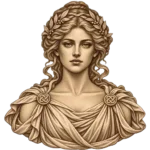
Aphrodite (Ἀφροδίτη) was a major Greek goddess of sexual desire, erotic attraction, beauty, marriage-related union, fertility and the persuasive power that draws beings together. Her influence is not simply sentimental romance. In early poetry she can move gods, mortals and animals to desire; she can bless unions, provoke jealousy and disrupt households or kingdoms. Greek communities also honored her in civic and maritime contexts. Her mythic power and the purposes of her actual cults must not be assumed to coincide in every place.
Two incompatible birth traditions
Hesiod, Theogony 188–206, tells that Cronus cast the severed genitals of Uranus into the sea and that Aphrodite arose from the foam surrounding them. The goddess then came to Cythera and Cyprus. By contrast, Homer, Iliad 5.370–417, identifies Dione as Aphrodite’s mother, while the Homeric Hymn to Aphrodite repeatedly calls her a daughter of Zeus. These are distinct ancient genealogies; placing Uranus, Zeus and Dione together in a single unquestioned family tree would disguise the evidence.
Name, sea foam and linguistic caution
The Greek word aphrós (ἀφρός) means ‘foam’. Hesiod explicitly links Aphrodite’s name with the foam of her sea-birth, an influential ancient explanation that helped shape art and literature for centuries. Yet this is a mythic or folk etymology, not a linguistically proven origin of the goddess’s name; its ultimate derivation remains disputed. The familiar phrase ‘born from sea foam’ describes Hesiod’s poetic tradition rather than an uncontested historical fact about her earliest cult.
Ancient origins and eastern Mediterranean contacts
Aphrodite’s cult belonged to Greek religion, but its development was influenced by exchanges across Cyprus and the eastern Mediterranean. Scholars often compare aspects of her cult and imagery with Near Eastern goddesses such as Astarte. Such comparisons can be historically useful, especially for Cyprus, yet they do not prove that every myth, epithet or ritual was borrowed unchanged from a single predecessor. Local evidence, chronology and differences matter.
A goddess of irresistible power, not universal power
The Homeric Hymn to Aphrodite (5.1–33) makes a revealing qualification: Athena, Artemis and Hestia remain outside Aphrodite’s compelling erotic influence. Zeus subsequently causes Aphrodite herself to desire the mortal Anchises. The hymn therefore explores both the impressive scope and the limits of divine erotic power. It does not present Aphrodite as a simple symbol of harmless love.

Desire, attraction and sexual union
Aphrodite presides over erotic attraction in all its ambivalence. In the Homeric Hymn to Aphrodite, her power extends over mortals, gods and animals, while specific goddesses stand beyond it. Her domain is therefore broader than modern romantic love: it includes the physical, emotional and social consequences of desire.
Persuasion, charm and the enchanted girdle
In Iliad 14.188–223, Hera borrows Aphrodite's richly embroidered band to win Zeus's desire. The object embodies the goddess's capacity to provoke attraction, conversation and emotional submission; it should not be reduced to a modern literal 'love spell' detached from the poem. Aphrodite's divine tools work through fascination as much as through force.
Marriage, fertility and generational continuity
Although Hera is especially associated with the institution of marriage, Aphrodite influences desire and union that may lead to marriage, children or their opposite: rivalry and scandal. Her myths with Anchises and Ares show that sexuality and kinship can carry both benefits and risks. Cult practice sometimes connected her to civic or marital well-being, but titles and functions varied by locality.
Sea travel and civic protection
Certain cult titles, including Aphrodite Euploia ('of the good voyage'), connected the goddess with sailors and safe passage; other forms such as Pandemos belonged to political and communal religious life. These aspects are documented cult identities, not inventions extrapolated from the sea-birth story. A goddess associated with intimacy could also belong to harbors, cities and public festivals.
Warlike Aphrodite and regional variation
Local traditions sometimes depicted Aphrodite as armed or identified her with martial protection. Pausanias preserves examples of armed Aphrodite imagery, especially in Laconian contexts. Such evidence complicates the cliché that Ares embodies all warfare while Aphrodite embodies nothing but peaceful affection. Nevertheless, the armed goddess should not automatically be made a universal classical Greek norm.
Nudity, dress and changing conventions
Aphrodite may appear richly clothed in archaic art or increasingly nude in classical and later sculpture. The celebrated Aphrodite of Knidos, attributed to Praxiteles, helped establish an influential monumental nude type. Images made centuries apart cannot be treated as portraits of one fixed original appearance; artistic conventions and social expectations changed.
Dove, sparrow, swan and marine imagery
Birds such as the dove and sparrow are often linked with Aphrodite, while swans and sea motifs appear in some poetic and artistic contexts. Shells, dolphins and marine settings evoke traditions of her emergence and journey through the sea. The precise prominence of each symbol varies by period, medium and cult locale; a modern emblem is not necessarily ancient and universal.
Myrtle, roses and perfume
Myrtle and roses became enduring attributes of Aphrodite, as did fragrant oils, garlands and elegant adornment. Their literary associations fit the goddess's power to transform perception and desire. Such symbols should be interpreted alongside concrete sanctuary dedications rather than assumed to have one meaning everywhere.
Eros, the Charites and attendant figures
Eros is regularly depicted beside Aphrodite in later art, along with the Charites (Graces) and figures of desire or persuasion. Yet Eros has an older and different genealogy in Hesiod, where he appears among primordial beings. The familiar mother-and-son image belongs to particular mythic and artistic developments, not to every surviving ancient source.
Rising from the sea and the arrival in Cyprus
Theogony 188–206 describes Aphrodite's birth amid sea foam after Cronus mutilates Uranus. The text explains the names Aphrodite, Cytherea and Cypris through that passage and her arrival at Cythera and Cyprus. It is a myth of divine generations and cosmic change, not just a picturesque story about beauty emerging from a shell. The shell became especially familiar through later artistic reception.
Ares, Hephaestus and the divine net
In Odyssey 8.266–366, the singer Demodocus recounts the affair between Ares and Aphrodite, wife of Hephaestus in that story. The smith creates an invisible trap, catches the lovers together and summons other gods to witness their humiliation. The episode is comic, but also reveals the tension between marriage, desire, shame and divine social order. Hesiod's different account of Hephaestus's wife Aglaia should not be silently fused with Homer's story.
Anchises, Aeneas and Aphrodite made vulnerable
The Homeric Hymn to Aphrodite (5.45–291) tells how Zeus causes Aphrodite to desire the Trojan mortal Anchises. Disguised as a woman, she approaches him near Mount Ida; after their union she reveals her identity and announces their son Aeneas. The story reverses the goddess's usual control over desire: the power she imposes on others now overwhelms her. It also establishes Aeneas's divine maternal lineage, later central to Roman literary identity.
Paris, Helen and the war at Troy
In the Judgment of Paris tradition, Aphrodite promises Paris the love of Helen in a contest with Hera and Athena. The promise contributes to the chain of events behind the Trojan War, but the detailed apple-and-judgment story is preserved differently across sources and artistic periods. In the Iliad Aphrodite protects Paris and rescues Aeneas from battle, while Hera and Athena often support the Achaeans. Her role is active, partisan and consequential, not merely decorative.
Wounded by Diomedes
In Iliad 5.311–430, Aphrodite tries to save Aeneas, but the warrior Diomedes wounds her hand with Athena's support. She returns to Olympus and is comforted by Dione, her mother in Homer's genealogy. Zeus tells her that war is not her assigned work. The scene illustrates the poem's particular ordering of divine spheres, not a timeless claim that all Greek cults excluded martial Aphrodite.
Adonis and the boundary between love and loss
Adonis belongs to Aphrodite's mythic network as a beautiful youth linked with seasonal mourning and erotic longing. Versions of his origins, death and ties to Persephone vary significantly, especially between Greek, Hellenistic and later literary evidence. Women's Adonia festivals became important contexts for lament, but the surviving material does not support one simple universal story of Adonis's annual resurrection.
Pygmalion and later literary reception
Ovid, Metamorphoses 10.243–297, tells of the sculptor Pygmalion whose ivory statue becomes alive through Venus's favor. This powerful later story is often retold as an ancient Greek myth of Aphrodite, yet the influential surviving narrative is Roman. It is valuable for understanding her reception, provided the author and historical layer are clearly identified.
Cyprus: a major center of worship
Cyprus was crucial to Aphrodite's sacred geography. Paphos was especially renowned, with local ritual traditions and a sanctuary whose prestige extended beyond the island. The epithet Cypris reflects these ties. Religious history on Cyprus also shows contact between Greek and eastern Mediterranean traditions, but should not be compressed into the claim that Aphrodite had only one origin.
Aphrodite Pandemos and civic togetherness
The title Pandemos can mean 'of all the people' and was associated with civic unity in some Athenian traditions. Later philosophy, especially Plato's Symposium 180d–181c, contrasts Pandemos and Urania to explore different kinds of love. That philosophical opposition must not be mistaken for the original or universal meaning of every cult dedicated to Aphrodite Pandemos.
Aphrodite Urania and local epithets
Urania ('Heavenly') was a significant title with its own sanctuaries and interpretations, including accounts preserved by Pausanias. In Hesiod's sea-birth genealogy, Aphrodite's link to Uranus offers a different context for the name; Plato's philosophical pairing of two Aphrodites adds yet another layer. Names, myths and theological speculation interacted but did not always mean exactly the same thing.
Ritual offerings and lived religion
Worshippers dedicated incense, garlands, small images and other offerings to Aphrodite, with practices differing by sanctuary and social setting. Her cult involved hopes about sex, partnership, fertility, civic stability and at times travel by sea. Archaeological offerings and inscriptions are essential checks on the assumption that literary love affairs describe ordinary religious practice.
Ritual prostitution: a disputed generalization
Ancient reports about sexuality and particular shrines have often been generalized into sweeping claims that Aphrodite's temples routinely employed 'sacred prostitutes'. The evidence is controversial and highly context-dependent. Neither every temple of Aphrodite nor every regional tradition should be described that way without explicit primary evidence and modern scholarly caution.
Palaepaphos and the sanctuary of Aphrodite
At Palaepaphos (Old Paphos), Cyprus, Aphrodite possessed a famous sanctuary attested by later Greek and Roman authors and by material remains. Its distinctive cult history should be studied within Cypriot religion rather than imagined simply as a mainland temple transported overseas. Her epithet Paphia commemorates this place.
Cythera and the sea-route tradition
Cythera appears in Hesiod's account of the newborn goddess's passage toward Cyprus, and was itself known for worship of Aphrodite. Pausanias (Description of Greece 3.23.1) describes a sanctuary there and connects its establishment to a tradition involving Phoenician origins. That ancient interpretation is historically interesting but is not by itself proof of one simple linear transmission.
Corinth and the Acrocorinth
Pausanias (Description of Greece 2.5.1) locates a sanctuary of Aphrodite on the Acrocorinth and describes cult images including an armed Aphrodite. Corinth's reputation in later storytelling has encouraged exaggerated claims about temple sexuality; these should be distinguished from what the specific ancient testimonies actually report.
Athens: Pandemos and Urania
Athens honored Aphrodite under titles such as Pandemos and Urania. Pausanias (Description of Greece 1.14.7 and 1.22.3) associates their cult places with different Athenian traditions. These sanctuaries demonstrate civic and local forms of devotion absent from the stereotype of an exclusively private goddess of romance.
Sparta and the armed goddess
Pausanias (Description of Greece 3.15.10–11) records an armed Aphrodite at Sparta in a setting involving cult and ritual. The testimony provides a concrete corrective to the claim that Aphrodite was incapable of martial associations. It also reminds us that local cult images did not always reproduce the familiar nude goddess of later art.
Parents and mutually exclusive genealogies
In Hesiod's Theogony 188–206 Aphrodite originates from the aftermath of Uranus's mutilation and has no mother named in that birth account. In Homer's Iliad 5.370–417 she is the daughter of Zeus and Dione. Both versions deserve explicit labels. The latter makes Zeus and Dione her parents; the former connects her to Uranus without the same familial structure.
Ares, Phobos, Deimos and Harmonia
Hesiod, Theogony 933–937, names Phobos (Fear), Deimos (Terror) and Harmonia as children of Ares and Aphrodite. Their identities are more than genealogical ornament: fear and dread become divine figures linked to war, while Harmonia evokes concord. These connections are particularly useful for understanding how ancient poetry personifies emotions and their consequences.
Hephaestus, husbands and the problem of harmonization
The Odyssey 8 presents Aphrodite as wife of Hephaestus and lover of Ares. Hesiod's Theogony 945–946 instead gives Hephaestus Aglaia as wife. Greek mythology is not a single canonical family database: one should not silently turn source-specific marriages into an invented sequence of divorce and remarriage.
Anchises and Aeneas
With Anchises, Aphrodite becomes mother of Aeneas, whose identity as a Trojan hero is recognized in the Iliad and celebrated in the Homeric Hymn to Aphrodite. Virgil later makes him central to the Roman Aeneid. The genealogical link is Greek as well as Roman, but its political interpretation changes markedly with Rome.
Eros, other children and variant descent
Eros is often called Aphrodite's son in later narratives and images, but Hesiod places a primordial Eros near the beginning of his cosmogony (Theogony 120–122). Other claimed offspring of Aphrodite vary by text and period. Relationship lists should mark such variants rather than place every attribution at the same level of certainty.
Venus in Roman religion
The chief Roman counterpart to Aphrodite is Venus. Their identification became widespread through literature and art, but Venus developed distinct Roman religious and civic roles. In particular, Venus Genetrix and Roman claims of descent from Aeneas gave the goddess an ancestral and political significance that should not automatically be imposed on archaic Greek cult.
Astarte, Ishtar and comparative boundaries
Aphrodite is frequently compared with Astarte and Ishtar because of overlapping domains, eastern Mediterranean contacts and some iconographic similarities. The comparison is not an identity equation. It is more accurate to discuss plausible cultural transmissions, local hybrid forms and changing historical contexts than to say these goddesses were simply one universal figure.
Ourania and Pandemos in Plato
In Plato's Symposium 180d–181c, Pausanias distinguishes heavenly and common Aphrodite in a philosophical discussion of love. His conceptual division is influential but should not be confused with evidence that every Greek sanctuary worshipped two wholly separate goddesses. Cult epithets and philosophical categories do not function identically.
Renaissance art and the Birth of Venus
Botticelli's famous Birth of Venus popularized an image of the goddess standing on a shell. It is a Renaissance reinterpretation of antique motifs, not a photograph of a standard ancient rite or the precise wording of Hesiod's birth story. The distinction is useful when modern iconography becomes more familiar than surviving Greek texts.
Hesiod: origin and family
Hesiod, Theogony 120–122 (primordial Eros), 176–206 (Uranus, sea foam, Cythera and Cyprus), 933–937 (Ares, Aphrodite and their children), and 945–946 (Hephaestus and Aglaia). These passages should be consulted together to avoid flattening independent genealogical strands.
Homer: love, war and divine kinship
Homer, Iliad 5.311–430 (Aphrodite wounded and comforted by Dione), 14.188–223 (the seductive band); Odyssey 8.266–366 (Ares, Aphrodite and Hephaestus). Epic scenes are literary evidence for divine characterization, not complete inventories of ritual practice.
Homeric Hymn 5 and the Trojan lineage
Homeric Hymn to Aphrodite 5.1–33 (reach and limits of erotic power) and 5.45–291 (Anchises, divine vulnerability and birth of Aeneas). The hymn distinguishes the three goddesses exempt from Aphrodite's desire-inducing rule.
Pausanias: local sanctuaries
Pausanias, Description of Greece 1.14.7 and 1.22.3 (Athenian Aphrodite cults), 2.5.1 (Acrocorinth), 3.15.10–11 (armed Aphrodite in Sparta), and 3.23.1 (Cythera). His second-century CE testimony describes local traditions, often many centuries after the earliest Greek poetry.
Philosophy, Roman literature and interpretation
Plato, Symposium 180d–181c (Urania and Pandemos in philosophical argument); Ovid, Metamorphoses 10.243–297 (Pygmalion and Venus); Virgil, Aeneid (Venus and the Roman reception of Aeneas). Later sources are valuable but must be identified by date and context.
 AresPartner and father of Phobos, Deimos, Harmonia
 PhobosSon with Ares
 HarmoniaDaughter with Ares
 HephaestusHusband in Odyssey 8; different account in Hesiod
 ZeusFather in Homeric lineage; alternate to sea-birth
 UranusSource of birth in Hesiodic account
 CronusUranus’s mutilator in Hesiodic birth account
 ErosAssociated deity; child in some later genealogies
 HeraRival in the Judgment of Paris
 AthenaRival in Judgment; immune to her erotic power in Hymn 5
 ArtemisImmune to her power in Hymn 5
 PersephoneLinked to Adonis in some traditions