
Harmonia: harmony within a troubled royal house
Harmonia personifies concord, agreement and the fitting joining of things in Greek mythology. Her identity is more specific than a vague promise that everything will be peaceful: she represents the possibility of bringing different forces into a working relationship. The familiar genealogy makes her a daughter of Ares and Aphrodite, a striking union of conflict and attraction. Her own marriage to Cadmus, founder of Thebes, gives that abstract principle a powerful human setting. Yet the descendants of this harmonious union suffer repeated tragedies. The contrast between the goddess’s name and the fate of her family is one of the most distinctive features of her myth.
A goddess, a wife and a dynastic ancestor
Harmonia is both a divine personification and a participant in heroic genealogy. Unlike Athena or Artemis, she is not chiefly known for a long list of independent adventures. Her most consequential stories concern a wedding attended by the gods, precious gifts whose histories turn ominous, the founding dynasty of Thebes, and the departure of Cadmus and Harmonia into the western lands of Illyria. Those episodes tie together religion, royal legitimacy, divine generosity and inherited suffering.
Two genealogies must remain distinct
The familiar Greek account calls Harmonia a daughter of Ares and Aphrodite, while a Samothracian account preserved by Diodorus Siculus identifies her as a daughter of Zeus and the Atlantid Electra, sister to Dardanus and Iasion. The Samothracian version places Cadmus’s encounter with her within the religious world of the island mysteries. These are alternative traditions, not two simultaneous parentages. Hesiod names Aphrodite as her mother and lists her children by Cadmus without explaining every element of the later wedding narrative.

Concord, agreement and joining
The Greek noun harmonia suggests a joining, fitting or agreement. The goddess embodies compatibility and the establishment of a workable bond where separate elements meet. She can accordingly represent harmony within marriage, society, family and the divine order. This interpretation follows the significance of her name; it should not be mistaken for an ancient inventory of narrowly defined magical powers.
Marriage and relational balance
Her union with Cadmus makes marriage her most visible sphere of action. The divine wedding formalizes an alliance between an immortal goddess and a mortal founder, suggesting that dynastic continuity depends on fitting relationships. Yet Greek storytellers do not portray this wedding as a guarantee of lifelong safety. The royal house that descends from them repeatedly shows how fragile that balance can be.
Tension with Ares and Aphrodite
In the common genealogy, the daughter of war and desire personifies something that neither parent alone can provide: reconciliation, adjustment and coexistence. This symbolism is compelling, but it is an interpretation of the genealogy, not a scene in which Harmonia is explicitly said to end all wars. She should be distinguished from Eirene, the personification of peace, and from Aphrodite, whose particular sphere is attraction and erotic bonds.
The bride at the divine wedding
Her best-grounded visual identity is as the bride of Cadmus, clothed in magnificent garments and surrounded by wedding offerings. Ancient and later artists could emphasize a poised woman in the company of her husband, the gods and the objects presented during the ceremony. Such imagery derives from identifiable mythic scenes rather than from an invented universal costume.
The necklace and the robe
A precious necklace is her most enduring narrative attribute. Accounts differ about its maker and donor: the object is associated with Hephaestus in prominent mythographic retellings, whereas Diodorus describes Athena giving a renowned necklace and a robe in the Samothracian wedding tradition. These accounts must not be blended into a single unqualified version. The robe, like the necklace, later becomes linked to ruin in the Theban cycle.
Serpents as the ending, not her permanent anatomy
In Ovid and related traditions Cadmus and Harmonia end their lives transformed into serpents. This does not mean Harmonia was originally a snake-bodied goddess. In representations of her earlier life she remains a female divine figure; the serpent form belongs to a specific narrative ending. A careful depiction should distinguish the wedding goddess from the metamorphosed couple.
The marriage of Cadmus and Harmonia
After establishing Thebes, Cadmus marries Harmonia. Some accounts make their wedding a moment of extraordinary divine attendance, with gods contributing gifts, music and honor. Diodorus Siculus locates the union in a Samothracian framework and describes offerings from Athena, Hermes, Demeter and others. The wedding’s splendor contrasts sharply with the subsequent disasters of the family, suggesting that divine favor and mortal misfortune can coexist in myth.
The necklace whose gifts turn dangerous
The famous necklace passes from Harmonia into the tragic genealogies of Thebes. In later versions it becomes entangled with the stories of Eriphyle, Amphiaraus and the wars known as the Seven Against Thebes and the Epigoni. It may serve as a bribe in decisive betrayals, bringing inherited disaster to successive holders. Ancient authorities give variant descriptions of the ornament and its origin; describing it as cursed is a useful shorthand for the later narrative tradition, not a universal statement in every earliest source.
Children at the heart of Theban myth
Hesiod names four daughters—Ino, Semele, Agave and Autonoe—and a son, Polydorus. Semele becomes the mother of Dionysus by Zeus; Agave is bound to the catastrophe of Pentheus; Ino’s story leads to a transformation into a sea divinity in later traditions; Autonoe is the mother of Actaeon; and Polydorus continues the royal line. This genealogy makes Harmonia indispensable to the larger cycle of Theban myth. The children’s distinct fates should not be simplified into a single curse caused solely by their mother’s necklace.
Illyria and transformation into serpents
The final journey of Cadmus and Harmonia is told in several ancient works. In Ovid’s Metamorphoses 4.563–603, the aged couple departs Thebes for Illyria after many losses. Cadmus recalls killing the serpent sacred to Ares, then begins changing into one himself. Harmonia wishes not to be separated from him, and she too transforms. Ovid portrays the resulting pair as gentle, nonvenomous serpents that retain awareness of their past. Other authors vary in their explanations and emphases, so the transformation is best presented as a family of related versions.
Mythical prominence and the limits of evidence
Harmonia is prominent in Theban genealogy and wedding narrative, but the surviving material does not establish a major panhellenic cult centered on her comparable to those of Hera, Athena or Demeter. Her symbolic domain should not be turned into invented ancient festivals or rituals. Literary fame and the existence of a goddess in myth are not identical to documented temples or recurring civic worship.
Samothracian mysteries require precision
The Samothracian account reported by Diodorus links Harmonia’s marriage and family to the island’s initiatory traditions. It does not follow that every initiate worshipped Harmonia as the island’s principal deity. The narrative shows how local communities could anchor a famous mythic marriage in their own sacred landscape and genealogical history.
Concord as an ethical reading
Through her name Harmonia can serve as a moral image for marriage, social accord and ordered relationships. This reading is valuable when clearly labeled as interpretation. There is insufficient basis to claim ancient Greeks universally performed special rites to Harmonia to reconcile lovers, cleanse jewelry or avert family curses.
Thebes and its founding dynasty
Thebes is the central setting of Harmonia’s story as Cadmus’s wife and ancestor of the royal family. The city anchors the myths of her children and descendants. Yet calling Thebes a place associated with her story is different from claiming it housed a well-documented major sanctuary dedicated exclusively to Harmonia.
Samothrace and the alternative marriage setting
Diodorus Siculus describes a Samothracian version in which Cadmus arrives on the island during his search for Europa, participates in initiation and marries Harmonia, daughter of Zeus and Electra. This is a local mythic geography that differs from the better-known Ares-Aphrodite genealogy. Its religious significance belongs to the tradition reported, not to every account of Harmonia.
Illyria and the ending of Cadmus
Illyria is the setting of the couple’s final transformation in Ovid and other sources. It belongs to the story of exile, age and metamorphosis rather than necessarily to an established temple cult. Ancient geographical notices also preserve memories of the pair beyond Thebes, showing how their legend spread around the Adriatic region.
Ares and Aphrodite: the standard genealogy
The familiar tradition calls Harmonia a daughter of Ares and Aphrodite. This ancestry is symbolically resonant because the child of war and love embodies fitting union. Hesiod explicitly calls her a daughter of Aphrodite in Theogony 975–978. Her connection to Ares is prominent in later mythographic accounts, but individual authors do not always give equally detailed parentage.
Zeus and Electra: Samothracian alternative
According to Diodorus Siculus 5.48.2–5, Samothracian tradition identifies Zeus and the Atlantid Electra as Harmonia’s parents, making Dardanus and Iasion her brothers. Diodorus explicitly sets this apart from the familiar account that names Ares as father. This should remain a separate genealogical option, not be combined with it.
Cadmus and their five children
Cadmus is Harmonia’s mortal husband. Hesiod Theogony 975–978 lists Ino, Semele, Agave, Autonoe and Polydorus among their children. Their descendants include major Theban figures such as Dionysus, Pentheus and Actaeon, although the exact pathways depend on the child in question. The family network, rather than an invented circle of abstract “harmony spirits,” is the correct basis for related-entity links.
Concordia as a Roman conceptual parallel
Roman Concordia personifies agreement and civic harmony, making her a useful conceptual comparison. The two should not be treated as identical in every aspect: Harmonia’s Greek identity is strongly tied to Cadmus and the Theban royal line, while Concordia developed a significant Roman civic and political cult context.
Not Eirene or Aphrodite
Harmonia should be distinguished from Eirene, Peace, and from her mother Aphrodite in the common tradition. Peace concerns the absence or settlement of hostility; erotic desire concerns attraction; harmony concerns the fitting conjunction of things and people. These concepts overlap, but Greek myth preserves separate divine identities for them.
The meaning of the name beyond myth
The word harmonia later acquires rich musical, philosophical and aesthetic meanings, but that later terminology must not be projected back as proof of a specific ancient cult to the goddess as patron of all musical theory. Her myth and the history of the word are related, not interchangeable.
Hesiod, Theogony 975–978
Hesiod identifies Harmonia as the daughter of Aphrodite and lists the five children she bears to Cadmus: Ino, Semele, Agave, Autonoe and Polydorus. This is the clearest early textual basis for her Theban genealogy.
Diodorus Siculus, Library of History 5.48–49
Diodorus preserves the Samothracian parentage from Zeus and Electra, her siblings Dardanus and Iasion, the island initiation of Cadmus, and a divine wedding with named offerings. The account is explicitly local and alternative.
Ovid, Metamorphoses 4.563–603
Ovid narrates the aged couple’s departure toward Illyria and their successive transformations into serpents. Its emotional and visual detail belongs to the Roman literary telling and should be distinguished from earlier Greek genealogies.
Pseudo-Apollodorus, Library 3.4–3.5; later Theban-cycle sources
For the marriage, Theban family, the history of the necklace and the consequences among successive generations, compare the mythographic account with other tellings rather than treating every later detail as if it came from Hesiod.
 AresFather in the prevalent Greek genealogy
 AphroditeMother in the usual Greek genealogy
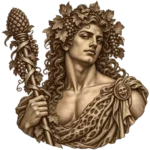 DionysusGrandson through Semele
 ZeusFather in the distinct Samothracian tradition