
Helios: the Sun as a god
Helios (Greek Ἥλιος, Hēlios) is the personification and deity of the sun in ancient Greek religion, not simply a poetic nickname for daylight. He traverses heaven, illuminates the inhabited world, witnesses hidden actions and maintains the recurring order of day. Greek poets make him a distinct divine character with ancestry, offspring, sacred herds and the ability to demand redress from Zeus. His importance consequently crosses cosmic order, moral testimony, the agricultural calendar and lived cult.
A Titan born of light
Hesiod, Theogony 371–374, identifies Helios as the child of the Titans Hyperion and Theia and the sibling of Selene, the Moon, and Eos, Dawn. The same grouping appears in the Homeric Hymn to Helios (Hymn 31), which calls his mother Euryphaessa, a name or epithet meaning far-shining. These names reflect related poetic genealogies; there is no need to invent a quarrel or separate history between Theia and Euryphaessa. As a member of this family, Helios belongs to an older divine genealogy but remains active within the Olympian world.
Helios and Apollo are not originally identical
An essential distinction is that the early Greek sun god and Apollo are separate figures. Apollo has his own roles in prophecy, music, archery, plague and purification; Helios is the cosmic sun who drives across heaven. The two could be identified increasingly in particular later philosophical, literary and religious contexts. Such identification is historical and significant, but calling every early appearance of Helios an appearance of Apollo would erase the evidence.
The meaning of his name
The word hēlios is the Greek word for sun, and Helios is its divine personification. Ancient Greek has dialectal variants, and the connection to an inherited Indo-European solar word is widely discussed in historical linguistics. This is firmer ground than sensational claims that every solar god of the Mediterranean descends directly from one Greek character. In English the adjective heliocentric and terms such as heliosphere preserve the root referring to the sun; they do not imply that the deity authored astronomical science.
What makes Helios distinctive
Unlike a god who governs one human occupation, Helios is a daily cosmic presence whose light makes nearly every human action visible. This produces a striking literary combination: the god who illuminates the world becomes witness to secrets, yet his property can still be violated in an isolated place, as in the Odyssey. His myths explore the limits of human power under a natural order that returns relentlessly each morning.

The daily solar journey
Helios' defining domain is the sun's visible passage through the sky. Greek poetry dramatizes that passage as the drive of a radiant chariot and horses. The image explains neither modern astrophysics nor a fixed technical calendar, but represents recurring cosmic order in divine terms. His movement marks day, departure, exposure and the apparent descent toward Oceanus at the edge of the world.
Light, heat and vision
His beams make land and sea visible and associate him with heat, radiance and life-giving energy. These benefits also have an intimidating side: overwhelming sunlight exposes, scorches and cannot be negotiated away by ordinary mortals. The Phaethon myth, especially as elaborated in Roman literature, dramatizes what occurs when the ordered trajectory of the sun is lost.
The witness who sees and hears
Homeric and hymnic poetry emphasize Helios as a witness to things concealed from others. In the Homeric Hymn to Demeter, after Persephone disappears, Demeter appeals to Helios because he ranges above the world and has seen what happened. In the Odyssey, his knowledge and rights matter when Odysseus' companions kill his sacred cattle. This is a divine mode of surveillance, not a claim that every ancient author made him perfectly omniscient in every scene.
Oaths, testimony and redress
Because the sun sees actions taking place under daylight, Helios can function in literary and ritual contexts as a witness to declarations or injustices. His visibility helps establish moral authority. Yet he is not equivalent to Zeus as king of the gods or to Themis as an embodiment of divine order; his special power lies in solar perception and the demand that injuries committed against him be acknowledged.
Cosmic rhythm and seasonal life
The unbroken return of Helios makes his presence essential to the experienced rhythm of days and agricultural work. Greek religion does not make him the same kind of crop goddess as Demeter, and his cult was not equally prominent in every polis. Still, the sun's power conditions journeys, sowing, ripening, human visibility and ritual time, giving his relatively simple cosmic function far-reaching effects.
Radiant figure and crown
Art commonly renders Helios as a youthful male with radiant or streaming hair, sometimes distinguished by a crown or halo of rays. The rays identify the solar body rather than a conventional royal crown. Representations vary across classical, Hellenistic and Roman periods, so not every ancient Helios must wear precisely the same number of rays or identical clothing.
The quadriga and horses
The four-horse chariot is a widespread image of Helios moving across the heavens. Ancient descriptions emphasize brilliant horses and splendid harness; the Homeric Hymn to Helios describes his golden-yoked chariot. Later texts give names to the horses, but there is no one immutable early list. The chariot is a narrative embodiment of solar order, and its uncontrolled motion becomes decisive in later versions of Phaethon's disaster.
The all-seeing eyes
Helios' gaze has symbolic power distinct from simple brightness. Depictions of his eyes and outward face can evoke the ancient idea that human actions are visible to the sun. This is why the god can appear as a witness in stories about Persephone, Aphrodite and Hephaestus. The attribute should not be confused with the all-seeing eyes of Argus Panoptes, who is a separate named character.
Sacred cattle and flocks
In Odyssey 12, the island of Thrinacia holds seven herds of cattle and seven flocks of sheep belonging to Helios, each containing fifty animals. The animals are tended by his daughters Lampetia and Phaethusa. The poem says that births do not increase them and deaths do not reduce them. They symbolize protected divine property and an order beyond human appetite; no new independent entity called 'cattle' belongs in Helios' relationships.
Sun disc and monumental representation
The sun disc, rays and Helios' head occur in Greek and later Mediterranean visual media, including coinage. The Colossus of Rhodes famously represented Helios, although the precise details of its ancient appearance are debated. The familiar image of an enormous statue straddling a harbor entrance is a later imaginative construction, not a securely documented ancient engineering fact.
The sacred cattle of Thrinacia
The Odyssey gives Helios one of his most consequential narrative roles. Circe warns Odysseus not to harm the sun god's cattle on Thrinacia (Odyssey 12.127–141). After storms trap the crew, hunger and disobedience lead Eurylochus and the other companions to slaughter the sacred animals while Odysseus sleeps. Lampetia brings word to her father; Helios protests to Zeus and threatens to descend to the underworld and shine among the dead if unavenged (Odyssey 12.374–383). Zeus strikes the ship with a thunderbolt. Odysseus survives alone. The episode concerns sacrilege, human necessity and limits, not the claim that Helios himself hurls Zeus' thunderbolt.
Helios reveals Persephone’s abduction
In the Homeric Hymn to Demeter, Demeter seeks news of her missing daughter and ultimately questions Helios, who has seen Hades seize Persephone with Zeus' consent. Helios explains the divine arrangement and attempts to counsel the grieving goddess (Hymn to Demeter 64–90). His function is testimonial: he does not abduct Persephone, negotiate the final compromise or preside over Eleusis. This makes him important within Demeter's myth without confusing him with its central actors.
Aphrodite, Ares and Hephaestus
In Odyssey 8.266–366, the bard Demodocus recounts how Helios saw Ares meeting Aphrodite secretly and told Hephaestus. The divine smith then prepared an invisible net to trap the pair. Helios' part is short but revealing: solar sight exposes a secret whose consequences unfold among other gods. The story shows how his witness function works in a comic but morally pointed episode of epic poetry.
Phaethon and the disastrous chariot ride
The story of Phaethon, a son of the sun god in influential traditions, is best known in its expansive version in Ovid, Metamorphoses 1.747–2.400. Seeking confirmation of his parentage, Phaethon persuades his father Sol to grant a wish and demands to drive the solar chariot. Unable to control the horses, he scorches regions of the earth and endangers cosmic order; Jupiter stops the disaster with a thunderbolt. The story is central to Helios' later reception, but its detailed dramatic sequence should be attributed to Ovid's Roman poem rather than presented as the same text as Homer's Odyssey.
Circe and Aeetes
Helios is father of Circe and Aeetes in genealogical traditions that make him ancestor of a line of powerful and sometimes dangerous figures. Hesiod, Theogony 956–962, gives Helios' offspring by Perseis, daughter of Oceanus, as Circe and Aeetes. Through Aeetes and later traditions, Helios is linked to Medea. These descendants broaden his mythology beyond the solitary chariot journey and show how solar genealogy intersects magic, kingship and the Argonautic cycle.
Rhodes and the sun god’s island
Pindar, Olympian 7, develops a memorable foundation account explaining Helios' relationship with Rhodes. When the gods divide the earth, Helios is initially absent and requests his own portion. Land rises from the sea, becoming Rhodes, and the island falls to him. The myth joins cosmic light, civic identity and a specific place. It should be distinguished from the later construction of the Colossus, which commemorated the god in a different historical setting.
Other children and variations
Traditions also name the Heliades, daughters associated with mourning for Phaethon and transformed into trees in later poetry. Their number and names vary. The Homeric attendants Lampetia and Phaethusa belong to the cattle story, while the Heliades belong chiefly to later treatments of Phaethon. Distinguishing these overlapping family groupings prevents the mythology from becoming a careless, universalized family list.
The cult of a cosmic but locally honored god
Helios' visibility did not mean his formal cult had the same status in every Greek city. Some communities treated him prominently, while in others his role was stronger in poetry and cosmic imagination than in large public institutions. The distinction between a ubiquitous heavenly object and the geographical distribution of actual sanctuaries is important for historical accuracy.
Rhodian worship
Rhodes stands out as the most celebrated Greek center of Helios. Pindar's seventh Olympian ode uses myth to affirm a special bond between the god and the island. Rhodian public identity, festivals, dedications and imagery made the sun god a civic patron of exceptional standing there. Accounts should distinguish the poetic explanation of this patronage from historical evidence of festivals and monuments.
The Halieia festival
Ancient testimony records a festival of Helios on Rhodes called the Halieia. It belongs to the island's public religious life and should be discussed as evidence of organized worship rather than merely a picturesque tale about the sun. Reports of horse-related offerings appear in ancient and later testimony, but ritual reconstructions should remain cautious where evidence varies or is incomplete.
Sacrifice and sacred animals
The sun god could receive sacrifices appropriate to regional and historical practice. Literary sources mention horses, cattle and other animals in connection with Helios, but there is no reason to claim a single standard sacrifice in every Greek sanctuary. The cattle of Odyssey 12 are divine property in an epic tale and should not automatically be equated with actual sacrificial regulations at Rhodes.
Helios as an invoked witness
Because Helios sees events across the daylight world, he can appear in oaths, laments and literary appeals. That role is religiously meaningful even in passages without a formally described temple. Yet it is important to distinguish these invocations from documented organized cult; mythic ubiquity does not automatically prove institutional ubiquity.
Rhodes and its sanctuaries
Rhodes is the principal place to begin an account of Helios' cult. Its tradition of solar patronage appears in Pindar, Olympian 7, and the island developed public monuments associated with him. References to Rhodian worship are grounded, whereas detailed claims about an otherwise unattested shrine should not be invented for a fuller-looking sacred geography.
The Colossus of Rhodes
The Colossus, created by Chares of Lindos in the third century BCE, was a monumental statue of Helios at Rhodes, famous among the wonders of the ancient world. Ancient testimony connects its destruction to an earthquake and its later ruins. Its exact pose and placement remain debated; the popular harbor-straddling image is not reliable evidence. The Colossus is therefore best described as a major dedication and monument, not a proven bridge-like gateway.
Corinth and other local attestations
Pausanias reports Helios in local sacred topographies, including a Corinthian tradition involving the division of Corinth and Acrocorinth between Helios and Poseidon (Description of Greece 2.1.6 in commonly used numbering). His appearances in travel literature reveal that solar worship and myth were not confined to Rhodes. Nevertheless, each local claim should be anchored to a particular author and place, not inflated into an imaginary network of grand temples.
Thrinacia as mythic setting
Thrinacia, where Helios' cattle graze in the Odyssey, is a narrative island, not an archaeological sanctuary that can safely be identified with a single present-day location. Ancient and modern attempts to map Homeric geography differ. A reliable encyclopedia separates sacred narrative landscapes from historically verifiable cult sites.
The ocean horizon and solar passage
The Oceanus encircling the earth functions as an imaginative cosmic boundary in early Greek poetry. When Helios' chariot rises and descends relative to this horizon, the texts express the passage of light through mythic geography. Oceanus is an important divine figure as well as a cosmological setting, but this does not authorize treating 'ocean' or 'sunset' as missing character entries.
Hyperion and Theia
Helios is son of Hyperion and Theia in Hesiod, Theogony 371–374. The same family includes Selene and Eos. The solar siblings express a poetic organization of the sky's luminous phenomena, but each is a separate divine figure with a distinct corpus of myths and cult associations.
Selene and Eos
Selene is the Moon and Eos is Dawn, both sisters of Helios. Their roles connect in daily sequence but they are not duplicates. Eos opens the day, Helios illuminates it, and Selene's identity belongs to the night sky and lunar rhythms. Some later images or interpretations combine solar and lunar language, but the underlying named figures remain distinct.
Perseis, Circe and Aeetes
Hesiod identifies Perseis (also spelled Perse) as the daughter of Oceanus and consort of Helios, giving birth to Circe and Aeetes. These children link solar genealogy to the worlds of Aeaea, Colchis and later stories about Medea. Other ancient texts may shift names or genealogies; the Hesiodic version is clear enough to cite specifically.
Phaethon and changing genealogies
Phaethon is son of the sun god in the influential later chariot narrative, but the names and parentage of figures called Phaethon vary across ancient sources. Eos herself has a son named Phaethon in some mythological material. A sound account must distinguish the celebrated charioteer of Roman and Greek reception from unrelated or differently placed homonyms.
Lampetia and Phaethusa
In Odyssey 12, Lampetia and Phaethusa are named as daughters of Helios and Neaera, attending his cattle and sheep on Thrinacia. Their role is specific: they protect or report on the sacred animals. They should not be treated as faceless generic 'nymphs' for the purpose of entity linking when the poem actually supplies individual names.
Apollo, Demeter and other divine relationships
Helios tells Demeter what happened to Persephone; he reports Aphrodite and Ares to Hephaestus; and later religious writers compare or identify him with Apollo. These are relationships of action, function or religious interpretation, not all blood kinship. A structured encyclopedia should use accurate explanations rather than misleading every relation as father, son or consort.
Helios and Roman Sol
The straightforward Roman counterpart of Helios is Sol, the sun deity. Latin texts such as Ovid's Metamorphoses often call the solar charioteer Sol. The comparison is historically meaningful, yet Greek and Roman cult histories are not wholly interchangeable. The later Roman cult of Sol Invictus has its own historical development and cannot simply be projected back unchanged into Hesiod's archaic Greek world.
Helios and Apollo
Later Greek and Roman traditions increasingly identify Apollo with solar imagery and sometimes with Helios himself. Nevertheless, in early epic and Hesiodic genealogy the figures are distinguishable. Apollo does not become retroactively the owner of Helios' cattle simply because later writers fuse solar roles. This distinction is essential when building relationships and cross-links between the two entities.
Hyperion is not automatically another name for Helios
Homer often uses the patronymic Hyperionides or refers to Hyperion in solar contexts. Later readers can mistake this for proof that the father Hyperion and son Helios were universally the same being. Hesiod explicitly distinguishes the generations. A profile should report the poetic overlap without erasing Hyperion as Helios' father in the relevant genealogy.
Solar language and astronomy
Modern words such as heliocentric, heliosphere, heliograph and heliotherapy preserve Greek solar vocabulary. They are lexical descendants of the word for sun, not evidence for cult practice in antiquity. This distinction permits the article to include a worthwhile cultural legacy without confusing mythological entities with scientific concepts or creating 'sunlight' as a relationship entry.
No invented one-to-one universality
Cross-cultural solar deities share recurring human concerns, but they are not automatically identical characters. Comparison with Egyptian Ra, Mesopotamian Shamash or other traditions requires specific evidence for historical contact or interpretatio, rather than a bare assertion that every culture worshipped the same named being. For a Greek entity article, the securely attested Roman Sol comparison is the clearest direct equivalence.
Hesiod and the Homeric hymns
Hesiod, Theogony 371–374, gives Helios' parents and siblings; Theogony 956–962 connects Helios and Perseis with Circe and Aeetes. Homeric Hymn 31, To Helios, describes his appearance, shining face, chariot and ascent, and names Euryphaessa as his mother. Homeric Hymn 2, To Demeter, especially lines 64–90, gives Helios' testimony about Persephone's abduction.
Homer and the Odyssey
Homer, Odyssey 8.266–366, reports Helios' disclosure of the affair of Ares and Aphrodite to Hephaestus. Odyssey 12.127–141 introduces his sacred cattle; 12.261–402 narrates the killing, complaint to Zeus and destruction of Odysseus' ship. These passages support distinct episodes, and should not be blended into one continuous Helios adventure.
Pindar, Pausanias and the Rhodian tradition
Pindar, Olympian 7, tells the allotment of Rhodes to Helios and articulates his special bond with the island. Pausanias, Description of Greece 2.1.6, preserves a Corinthian account involving Helios and Poseidon. Such evidence helps distinguish a local cult tradition from universal epic cosmology.
Later literary evidence
Ovid, Metamorphoses books 1–2, provides an influential extended account of Phaethon and the Sun's chariot. Pliny the Elder, Natural History 34.41–42 in common modern chapter divisions, discusses the Colossus of Rhodes. These Latin accounts illuminate later reception but must be labeled as such rather than silently attributed to early Greek epic.
Method and source hierarchy
The oldest surviving literary witnesses, later Greek local testimony, Roman literary retellings and archaeological interpretation answer different questions. The source list therefore identifies passage locations and the kinds of claims each supports. Interpretive uncertainty remains important for the etymology of Euryphaessa, the mapping of Thrinacia, details of the Colossus and the history of the Apollo–Helios identification.
 HyperionFather; Titan of the older generation
 TheiaMother in Hesiod
 SeleneSister; goddess of the Moon
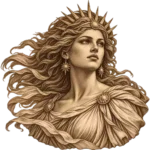 EosSister; goddess of the Dawn
 OceanusAncestor through Perseis and cosmic Ocean
 DemeterGoddess to whom he discloses Persephone’s abduction
 PersephoneHer abduction is witnessed by Helios
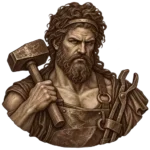 HephaestusHe tells him about Ares and Aphrodite
 AresHis secret affair is exposed by Helios
 AphroditeHer affair with Ares is exposed by Helios
 ZeusHe demands justice from Zeus for his sacred cattle
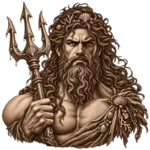 PoseidonAppears in Corinthian local tradition alongside Helios
 ApolloDistinct Greek deity later identified with the Sun