
Nyx: Primordial Goddess of Night, Shadow and the Ancient Darkness Before Dawn
Identity and scope
Nyx (Νύξ) is the Greek primordial goddess of Night, one of the oldest and most formidable beings in the cosmological imagination of archaic Greece. She does not belong originally to the later generation of Olympian gods. Instead, she stands much deeper in the structure of myth, at the level of the first cosmic realities that emerge near the beginning of existence itself. Night in Greek thought is not merely the absence of daylight. In Nyx, Night becomes a living power: enveloping, generative, mysterious, fearful and sacred.
A primordial rather than merely poetic figure
Modern readers sometimes treat Nyx as though she were simply a decorative literary personification, but ancient Greek tradition presents her with far greater seriousness. In Hesiod’s cosmology she emerges among the earliest beings and gives rise to a striking lineage of powers connected to mortality, fate, sorrow, sleep and the darker conditions of existence. This makes her indispensable for understanding how Greek myth explained not only the structure of the universe, but also the emotional and existential realities that govern human life.
Night as mother of powers
Nyx is especially important because she is not only Night herself; she is a mother of potent personified forces. Many of her children embody states or inevitabilities that shape the human condition, including Sleep, Death, Strife and other unsettling or solemn realities. Through this genealogy, Greek mythology suggests that darkness is fertile. Night does not produce nothingness. It gives birth to conditions, powers and truths that daylight cannot erase.
Awe, fear and majesty
Nyx’s stature is magnified by the reverence and caution shown toward her even by powerful gods. In Homeric tradition, Sleep once escapes Zeus by taking refuge with Night, and Zeus refrains from provoking her further. This detail is extremely important. It signals that Nyx is not a marginal figure of poetic decoration, but a primordial power before whom even the ruler of Olympus shows restraint. She carries an ancient authority deeper than ordinary divine hierarchy.
Nyx as cosmic atmosphere
Nyx should not be reduced to a narrow domain. She is the night sky, the cloak of darkness, the transition that covers the world and the metaphysical atmosphere from which dreams, fear, rest and hidden knowledge may emerge. She is a cosmological mother, a symbolic principle and a divine being of enormous antiquity. Few figures in Greek mythology combine cosmic age, poetic force and genealogical importance so powerfully.

Night and cosmic darkness
Nyx governs Night in its fullest mythic sense. This includes not only darkness after sunset, but the enveloping condition in which the visible world is concealed, softened or transformed. Night becomes under her influence a living cosmic interval with its own power, moods and consequences.
Threshold, transition and concealment
Night marks transition. Under Nyx, the world passes from activity into quiet, from exposure into concealment and from certainty into ambiguity. This liminal quality explains why Night is linked not only to fear, but also to dreams, visions, rest, secrecy and altered awareness. Nyx governs one of the most important transitional states in cosmic rhythm.
Motherhood of existential powers
One of Nyx’s defining attributes is her generative role. She produces beings associated with fate, death, sleep, sorrow, retribution, old age and conflict. This does not make her simply “evil.” Instead, it places her at the root of fundamental conditions of existence. She is a mother of realities that mortals cannot escape.
Mystery, fear and sacred depth
Nyx embodies mystery as much as darkness. The night conceals, but it also reveals in other ways: through dreams, omens, reflection and encounters with the unseen. This gives her a sacred depth distinct from purely destructive figures. She is fearsome, but not merely violent. She is solemn, hidden and ancient.
Rest, dreams and proximity to death
Because many children of Nyx include Sleep and Death, her domain stands close to the experience of human vulnerability. Under night, mortals sleep, dream, fear, grieve and face the unknown. Nyx thus forms the cosmic backdrop for some of the most intimate and universal human experiences.
Veiled or dark-robed goddess
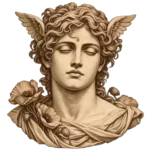
Nyx is often imagined as a majestic female figure cloaked in darkness, veils or flowing robes. This appearance suits her identity as the one who covers the world. She does not need armor or overt weaponry to signify power. Her authority lies in overwhelming presence, shadow and enveloping vastness.
Stars, darkness and the night sky
Symbols associated with Nyx naturally include stars, the nocturnal sky and the dark canopy spread over heaven. These images do not merely ornament her. They communicate her cosmic scale. She is not just a woman standing in the dark, but the divine force of the darkened heavens themselves.
Wings, chariot and sweeping movement
Later art and poetic imagination may present Nyx as winged or traveling through the sky in a chariot. These motifs express motion and cosmic cycle: Night arrives, spreads and departs with regular grandeur. Although not every ancient source gives the same image, the symbolism suits her role well.
Torch, moonlit gloom and nocturnal atmosphere
Nyx may also be associated with torches or dim light within surrounding darkness. This is not because she is a goddess of daylight illumination, but because faint light amid night intensifies the atmosphere of mystery. Moonlit gloom, deep shadow and stillness all belong to her iconographic world.
Maternal yet formidable presence
Unlike later monstrous depictions of darkness, Nyx often remains dignified and queenly. Even when feared, she is not necessarily grotesque. Her imagery combines maternity and terror, calm and solemnity, emphasizing that primordial forces need not resemble simple monsters to inspire awe.
Nyx in the Hesiodic cosmogony
In Hesiod’s Theogony, Nyx appears among the earliest cosmic powers. Depending on the structure of the tradition, she emerges after Chaos and stands among the primordial conditions from which the world becomes differentiated. This placement is essential: Nyx is not a late arrival but an elemental component of the universe’s earliest order.
Union with Erebus
Nyx is closely linked with Erebus, the darkness of the deep or shadowed underworld. Through this union, according to Hesiod, she brings forth Aether and Hemera. This is one of the most fascinating dynamics in Greek cosmology: from darkness are born brightness and day. Mythically, Night is not opposed to creation. It participates in the generation of cosmic balance.
Mother of Hypnos, Thanatos and other forces
Nyx is credited with giving birth to many powerful personifications, among them Hypnos (Sleep), Thanatos (Death), Moros (Doom), Nemesis, Eris and others, though specific listings and emphases can vary somewhat by source. This genealogy makes her one of the most consequential maternal figures in Greek myth. She gives form to the invisible laws and burdens that govern mortal existence.
Zeus’ respect for Night
An especially important Homeric moment occurs when Hypnos recalls how Zeus once threatened him. Sleep escaped and took refuge with Nyx, and Zeus held back out of regard—or caution—toward Night. This passage powerfully communicates Nyx’s stature. She is among the rare figures whose primordial authority even Zeus does not casually challenge.
Nyx in Orphic and later traditions
Later traditions, especially Orphic currents, could elevate Nyx even further, presenting her as a figure of deep cosmic wisdom, prophecy or primordial insight. Though the exact theological system changes by source, these traditions reinforce the notion that Night is not merely environmental darkness. She is a profound metaphysical principle.
Night in poetic and tragic imagination
Greek tragedy and later literature repeatedly draw upon Night as a figure of fear, concealment, vengeance and solemn revelation. Even when Nyx is not always an active narrative character, her divine presence helps structure how darkness itself is imagined. She is thus a mythic force with both direct genealogy and broader symbolic life.
Limited widespread civic cult
Nyx does not seem to have possessed a broad panhellenic public cult on the scale of major Olympian deities such as Athena or Apollo. This is not surprising. Primordial deities often held immense mythological significance without dominating public civic worship in the same way later gods did.
Religious significance without major temple networks
The absence of a vast cult infrastructure does not diminish Nyx’s importance. Some divine figures matter most through cosmology, ritual language, hymns, mystery-oriented traditions and symbolic power rather than through numerous monumental sanctuaries. Nyx belongs firmly to this category.
Orphic and hymn-based presence
Nyx appears in religious-poetic traditions such as the Orphic Hymns, where primordial and cosmic deities receive reverent invocation. This shows that Night could be approached in prayerful or contemplative form, especially within traditions more concerned with cosmic theology and sacred symbolism.
Sanctity of night in ritual practice
Even beyond direct cult to Nyx, the religious importance of night in Greek practice helps illuminate her stature. Nocturnal rites, dreams, sleep, incubation and underworld-oriented ceremonies all belong to a religious environment in which Night itself had sacred weight. Nyx serves as the divine face of that environment.
Fear, reverence and metaphysical prestige
Nyx’s cultic profile is shaped by reverence more than familiarity. She is not an approachable domestic helper deity in the usual sense. Her importance is majestic and atmospheric, tied to the sense that Night is older than the ordinary divine order and must be honored with seriousness.
No dominant panhellenic sanctuary
There is no single great panhellenic sanctuary that defines Nyx in the way Epidaurus defines Asclepius or Delphi defines Apollo. This absence is consistent with her primordial nature. Her religious importance is broader and more atmospheric than site-dependent.
Megara and reports of Night-related worship
Ancient testimony associates Night with limited local cultic or symbolic presence, including reports connected with Megara in the broader ancient tradition. Even where evidence is sparse, such references suggest that Nyx was not wholly absent from place-based reverence.
Caves, darkness and liminal sites
Nyx belongs naturally to caves, thresholds, silent places and sites marked by darkness or underworld resonance. These are not necessarily formal sanctuaries exclusively hers, but they suit her sacred geography. She inhabits spaces where visibility yields to mystery.
The cosmic sky as sacred place
More than many deities, Nyx’s “temple” is the cosmos itself. The night sky, the dark vault above the earth and the encompassing silence after sunset function as her most natural sacred environment. This vastness is integral to her identity.
Dream and night ritual environments
Any place structured around sleep, incubation, secret ritual or nocturnal transition can also be understood as participating in Nyx’s symbolic sphere. Her sacred geography is therefore diffuse but potent, woven into the rhythms of darkness, silence and inward experience.
Chaos
Chaos stands at the beginning of the Hesiodic cosmos and is one of the most important primordial antecedents to Nyx. Whether one emphasizes origin directly or cosmological sequence, Chaos is indispensable for situating Night in the earliest order of being.
Erebus
Erebus is Nyx’s closest mythic counterpart and consort in major tradition. Together they generate Aether and Hemera, making their union a central expression of how darkness can give rise to brightness and day.
Aether and Hemera
Aether and Hemera are among Nyx’s most important offspring in the Hesiodic framework. Aether represents the bright upper air, while Hemera is Day. Their birth from Night and Darkness is cosmologically striking and should never be overlooked.
Hypnos and Thanatos
Among Nyx’s many children, Hypnos and Thanatos are perhaps the most famous pair. Sleep and Death express the intimate relation between rest, vulnerability and finality that takes place under the dominion of Night.
Moros, Nemesis and Eris
Nyx is also associated with offspring such as Moros (Doom), Nemesis and Eris (Strife), depending on the source and emphasis. These children deepen her significance by linking Night with fate, retribution and conflict—not because Night is “bad,” but because primordial reality contains harsh inevitabilities.
Extended dark lineage
Many additional children are attributed to Nyx in various traditions, including beings associated with dreams, blame, deceit, old age and sorrow. Not every descendant needs to be listed in one place to recognize the overall pattern: Nyx mothers a vast network of personified powers that define the mortal condition.
Nox
The Roman equivalent of Nyx is Nox. The correspondence is straightforward and important, especially because Roman literature and art preserve and reinterpret the figure of Night in ways continuous with the Greek tradition.
Night as personification and goddess
The Greek word for night can refer simply to the natural phenomenon, but Nyx is the divine personification and primordial being who gives that phenomenon sacred identity. This distinction matters because not every mention of “night” in ancient literature is necessarily a theological invocation of the goddess herself, even though the conceptual overlap remains strong.
Nyx in later esoteric and literary traditions
Later philosophical, literary and esoteric traditions often expanded Nyx’s stature, treating her as a symbol of cosmic depth, hidden knowledge or primordial mystery. These later receptions are important, but they should be grounded in the ancient mythic identity from which they arise.
Not a simple goddess of evil
Modern simplifications sometimes treat darkness as automatically evil, but Nyx should not be flattened into that moral scheme. She is fearsome and associated with hard realities, yet she is also maternal, generative and cosmically necessary. Night is not identical with wickedness; it is an ancient dimension of being.
Primary ancient sources
Hesiod’s Theogony for Nyx’s primordial status, union with Erebus and wide-ranging offspring; Homer’s Iliad for the episode in which Hypnos seeks refuge with Night and Zeus refrains from offending her; Orphic hymnic and later theological traditions for her elevated cosmic role; and broader poetic and tragic literature for her symbolic power.
Interpretive note
Nyx must be understood as far more than a decorative personification. She is one of the deepest primordial powers in Greek mythology, a mother of existential realities and a figure whose authority reaches beneath the later Olympian order. Her mythology reveals that darkness in the Greek imagination is fertile, sacred, feared and profoundly woven into cosmic structure.
 ChaosPrimordial antecedent within the earliest cosmic order
 ErebusConsort or closest primordial counterpart in major tradition
 HypnosChild associated with sleep and the night-state
 ThanatosChild associated with death and mortal finality
 NemesisChild associated in some traditions with retribution
 ErisChild associated with strife and conflict