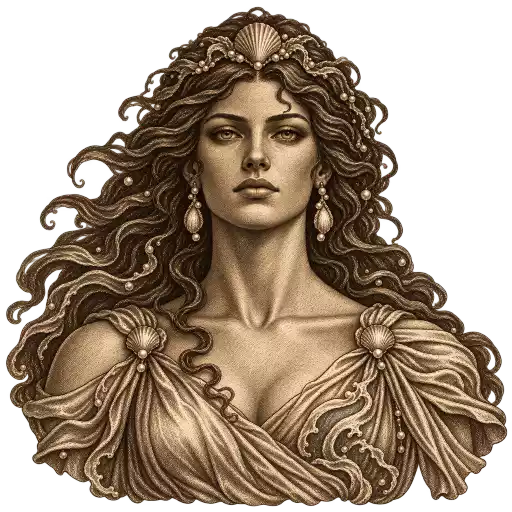
Tethys: the Titan mother of rivers and Oceanids
Tethys (Τηθύς) belongs to the first generation of Titans in Greek mythology. Hesiod names her among the children of Gaia (Earth) and Uranus (Sky), placing her before the sovereignty of Zeus and the Olympian order. Her importance rests chiefly in genealogy and cosmology: joined to Oceanus, the great world-encircling stream, she becomes mother of innumerable rivers and freshwater-associated daughters called Oceanids. She should not be confused with the Nereid Thetis, mother of Achilles; their names resemble one another in English, but they are distinct ancient figures with different family histories.
A generative figure rather than a sea ruler
Although imagery of Tethys often evokes water, she is not a replacement for Poseidon, whose rule concerns the sea in the Olympian order. She is likewise distinct from Amphitrite, Poseidon’s consort. The Greek family of waters is diverse: primordial sea figures, the encircling Oceanus, river gods, springs and ocean nymphs need not all be assimilated into a single marine deity. Tethys particularly represents the maternal source of waters as described by Hesiod.
Her ancient evidence
Two early witnesses are particularly important. Hesiod’s Theogony 132–138 names Tethys in the Titan generation, and 337–370 attributes to her and Oceanus rivers and Oceanids. Homer’s Iliad 14.200–207 and 14.300–306 instead highlights her nurturing relationship with Hera. These are complementary but differently focused narratives, and an encyclopedia should preserve their distinct emphases rather than create a single invented biography.

Freshwater origins and the world river
The most secure sphere of Tethys is the prolific generation of rivers and their associated divine daughters. Hesiod places major waterways—including the Nile, Alpheus, Achelous, Meander and Scamander—among the river gods born of her and Oceanus. Their names connect the divine genealogy to geographical waters familiar to Mediterranean and Near Eastern audiences.
Nurture and abundance
The Oceanids form a broad network of water-associated goddesses. Hesiod says that their assigned role, alongside Apollo and the Rivers, involves caring for the young. This gives Tethys’ family a nurturing dimension beyond the abstract ownership of water. The idea of her as an immense maternal source follows from the genealogy; it should not be expanded into unsupported claims that she was universally worshipped as a goddess of motherhood.
Primordial status and limits of power
Tethys is a Titaness by descent, not the sovereign of all oceans or a participant in every struggle among the Titans. Her surviving myths emphasize parenthood and occasional domestic intervention rather than conquest. Modern summaries describing her as “ruler of the sea” or claiming definitive battle feats often go further than the early texts allow.
Water as a genealogical network
Rivers in Greek mythology can be divine persons, places and natural features at the same time. Tethys’ descendants illustrate that overlap especially well. The connection between flowing rivers, inhabited territories and divinely personified springs turns geography into a family tree and helps explain why her brief appearances carry such large cosmological consequences.
Ancient imagery and the problem of identification
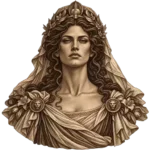
Tethys has no single universally fixed appearance comparable to the thunderbolt of Zeus. Artistic identifications should be linked to the original object and its inscription where possible. Roman-period mosaics sometimes label Tethys together with Oceanus and present her in an aquatic setting; these works are valuable evidence for later visual reception, not proof of an unchanged archaic cult image.
Aquatic attributes
Waves, aquatic creatures and water-bearing imagery appropriately signal her relationship to the river and Oceanid family. Such motifs may help explain an illustration, but they must not be called exclusive ancient symbols without evidence. Some late images of water goddesses include marine attributes that are shared across many figures.
Distinguishing Tethys from Thetis
The similarity of Tethys (Τηθύς) and Thetis (Θέτις) is a particular hazard in image captions. Thetis is a Nereid, daughter of Nereus and Doris in familiar genealogies, and mother of Achilles with Peleus. Tethys is an older Titaness, daughter of Gaia and Uranus, and partner of Oceanus. An image depicting Achilles or Peleus normally points to Thetis, not Tethys.
Her birth among the original Titans
In Theogony 132–138, Hesiod names Tethys among the sons and daughters of Earth and Sky. This places her in the same generational stratum as Oceanus, Hyperion, Rhea, Cronus and the other Titans. The genealogy makes her both sibling and consort of Oceanus under the conventional Hesiodic account, a relationship that follows the ancient divine family structure rather than human social norms.
Mother of the rivers
Theogony 337–345 begins the remarkable list of rivers born of Tethys and Oceanus: the Nile, Alpheus, Eridanus, Strymon, Meander, Ister, Achelous, Scamander and others. Their significance is not merely numerical. River names anchor the myth in waterways around which cities, agriculture and trade developed. The list is a mythological map of flowing water.
Three thousand Oceanids
Theogony 346–370 next names several daughters, including Metis, Eurynome, Styx and Tyche, and states that the Oceanids number three thousand, matched by an equal number of river sons. Three thousand is part of the poem’s immense cosmic scale, not a modern census. A responsible account distinguishes the named daughters from the wider poetic total and does not pretend a complete surviving roll of six thousand individuals exists.
Tethys raises Hera
In Iliad 14.200–207 Hera tells Aphrodite that Oceanus and Tethys lovingly raised her, receiving her from Rhea during the upheaval connected with Zeus and Cronus. Hera repeats the claim to Zeus in 14.300–306. This makes Tethys an important foster mother in a Homeric episode rather than simply a genealogical name.
The apparent quarrel with Oceanus
In the same Iliad passage, Hera says Oceanus and Tethys have long been estranged and that she means to reconcile them. Yet the reader must notice the scene: Hera is attempting to distract Zeus in the famous deception of Zeus, and her words are part of that strategy. Their alleged marital separation cannot be treated uncritically as an independently established historical event within the myth.
Position during the Titanomachy
Tethys is sometimes casually included among the combatants in the Titanomachy. The surviving early passages do not provide a clear individual battle narrative or unique punishment for her. It is more accurate to acknowledge the limits of the evidence than to supply a dramatic role just because she belongs to the Titan generation.
What can be said about devotion to Tethys
Tethys is essential to mythic genealogy, but evidence for an extensive independent Greek civic cult is limited. One should not turn her cosmological importance into invented temple networks or annual festivals. The evidence is principally literary and, particularly in later periods, artistic.
Waters, local river cults and indirect relevance
Greek communities did honor many rivers and local springs. Those local practices are relevant to the world of Tethys’ descendants but do not automatically prove that every such cult was directed to Tethys herself. The distinction between worship of a named river and worship of the river’s mythological mother is important.
Maternal reputation in epic
Homer’s portrayal of Tethys as Hera’s nursemaid supplies a relationship of affection and trust, although it is not a liturgical instruction. It is evidence of how an ancient audience could imagine the elder Titaness as protective and nurturing rather than solely as a remote cosmic abstraction.
Later visual reception
In Roman-period decorative art, images of Oceanus and Tethys may figure in domestic water-themed programs. Their presence reveals cultural prestige and the symbolism of abundance. A mosaic depiction is not, by itself, proof of dedicated public worship at that place.
No securely dominant sanctuary
No major panhellenic sanctuary is chiefly identified with Tethys in the surviving record, unlike Delphi with Apollo or Eleusis with Demeter. An encyclopedia should record this negative state of the evidence plainly rather than naming imagined temples.
The world-encircling Oceanus
Tethys’ principal mythological setting is her association with Oceanus, traditionally imagined as the great watercourse bounding the known world. The location is cosmographic rather than a single excavated place. Her children, however, are associated with named rivers in many regions.
Geographical reach through her descendants
The Nile, Alpheus, Achelous, Scamander, Meander and other waterways embody the geographical scope of her genealogy. Their riverine sanctuaries, where attested, belong first to the particular river deity; genealogical connection should not be mistaken for a sanctuary dedicated to Tethys.
Mosaic settings versus sanctuaries
Water-themed floor mosaics and late antique personifications of Tethys can be found in the visual culture of the Roman world. Without specific archaeological context, it is not appropriate to label a decorated room a temple. This matters especially when modern websites reproduce isolated images without their provenance.
Gaia and Uranus
Hesiod identifies Gaia and Uranus as the parents of the Titan generation that includes Tethys. Her place within this earliest divine family distinguishes her from later nymphs and from the younger Nereid Thetis.
Oceanus
Oceanus is both her Titan-generation relative and her consort in the Hesiodic genealogy. Their union generates rivers and Oceanids, a divine network that reaches far beyond any single mythic episode.
Named Oceanid daughters
Metis, associated with counsel and with Zeus’ early reign; Styx, associated with the underworld river and divine oath; Eurynome; and Tyche are among the daughters named by Hesiod. These individual relationships are documented, although later authors can supply alternative genealogies for some figures.
Rivers and local divine lineages
Hesiod names the Nile, Alpheus, Achelous and Scamander among the river sons of Oceanus and Tethys. Greek myths about these figures can follow their own independent genealogical and local traditions. Tethys’ parenthood links them without making all their stories episodes in her own life.
Hera as foster daughter, not biological child
In Homer, Hera says Tethys and Oceanus reared her. Hesiod instead identifies Hera as daughter of Cronus and Rhea. Both can be true within their respective roles: foster care is not the same as biological parentage. Maintaining this distinction prevents a common genealogical error.
Tethys and the Roman reception
The Greek proper name Tethys was preserved in Latin literary and artistic culture. Ancient Rome did not require a wholly separate and universally standardized goddess name to discuss the Titaness. Roman representations can elaborate her aquatic imagery without changing the core Greek genealogy.
Tethys is not Thetis
Thetis (Greek Θέτις) is a Nereid and the mother of Achilles. Tethys (Τηθύς) is a Titaness and mother of rivers and Oceanids. English spelling and modern translations make confusion especially easy; in Spanish the overlap of “Tetis” is even stronger, so the entity must be labeled Tetis (titánide) whenever ambiguity is possible.
Not Poseidon, Amphitrite or Thalassa
Poseidon is a later Olympian ruler of the sea; Amphitrite is his consort in many traditions; Thalassa is a personification of the sea. Tethys’ principal narrative identity is as Oceanus’ consort and mother of fresh waters. These figures may share watery motifs but are not interchangeable.
The name in modern science
The ancient mythological name inspired the scientific term Tethys Ocean for a prehistoric ocean, and the moon Tethys of Saturn likewise bears her name. These modern namesakes are not sources for reconstructing ancient ritual roles or mythic events.
Hesiod, Theogony 132–138
The list of the Titan children of Gaia and Uranus names Tethys. This establishes her status within the earliest generation of Greek gods.
Hesiod, Theogony 337–370
The most detailed early surviving account of Tethys’ children: river gods, named Oceanids, and the formula of three thousand Oceanid daughters matched by three thousand rivers. It also describes the Oceanids’ concern for the young.
Homer, Iliad 14.200–207; 14.300–306
Hera identifies Oceanus and Tethys as those who reared her. She also alleges a quarrel between the pair while pursuing a deliberate deception of Zeus; the rhetorical context is essential.
Evidence and interpretation
Later art and modern mythographic summaries are useful for reception, but should be separated from archaic testimony. No early source securely makes Tethys Poseidon’s counterpart, mother of Achilles or leader of the Titanomachy. Limited cult evidence must not be supplemented with invented sites or rituals.
 GaiaMother
 UranusFather
 OceanusConsort and brother
 TycheDaughter, Oceanid in Hesiod
 HeraFoster daughter in the Iliad
 RheaMother of Hera, who entrusted her to Oceanus and Tethys in Homer