Hyperion among the first Titans
Hyperion (Ὑπερίων) belongs to the first generation of Titans, the children of Gaia (Earth) and Ouranos (Sky). He is a father of the great lights rather than the god who physically drives the sun each day. The most secure account of his identity comes from Hesiod, who places him among the twelve Titans and names his three celestial children. This distinction matters: in later summaries Hyperion is sometimes called a sun god, but Greek epic can also use his name as an epithet or patronymic for Helios, the actual solar driver.
What his name suggests
The name Hyperion is traditionally understood as “the one above” or “he who goes high.” Such an interpretation accords with his position in the luminous family but should not be expanded into an invented portfolio of cosmic offices. Ancient texts give surprisingly little independent biography for him. His significance is anchored in ancestry, celestial genealogy and the transition from the primordial generation to the visible powers of Sun, Moon and Dawn.
Why his profile matters
Hyperion is a major structural figure in Greek mythology: without his union with Theia, the Hesiodic family tree would lack Helios, Selene and Eos. He represents the source of light-bearing deities without replacing those children. He is not one of the Olympians, and stories about the daily journey of the sun usually concern Helios rather than Hyperion himself.

Heavenly light and lineage
Hyperion is commonly connected with heavenly brightness because of his name and his children, not because every ancient source assigns him a separate office ruling the sun. The evidence supports a Titan of the celestial family, particularly a genealogical link to solar, lunar and dawn light. It does not justify making him the patron of every star or inventing a solar chariot specifically belonging to him.
A generative power of the first divine generation
The Titans stand between the primordial cosmos and later Olympian order. Hyperion participates in this generative stage: he and Theia produce the distinct deities of the sun, moon and dawn. Their children show an ordered heaven in which different kinds and times of light possess their own divine identities.
Observation and astronomical wisdom in a later account
Diodorus Siculus, Library of History 5.67.1, reports a rationalizing tradition in which Hyperion was the first to observe movements of the sun, moon, stars and seasons and to communicate that knowledge. This is a later explanation of his fame, not a reason to replace Hesiod’s genealogy with the claim that he literally invented astronomy. It is valuable evidence for the changing interpretation of Titans.
Not the same as Helios
Homeric language sometimes calls the sun “Hyperion” or “Hyperionides,” which can blur the line between father and son. However, Hesiod, Theogony 371–374, clearly distinguishes the Titan Hyperion from his son Helios. For an encyclopedia, the distinction should remain visible in every section.
Limited independent iconography
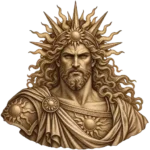
Unlike Helios, who may be shown driving a radiant chariot, Hyperion has no universally established, individually recognizable set of attributes in classical Greek art. Modern portraits depicting him as a crowned sun king or radiant warrior are interpretations, not securely documented ancient standards.
Sky and radiance as interpretive symbols
The high sky, a horizon of light and the contrast between day and night can serve as responsible symbolic imagery when clearly labeled as interpretations. Such motifs evoke the celestial genealogy of Hyperion and Theia without pretending that he inherited every attribute of Helios.
Titanic human form
The first-generation Titans often appear in later art as majestic anthropomorphic divinities, but for Hyperion specifically the surviving visual evidence is comparatively thin. A dignified mature form is plausible artistic reconstruction, not a portrait attested by a famous cult statue.
Do not confuse him with the sun chariot
A four-horse solar chariot, a rayed crown and a daily east-to-west crossing are best treated as images of Helios unless a given artwork or text identifies Hyperion. This warning is particularly important for modern illustrated mythologies and searchable image captions.
Birth from Gaia and Ouranos
Hesiod, Theogony 132–138, places Hyperion in the generation born from Earth and Sky. His siblings include Oceanus, Coeus, Crius, Iapetus, Cronus and the Titanesses. This is his clearest place in the early succession of divine generations.
Theia and the birth of the heavenly lights
Hesiod, Theogony 371–374, explicitly says that Theia bore to Hyperion great Helios, bright Selene and Eos, who brings light to mortals and immortals. This short but rich passage is the central ancient source for Hyperion’s independent identity. It also prevents a common mistake: Eos is a goddess of dawn in her own right, not simply a title of Helios.
His position in the Titan succession
Hyperion belongs to the generation that precedes Zeus and the Olympians. Cronus is the central actor in overthrowing Ouranos, whereas Hyperion is not given an equally developed episode of rebellion in Hesiod. General narratives of Titan conflict should not be converted into unsupported claims that Hyperion personally led a battle or received a unique punishment.
The name of Helios in epic
In Homeric epic and the Homeric Hymn to Demeter, language such as “son of Hyperion” links Helios with his Titan father. Some passages also use Hyperion as a solar title. This flexible poetic naming helps explain why modern sources sometimes collapse the two figures, but it should not erase the genealogical distinction.
Astronomer Hyperion in Diodorus
Diodorus Siculus 5.67.1 presents a euhemerizing or rationalizing explanation in which Hyperion was an early observer of celestial motions. It is a revealing alternative intellectual tradition. It does not belong to the same genre as Hesiod’s divine birth narrative and should be introduced with that distinction.
The stories that are not securely his
There is no widely attested standalone cycle of Hyperion adventures comparable to the labors of Heracles or the deeds of Zeus. Accounts that assign him a palace of the sun, a named set of horses or detailed conflicts may have transferred stories from Helios or elaborated later myth. This absence of lengthy narrative is part of the historical evidence, not a gap to conceal.
A genealogically important, cultically obscure Titan
Hyperion is well established in literary genealogy, but evidence for a major independent Greek public cult is limited. No large panhellenic shrine comparable to Olympia or Delphi can be assigned confidently to him. The lack of a celebrated cult should not be filled with invented priesthoods, rites or festivals.
Family connection is not proof of shared cult
Helios and Eos could be invoked and represented in their own ways. It does not follow that Hyperion received the same rites or was addressed at every solar sanctuary. The father-son relationship belongs first to mythological genealogy; actual ritual practice needs independent evidence.
Titans in Greek religion
The word Titan can evoke an ancient divine generation, but it does not imply identical worship patterns for every Titan. Hyperion’s literary authority comes above all from his place in Hesiod and from later interpreters. His religious profile is therefore more strongly cosmological than temple-centered.
Literary transmission and reception
Poetry and mythography preserved Hyperion long after specific ancient rites, if any, became difficult to identify. His name was useful for expressing celestial antiquity and for dignifying Helios by recalling his parentage. Such literary survival should be described honestly as transmission, not as undocumented cult activity.
No verified principal sanctuary
A dedicated and widely recognized ancient sanctuary of Hyperion is not attested in the standard surviving evidence. A responsible sacred geography entry must state that limitation instead of assigning him temples by analogy with other sun deities.
Celestial rather than geographical association
Hyperion’s association with the upper sky arises from his name and from his children, the Sun, Moon and Dawn. This provides a symbolic geography but not an excavated shrine. The distinction between poetic space and cult architecture is essential for historical accuracy.
Places tied to Helios are not automatically his
Rhodes is famously associated with the cult of Helios; that cult cannot simply be relabeled the worship of Hyperion. Ancient cities, islands and sanctuaries need to be attributed to the figure actually named by inscriptions or literary testimony.
The sphere of the Titans
In cosmogonic narrative, Hyperion belongs to the oldest generation of divine beings, not to one specific city or landscape. His main setting is the structure of the heavens and the succession of cosmic generations as narrated by the poets.
Gaia and Ouranos
Gaia and Ouranos are the parents of Hyperion in the Hesiodic Titan genealogy. He belongs to the first Titan generation, before the Olympian order led by Zeus.
Theia, his sister and consort
Theia is his sister among the Titans and the mother of their children. Hesiod does not confuse her with Selene or Eos; the female generations are distinct. Modern summaries sometimes call Theia the goddess of sight or shining, but those later interpretations should not displace the secure genealogy.
Helios, son of Hyperion
Helios is the sun deity, distinct from his father. The epic epithet Hyperionides means “son of Hyperion,” and it can become ambiguous when poetry also uses Hyperion as a solar name.
Selene, daughter of Hyperion
Selene is the Moon, whose luminous identity is independent of the Sun. Hesiod explicitly names her between Helios and Eos, underscoring the complete celestial family.
Eos, daughter of Hyperion
Eos is the Dawn. She opens the day before Helios crosses the sky and is herself mother of later celestial and atmospheric powers in Hesiod.
Cronus and the Titan siblings
Cronus, Rhea, Oceanus and other Titans are siblings or members of the same generation. Hyperion should not be credited with Cronus’ specific overthrow of Ouranos, although the succession provides the framework for his era.
Hyperion and the Greek meaning of height
The Greek name Hyperion is linked to the sense of “above” or “high-going.” This is best understood as an ancient divine name and poetic designation, not a modern astronomical classification.
Hyperion and Helios must remain separate
The most important interpretive clarification is the dual use of the name. Some poets use Hyperion in reference to the sun, while genealogical accounts make Hyperion the father of Helios. The two uses should be reported, not artificially harmonized.
Later artistic and literary reception
Hyperion reappears in modern poetry, fantasy and astronomical naming. Those uses testify to the endurance of the name but are not proof of ancient cult or a fully elaborated classical mythology.
Roman reception
Latin writers could preserve the Greek name Hyperion, especially in elevated literary descriptions of the sun. There is no need to invent a separate fixed Roman identity with an independent temple tradition.
Hesiod, Theogony 132–138
Primary testimony identifying Hyperion among the Titans born to Gaia and Ouranos.
Hesiod, Theogony 371–374
The central primary passage naming Theia as mother of Helios, Selene and Eos by Hyperion.
Homeric Hymn to Demeter 74–89
Relevant to the poetic use of the patronymic of Helios and his place as a divine witness in the Persephone story; it should not be presented as a separate adventure of Hyperion.
Diodorus Siculus, Library of History 5.67.1
A later rationalizing interpretation of Hyperion as an observer and teacher of celestial movements. It is not identical in authority or genre with Hesiod.
Editorial distinction
The secure core of Hyperion’s mythology is family and cosmic genealogy. Claims of particular temples, a dedicated sun chariot or a detailed individual role in the Titanomachy should be marked unsupported unless a specific ancient source is produced.