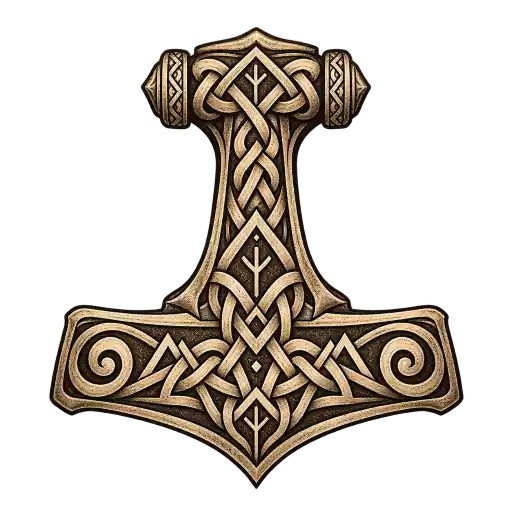
Scope: Norse traditions rather than a single scripture
Norse mythology names overlapping bodies of narratives remembered in medieval Iceland and elsewhere in Scandinavia about gods, supernatural beings, heroic ancestors and the shape of the cosmos. They were never a unified creed governed by one priesthood or revealed book. Language, locality and century matter: a farmer in Viking-Age Sweden and a poet in thirteenth-century Iceland did not necessarily understand every figure in the same way. This directory treats the myths as historically situated stories, not as one internally consistent fictional universe. The surviving record is rich but selective, and silence in a source cannot be equated with absence from earlier religious life.
Northern Europe before Christianization
The traditions arose among North Germanic-speaking populations over centuries of exchange around the Baltic and North Seas. The Viking Age, conventionally placed around the late eighth through eleventh centuries, is especially visible in written memory and material evidence, yet many narrative themes have earlier roots. Trade, migration, intermarriage and warfare connected Scandinavians to the British Isles, the Frankish world, the Baltic and farther east. Norse religion therefore developed in contact with other customs, not behind an impermeable cultural boundary. Archaeological horizons, runic inscriptions and later prose each illuminate different parts of this long history; none provides an unbroken transcript of prehistoric belief.
Old Norse poetry and its medieval witnesses
Eddic poems preserve dialogues, prophecies and confrontations, while skaldic poetry frequently conveys mythology through compact metaphors called kennings. Much verse may contain pre-Christian material, but assigning exact dates to individual poems remains contested. The principal manuscript of the Poetic Edda, Codex Regius GKS 2365 4to, was written around 1270; the date of a manuscript is not automatically the date of a composition. Völuspá, Hávamál, Vafþrúðnismál, Grímnismál and Þrymskviða present distinct voices, genres and assumptions. Modern editions combine surviving witnesses and make editorial choices that should be visible when interpreting an apparent contradiction.
Snorri Sturluson and the Prose Edda
Snorri Sturluson, an Icelandic politician and poet who lived from 1179 to 1241, composed an Edda in the early thirteenth century to explain traditional poetic language. Gylfaginning organizes mythological information as a dialogue; Skáldskaparmál accounts for poetic diction through stories and examples; Háttatal addresses verse forms, while the Prologue offers a medieval explanatory frame. Snorri preserves material unattested elsewhere, including details about the primordial cow Auðhumla, but his synthetic account is not a transparent recording of a pagan catechism. Comparison with older verses and variant manuscripts is essential, especially where his neat genealogies exceed the evidence of surviving poetry.
Places, households and religious diversity
Pre-Christian practices were carried by households, local assemblies, powerful families and regional communities. Sacred groves, cult buildings, burial grounds, springs and farms could become meaningful religious landscapes; the functions of particular sites must be established through evidence rather than assumed from a name. Some communities may have emphasized Thor, others Freyr, Odin or local powers. Historical sources describe ritual specialists and gatherings, but they cannot be flattened into a universal Scandinavian institutional model. A useful description of Norse mythology therefore preserves plural traditions and recognizes that surviving Icelandic literature disproportionately reflects elite storytellers and particular places.
Conversion and Christian manuscript culture
The conversion of Scandinavian kingdoms unfolded at different speeds through royal patronage, political alliances, preaching and local negotiation. Iceland's official adoption of Christianity around the year 1000 did not erase every inherited story overnight. Poets could remember divine names as tools of their craft, and manuscript writers could treat old narratives as history, entertainment, learned antiquity or dangerous error. This double perspective helps explain why mythological information survives in Christian manuscripts but cannot simply be equated with the lived religion of an earlier generation. Every text belongs simultaneously to the world it depicts and the medieval community that copied, reshaped or debated it.
Archaeology and the limits of identification
Thor's-hammer pendants, ornate animal imagery, burial assemblages, picture stones and ritual deposits offer evidence independent of full literary narratives. Yet an image of a figure with a spear is not necessarily Odin, and a boat burial does not prove belief in a single standardized afterlife. Iconographic readings become stronger when several clues converge: runic text, place, object form and parallels in independently transmitted stories. The Altuna runestone's fishing scene is often linked to Thor and Jörmungandr, while other monuments remain disputed. Material evidence can confirm that imagery and ritual acts mattered without reproducing the stories or motivations of participants word for word.
The Æsir and Vanir as narrative groups
Old Norse texts sometimes distinguish the Æsir, prominently associated with Odin's circle, from the Vanir, linked especially with Njörðr, Freyr and Freyja. Völuspá alludes to a war and settlement among gods, while Snorri's prose describes exchanges of hostages and a constructed reconciliation. The evidence does not prove that two discrete ethnic religions merged in a datable prehistoric event. Scholars debate whether the group names preserve cult differences, literary categories or other histories. The myths themselves also blur boundaries through marriages and shared residences, so the two groups should not be displayed as mutually exclusive cast lists with rigid membership rules.
Jötnar, gods and unstable boundaries
Jötnar are often translated as giants, but the word denotes a diverse category of beings rather than an anatomical species of uniformly enormous monsters. Several gods have jötunn relatives or spouses, and beings of this group can possess wisdom, wealth, artistry or threatening force. The conflict between Thor and particular adversaries should not be transformed into a simple moral war between a perfectly good divine race and an evil one. Shape shifting, kinship and competing loyalties frequently complicate the tales. Dwarfs, elves, dísir and other beings likewise enter the record unevenly, and modern fantasy taxonomies cannot supply definitions absent from the ancient sources.
Landscape, season and cultural memory
Seafaring routes, mountain farms, harsh winters, seasonal assemblies and networks of kinship shaped the environments in which these stories circulated. Myths connect divine figures to crops, dangerous weather, inheritance, poetic reputation and contested leadership, but correlations do not amount to a key that reduces every god to one natural phenomenon. Names embedded in toponyms can suggest forms of local commemoration or devotion, though their interpretation requires linguistic and historical caution. The literature also preserves ideas about honor, guest-right, generosity and the uncertain outcomes of conflict. These concerns belong to particular societies, not an abstract timeless Nordic personality.
Romanticism, nationalism and popular reinvention
Beginning in the early modern era and especially during nineteenth-century Romanticism, scholars, artists and national movements remade Old Norse myth as cultural heritage. These projects generated important editions alongside idealized and sometimes ideologically distorted visions of the pagan past. Twentieth- and twenty-first-century fiction, music, film and games further changed familiar images of Thor, Loki and Valhalla. Such adaptations can be studied as modern reception, not cited uncritically as pre-Christian evidence. Contemporary Heathen or Ásatrú movements are living religions with varied beliefs and practices; they are not direct, homogeneous copies of Viking-Age worship, and their modern diversity deserves separate treatment.
How to read this directory critically
Names are given in recognizable modern forms, with Old Norse spellings where useful; transliteration and editorial conventions vary. Genealogies and locations are qualified when poems disagree or Snorri offers a detail without early corroboration. Literary immortality must be distinguished from archaeological attestation, and a motif found in a medieval Icelandic text must not automatically be projected onto every earlier Scandinavian community. The sections below group figures, narratives and practices for navigation rather than claiming that ancient worshippers used precisely these categories. When possible, each discussion points readers toward a named poem, prose work, inscription or archaeological context instead of treating modern summaries as primary documents.
There are no published entities in this directory yet.
Odin: knowledge, sovereignty and peril
Óðinn is associated with poetic inspiration, warfare, rulership, magic and the acquisition of perilous knowledge, but those associations vary by text. Hávamál portrays a speaker who hangs on a wind-swept tree and takes up runes; Völuspá and Vafþrúðnismál place Odin amid secrets about cosmic origins and destruction. In Snorri's account he exchanges an eye for wisdom at Mímir's well, a vivid story not independently stated with the same detail in every poem. His ravens Huginn and Muninn and his spear Gungnir belong to a wider iconographic and narrative network. Odin is not simply a benevolent king: deception, sacrifice and conflict form part of his literary profile.
Thor: hammer, protection and confrontation
Þórr is a defender of gods and human settlements, famous for the hammer Mjöllnir and journeys into dangerous territories. His contests with jötnar move between strength, comedy and cosmic danger, as in Þrymskviða and the fishing episode preserved in Hymiskviða and Snorri's prose. His goats, chariot and travelling companions are described with different emphases across texts. Hammer-shaped amulets show that his symbol was materially meaningful in parts of Viking-Age Scandinavia; they do not by themselves disclose every ritual performed by their owners. Thor's hostility toward the world serpent becomes decisive at Ragnarök, even though neither antagonist can be reduced to a modern superhero archetype.
Freyja: desire, wealth, battle and seiðr
Freyja belongs to the Vanir traditions and is associated with desire, precious objects, magical knowledge and the selection of some of the slain. Grímnismál mentions Fólkvangr, while Snorri gives further details about her hall and attributes. Her necklace Brísingamen appears in medieval accounts and allusions that require careful separation, and the popular image of a single goddess with fixed universal functions simplifies a complex dossier. Freyja's identity should not be casually conflated with Frigg because both appear in some stories of love, loss or prophecy. Narratives about seiðr must likewise be compared with contemporary evidence rather than treated as an intact ritual instruction manual.
Frigg, Baldr and Höðr
Frigg is closely linked to Odin in literary genealogies and appears in the story of Baldr's death. Snorri describes her attempts to secure promises from the world so that nothing will injure her son; mistletoe becomes the exception exploited through Loki's intervention and Höðr's act. The shorter allusions of Völuspá and Baldrs draumar do not supply all the same narrative detail. Baldr's purity in modern retellings should not obscure the tragedy's preoccupation with fate, ignorance and the limits of divine power. Höðr, often represented as blind in Snorri's version, also has a distinct portrayal in Saxo Grammaticus, demonstrating the complexity of northern medieval traditions.
Týr, law and the binding of Fenrir
Týr is prominent in the story of Fenrir's binding because he alone places his hand in the wolf's mouth as a pledge. When the fetter holds, he loses that hand, making the scene a meditation on trust and costly promises rather than merely a battle illustration. Other texts connect Týr to courage and a particular divine identity, but calling him the original supreme god of all Norse people goes beyond secure evidence. Tacitus' earlier Germanic comparisons and related names are relevant to historical linguistics but do not permit simple one-to-one projections over centuries. In Ragnarök traditions Týr is associated with the hound Garmr; sources should be consulted for their precise phrasing.
Njörðr, Freyr and agricultural prosperity
Njörðr is connected with seafaring wealth and the coastal world in later accounts; Freyr appears in poems and prose as a figure of fertility, peace, lordship and prosperity. In Skírnismál, Freyr's desire for Gerðr leads his servant Skírnir to pursue a troubling negotiation filled with gifts and threats. That poem resists being paraphrased as an uncomplicated romance. Cult traditions around Freyr in Scandinavia have been inferred from place-names, saga reports and images, each with different evidentiary limits. The Vanir category helps organize these figures within some narratives, yet their actual worship may have differed greatly from one landscape and period to another.
Loki: kinship, transformation and responsibility
Loki changes shape, engineers bargains, mocks the gods and sometimes resolves the problems he has caused. He is father or parent of figures such as Fenrir, Jörmungandr and Hel in Snorri's genealogy, and his role in Baldr's death leads toward violent punishment. Lokasenna dramatizes his accusations against a divine gathering, yet the speech of a character in a literary flyting is not a neutral census of actual divine behavior. Loki should not be automatically classified as a historical object of a unified cult, nor identified with a Christian Satan; medieval writing can nonetheless frame his actions through ethical expectations meaningful to Christian readers. His ambiguity is central, not a defect to erase.
Heimdallr, Bragi, Iðunn and the divine household
Heimdallr guards the gods and blows the horn at the onset of the final catastrophe in familiar narratives; his enigmatic birth from nine mothers survives in poetic allusions. Bragi personifies or embodies poetry in some prose accounts, while Iðunn holds apples associated with the gods' continuing youth. The tale of her abduction by Þjazi, told in Skáldskaparmál, links vulnerability, exchange and restoration. Because the sources preserve some figures almost entirely through episodic reference, an encyclopedia should not assign elaborate universal domains where no historical testimony warrants them. The household of the gods is an evolving narrative setting, not a fully codified administrative bureaucracy.
Hel, Fenrir and Jörmungandr
Hel can name the realm of the dead and, in Snorri's narration, a being appointed to preside over it; the distinction between place and person must remain explicit. Fenrir's growth and confinement reflect the gods' fear of a threatening future, while Jörmungandr encircles the world in traditions about Thor and the last battle. These beings are relatives within a story, not proof of a single coherent demonic hierarchy. Hel is not equivalent to Christian hell, nor does every dead person go to Valhalla. The precise shape of these figures depends on poetic imagery, later narrative order and the interpretive decisions of modern editors.
The Norns, Valkyries and dísir
Urðr, Verðandi and Skuld are named beside the world tree in Völuspá, associated with shaping lives and decisions; later prose arranges norns in a more systematic framework. Valkyries choose among battle-dead in martial poetry, but their representations also intersect with heroic stories, hospitality and the afterlife. Dísir appear in varied contexts of female supernatural power and remembrance and should not be treated as an exact synonym for every valkyrie or norn. The surviving terminology is flexible, revealing a web of ideas about fate, death and kinship rather than an exhaustive taxonomy. Burial imagery and name lists provide evidence, but linking any individual object to a named being can remain uncertain.
Dwarfs, elves and craftsmen of the impossible
Dwarfs forge exceptional treasures in narratives about the gods, including items linked with Thor and Odin, and Völuspá preserves a long catalogue of their names. Their places of origin and cosmic roles shift between poetic and prose accounts. Elves appear as a category of beings, sometimes beside the Æsir in formulaic expressions, but the texts do not describe a single stable physiology or comprehensive realm system. Later folklore about hidden people and nineteenth-century fiction are valuable for reception history, not straightforward witnesses to Viking-Age belief. When a magical object is ascribed to craftsmen, attention belongs equally to the economics of gifts, obligation and compensation represented in the story.
Sigurðr, Brynhildr and heroic tradition
The Eddic corpus includes poems about Sigurðr's killing of Fáfnir, cursed treasure, the valkyrie Brynhildr and dynastic catastrophe. These are heroic legends with supernatural actors, not episodes that should be inserted unquestioningly into the same chronology as the creation of the world. Related stories survive in Völsunga saga and continental traditions, but their variants reflect distinct literary and political settings. Some figures also enter disputes about remembered history, legendary kings and the migration period. Their value for a mythology directory lies in the meeting of heroic ethics, fate, greed and divine intervention; their details should be attributed to particular sources instead of flattened into a single authorized version.
Ginnungagap and the beginnings
The opening of Völuspá evokes an early condition before earth, sea and an ordered sky. Snorri's Gylfaginning elaborates this into Ginnungagap, an opening between realms of cold and heat, from which conditions for life develop. Treating that prose as the only ancient account would obscure poetic differences, including passages where the earliest beings are named without systematic explanation. Creation in these stories is more often transformation and ordering of existing primordial reality than a simple act of manufacture from absolute nothing. Modern diagrams showing every stage and realm on one map are editorial devices; the medieval texts do not deliver a uniform geographical blueprint.
Ymir and the shaping of the world
Vafþrúðnismál and Grímnismál associate the world's substance with the body of the primordial Ymir: flesh, blood, bones and skull become the ordered environment. In Snorri's account Odin and his brothers destroy Ymir and fashion the inhabited world; the details can be fuller and differently arranged than in the poems. The story is not simply a battle between mankind and a monster, for the gods themselves arise within a complicated primordial genealogy. The conversion of bodily substance into landscape is also a poetic way of conceiving correspondences between life and cosmos. Comparisons with other Indo-European narratives may be stimulating but do not establish historical borrowing without independent evidence.
Askr, Embla and human origins
Völuspá describes gods encountering Askr and Embla, beings lacking the powers that will make them human; divine gifts confer breath, understanding and other capacities. Snorri provides a related but not identical arrangement and assigns creative acts to a named triad. Differences in the divine names and gifts should remain visible rather than be harmonized into one supposedly original account. The material invites reflection on personhood, speech and dependence upon divine generosity without supplying a universal anthropology practiced by all Scandinavians. Interpretations of the two names, including associations with trees, are linguistic and comparative questions whose certainty should be distinguished from the direct wording of surviving verse.
Yggdrasill, wells and cosmic location
Yggdrasill is presented as an immense tree connected with divine assemblies, wells, diverse beings and the fate of the world. Grímnismál offers vivid details of its roots and creatures, while Völuspá places prophetic knowledge beside its setting. Snorri systematizes material from several strands into a more continuous account. The celebrated diagram of nine worlds arranged in neat vertical tiers is not preserved as a single ancient illustration or universal map. Specific locations such as Ásgarðr, Miðgarðr, Jötunheimar and Niflheimr are mentioned in various contexts, with forms and relationships that must be established poem by poem. The tree symbolizes relationship and vulnerability rather than a perfectly standardized atlas.
The first divine conflict and the exchange of hostages
Völuspá evokes violent conflict among gods, including an episode involving Gullveig and the first war. Later prose associates Æsir and Vanir with a settlement and exchange of prominent persons, though the identity of all participants and the chronology are not supplied consistently by every source. One influential scholarly theory once explained the episode as memory of a merger between separate religious populations; such reconstruction remains speculative. The tale is better approached as a collection of narratives about conflict, negotiation, social order and overlapping divine networks. Its ambiguities have historical value: they resist imposing the habits of later family trees upon poetry built from partial allusions.
The theft of Mjöllnir and comic inversion
In Þrymskviða a giant demands Freyja as bride in exchange for Thor's stolen hammer. Thor goes disguised as the proposed bride with Loki assisting, and the deception culminates when Mjöllnir returns to his hands. The poem plays with clothing, appetite, gender expectations and social performance; treating it as a straightforward description of a ritual wedding would overlook its comic form. The story also shows the vulnerability of the gods when an essential weapon is lost and recovered through cunning rather than brute force alone. Its textual status as a surviving medieval poem matters as much as the scene's immense popularity in modern art and adaptation.
Thor and the Midgard serpent
Hymiskviða and later prose recount Thor's fishing expedition, during which he hooks the enormous serpent Jörmungandr. Accounts differ about companions, the cutting of the line and how the encounter ends; these variants matter when explaining whether the creature survives for the last battle. The episode appears to have inspired visual representation, notably interpretations of the Altuna runestone. The story juxtaposes fishing and cosmic confrontation, a striking example of heroic action growing from an ordinary activity into a struggle at the world's boundary. It is more accurate to cite the poem or prose version being described than to merge every detail into a single cinematic sequence.
The death of Baldr and the failure of protection
Baldr's death is preserved in allusions and extended medieval narrations. In Snorri's version most things promise not to harm him, yet the overlooked mistletoe permits Loki to guide the action of Höðr. The story explores an apparent paradox: the gods know danger exists, but acts of prevention contribute to the tragedy that foretells larger collapse. Saxo's account of Balderus belongs to a markedly different literary world and should not be silently treated as the same historical version. The punishment of Loki and the quest for Baldr's return from Hel vary in emphasis and belong within the broader uncertainty surrounding the chronology of the gods' end.
Fate, prophecy and the possible futures
Fate appears through norns, prophetic knowledge, dreams and statements about events that cannot readily be avoided. Yet the texts do not articulate a single philosophical doctrine of predestination. Hávamál emphasizes practical judgement and the uncertain lives of mortals, whereas Völuspá speaks in a prophetic register and heroic poems dramatize obligations that lead toward catastrophe. A god's possession of knowledge need not imply an ability to change every outcome. Modern language of rigid inevitability should be balanced against the sources' interest in action, responsibility, memory and competing choices. The relationship between inherited circumstance and individual decision remains literary and historically variable.
Valhöll, Fólkvangr and other destinations
Valhöll, often anglicized Valhalla, is an Odinic hall associated with some battle-dead; Grímnismál also connects Freyja with Fólkvangr. These passages do not establish that every honorable person, every warrior or every Scandinavian believed in an identical afterlife. Hel can designate the realm of many dead without carrying the Christian moral meaning of eternal fiery punishment. Burial practices, memorial poetry and legendary journeys offer additional, not always reconcilable evidence. The famous image of warriors training daily for Ragnarök is especially dependent on particular textual scenes. Funeral archaeologists caution against translating the presence of weapons or ships into a complete map of an individual's beliefs.
Ragnarök: catastrophe, combat and renewal
Völuspá depicts a cascading catastrophe of broken bonds, monsters, fire and the deaths of gods, followed by signs of a world restored. Snorri provides a more continuous account of the confrontations, including Thor and the serpent, Odin and Fenrir, and other divine combatants. The traditions disagree or remain silent on various details; even the extent of Christian influence on some images of renewal is debated. Ragnarök does not simply mean a modern apocalypse with a single fixed timetable. Its prophetic poetry asks what remains of creation and social order after violence, and how remembrance and rebirth might be imagined from the perspective of a medieval text that remembers an older world.
Wisdom contests, runes and the limits of magic
In Vafþrúðnismál Odin questions a knowledgeable jötunn until an intimate secret reveals the questioner's identity. Alvíssmál likewise structures a dramatic encounter through catalogues of names, showing language as knowledge and strategy. Hávamál connects runes with suffering, insight and several forms of verbal power, but it is not an independently verified record of all historical magical practice. Runic alphabets were writing systems used in many ordinary and commemorative contexts, not inherently supernatural symbols in every inscription. Distinguishing literary rune lore from archaeological literacy prevents a common reversal in which a modern occult interpretation is projected onto every Viking-Age carved sign.
Blót: offerings and shared ritual meals
The Old Norse word blót is used for sacrificial and offering practices, but no surviving text records a universally prescribed sequence for all times and places. Feasting, animal sacrifice, hospitality and communal obligation may appear together in particular reports. A narrative in a saga written after conversion is evidence of what its author portrayed, not an untouched field report from the Viking Age. Archaeological deposits of animal bones and objects can strengthen an interpretation when context, dating and comparison permit. Reconstructed modern rites should be identified as contemporary practice; they need not reproduce any one medieval description, and supposed blood rituals should never be invented from a vague mythological analogy.
Cult sites, halls, groves and water
Evidence for religious gatherings is found at farm complexes, prominent halls, deposits in wetlands and certain buildings whose interpretation remains disputed. Some sources describe hofs or temples, while linguistic evidence suggests sacred groves and other special places. The famous temple at Uppsala appears in Adam of Bremen's eleventh-century description, a text written from an outsider's viewpoint with its own agenda. Excavations around elite centers can contribute evidence about feasting and ceremony but cannot automatically confirm every dramatic detail in the written account. The diversity of possible settings cautions against depicting every Scandinavian ritual as occurring inside the same wooden hall with an identical altar.
Thor-hammer pendants and burial objects
Hammer pendants made from metal and other materials are among the best-known objects associated with Norse deities. Their contexts include graves and settlements, and some hammer-like objects were threaded onto larger rings in the Mälaren region. The Swedish History Museum notes that the exact use of these rings is uncertain despite their clear religious associations. A pendant may signal attachment, protection, identity or several meanings, but archaeology does not allow an identical interpretation for every wearer. Such objects belong alongside picture stones and runestones as evidence for religious imagery, not as detachable illustrations proving each episode of the Eddas literally occurred.
Seiðr and contested accounts of ritual specialists
Seiðr is associated with prophecy, influence and ritual expertise in several Old Norse texts. Saga episodes describe völur, staffs, special clothing, chanting and performances, yet the precise relationship between literary scenes and pre-Christian institutions is debated. Some grave finds with staffs have been interpreted in this context, although object identification and the gender of a burial do not by themselves settle the ritual role of the deceased. Sources also carry moral judgments about masculinity and magic that must be read within their social and literary setting. A responsible overview avoids presenting modern step-by-step seiðr practice as something directly and completely preserved from Viking-Age Scandinavia.
Seasonal rites, assemblies and public obligations
Accounts link sacrificial gatherings with seasonal transitions, political alliances, prosperity and the maintenance of social relationships. A feast could be religious and political at once, especially when hosted by someone seeking legitimacy and followers. Later calendar traditions, however, cannot be mapped mechanically onto a uniform pre-Christian festival year. Names such as jól have complex histories, and modern eight-festival diagrams often combine practices from distinct periods and regions. Discussion of ritual time must therefore emphasize the difference between a word attested in a source, a reconstruction from language or archaeology, and a celebration organized by a contemporary religious community.
Burial customs and the diversity of death
Cremation and inhumation occur in different periods and locations, alongside considerable differences in grave goods, monuments and memorial forms. Some elite graves include ships or boats, weapons, animals and striking assemblages, but these objects do not license a single story about the soul's exact destination. Literary references to halls of the slain, Hel and ancestral remembrance illuminate possibilities rather than an official funerary doctrine. Ship burials in particular have generated extensive modern speculation, so excavation reports, chronology and the social status of those buried matter more than romanticized Viking imagery. The dead were also present through names, inheritance, landscape and familial commemoration.
Poetic Edda: major poems and manuscripts
The Poetic Edda is a modern title for a collection of Old Norse poems, not a book composed by a single known pagan author. The manuscript GKS 2365 4to, conventionally called Codex Regius, dates to approximately 1270 and preserves a crucial sequence of mythological and heroic poems. Other witnesses and poems outside that codex complicate any assumption of a fixed canon. Key texts include Völuspá for cosmology and catastrophe, Hávamál for wisdom traditions, Grímnismál for places and divine descriptions, and Vafþrúðnismál for mythic knowledge. Individual translations differ in stanza numbering and editorial choices, so citations should identify the poem and, where possible, the edition being used.
Prose Edda: mythology as poetics
The Prose Edda attributed to Snorri Sturluson was composed in thirteenth-century Christian Iceland and preserves a guide to traditional verse-making. Its sections include Gylfaginning, Skáldskaparmál and Háttatal, with a Prologue framing the subject. Because mythological knowledge helps explain metaphors in skaldic poetry, Snorri reports stories that would otherwise be difficult to reconstruct. His project nevertheless organizes older material for a particular scholarly purpose and readership. Comparing him with the Poetic Edda is more fruitful than asking which of the two books contains the sole true Norse mythology. Editions of Snorri's text also differ according to their surviving manuscript basis.
Sagas, Saxo and outside observers
Kings' sagas, family sagas and legendary sagas preserve valuable accounts of remembered cult, landscape and supernatural storytelling, but were generally composed well after conversion. Heimskringla, Eyrbyggja saga, Völsunga saga and other works serve different literary purposes; they should not be cited interchangeably. Saxo Grammaticus' Gesta Danorum recasts northern gods and heroes through Latin historiography, often presenting strikingly different versions. Adam of Bremen, Ibn Fadlan and other outside observers supply additional reports of northern peoples, with their own distances, hearsay and cultural assumptions. A comparison of such witnesses is historically stronger than selecting whichever version best fits a modern narrative.
Runic and visual testimony
Runestones commemorate people and relationships, sometimes using divine names, symbols or imagery that can be connected with myth. The Altuna stone is especially discussed in relation to Thor's fishing story; picture stones from Gotland also contain scenes interpreted against heroic and mythological poetry. Not all interpretations are accepted, and the presence of a cross or hammer may reflect cultural negotiation during conversion rather than simple religious exclusivity. Researchers combine epigraphy, archaeology, visual comparison and landscape context to assess meaning. Runes are not intrinsically secret magical marks: many inscriptions are memorial, proprietary or practical, and the material record provides essential evidence beyond later story collections.
Reading editions, translations and scholarship
Primary references: Völuspá, Hávamál, Grímnismál, Vafþrúðnismál, Þrymskviða, Hymiskviða, Lokasenna and Skírnismál in the Poetic Edda; Snorri Sturluson's Gylfaginning and Skáldskaparmál; selected passages from Gesta Danorum and the Icelandic sagas. For critical study consult Margaret Clunies Ross, Prolonged Echoes: Old Norse Myths in Medieval Northern Society (1994–1998); John Lindow, Norse Mythology (2001); Neil Price, The Viking Way, second edition (2019); and The Cambridge History of Old Norse-Icelandic Literature (2024). The Swedish History Museum's resources on sources, cult and hammer rings provide accessible archaeological context. Every reconstruction should distinguish ancient witness, medieval compilation, modern translation and scholarly hypothesis.
Modern religious practice and ethical presentation
Contemporary practitioners of Heathenry, Ásatrú and related movements draw upon medieval texts, archaeology, lived experience and local communal choices in different proportions. Their ceremonies are not a single historical survival unchanged since the Viking Age, but they are real modern religious expressions deserving accurate description. Popular media adaptations and extremist appropriations can also invoke Norse symbols; neither phenomenon defines the ancient evidence or all modern worshippers. An editorially responsible presentation avoids instructing readers to perform supposedly authentic blood rites and does not turn diverse figures into a false hierarchy of demons and angels. Source transparency, historical context and respect for living communities take priority over sensationalism.