
Who is Sandalphon?
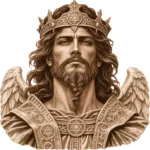
Sandalphon, also spelled Sandalfon, is a towering angel associated with the vision of the divine throne in strands of Jewish rabbinic literature and later mystical interpretation. His oldest widely cited description is not a continuous biography but a striking passage in the Babylonian Talmud, Ḥagigah 13b. There he stands behind the heavenly chariot and binds crowns for his Creator. The picture belongs to a symbolic discourse about the heavenly court, the limits of human perception and the radical transcendence of God. Sandalphon is not presented as a second deity, a rival creator or a figure worshipped independently. His literary identity changes as commentators, liturgists and kabbalists place him in distinct celestial systems.
The earliest explicit witness
In Ḥagigah 13b, a discussion beginning from Ezekiel 1:15 identifies a remarkable wheel or ofan with an angel whose feet touch the earth and whose head reaches the living creatures. A transmitted teaching names him Sandalphon and describes his height in the measure of a five-hundred-year journey. The passage then places him behind the chariot, forming crowns for his Maker. These details should not be moved back into the Book of Ezekiel as though the prophet had written Sandalphon's name. Ezekiel supplies the visionary imagery; the rabbinic interpretation supplies the name and distinctive portrait. This distinction allows readers to see how scripture inspired later angelological elaboration.
An uncertain name
The derivation of Sandalphon's name is not securely established. The early Jewish Encyclopedia discussed a possible Greek origin related to a word for a fellow brother, while rejecting other confident derivations current in its period. Such philological proposals are not proof that the angel was originally conceived as Metatron's literal sibling. Names can be reinterpreted by communities long after their first use; a suggestive etymology does not establish a heavenly family tree. English texts employ Sandalphon, Sandalfon and variant transliterations because they reflect different conventions for rendering Hebrew forms. For historical work the reliable approach is to identify the precise manuscript or printed witness rather than insist on an unattested original spelling.
An angel, not a biblical protagonist
The canonical Hebrew Bible contains visionary descriptions of divine messengers, cherubim, living creatures and throne imagery, but it does not offer a self-contained account of an angel called Sandalphon. The familiar scenes in which he collects prayers, governs a cosmic realm or is equated with Elijah belong to subsequent literature and are not interchangeable with the biblical text. This does not make such traditions insignificant: medieval mysticism and liturgy are important historical witnesses in their own right. It means that each claim needs a date, genre and textual context. A description from a seventeenth-century kabbalistic book should not be attributed casually to an ancient prophet or presented as universal Jewish doctrine.
The relation to the Merkabah
Merkabah means chariot, a name applied to traditions of contemplating the divine throne, especially the vision in Ezekiel 1. The chariot vocabulary refers to a sacred vision rather than to a physical vehicle that could be mapped by ordinary measurements. Sandalphon's colossal proportions and place behind the chariot are meaningful within this imaginative world. They evoke cosmic scale, hierarchical difference and access restricted to the divine court. The distinction between seeing an angel and seeing God also matters: the Talmud immediately raises an objection to the idea that anyone knows God's location. Sandalphon's role is resolved without making divine presence a bodily object in ordinary space.
A developing rather than fixed character
Later Jewish mystical materials expand Sandalphon's significance through ritual poetry, angelic chains, worlds of emanation and comparisons with Metatron. Some works emphasize praise and prayer; others cosmic administration or the exceptional rank of the angel. A single encyclopedia entry cannot flatten those layers into an ancient official biography. Readers should instead follow a sequence of attestations: the talmudic angel behind the chariot, the agent of crowns and prayers in liturgical interpretation, and the counterpart of Metatron or Elijah in selected kabbalistic systems. This historical sequence is the central biography of a literary and religious figure whose identity is constituted by transmission.

A place behind the heavenly chariot
The most specific early positional claim is that Sandalphon stands behind the divine chariot in Ḥagigah 13b. This location makes him close to the throne vision yet does not imply an administrative office identical with later angelic taxonomies. Nor should behind be converted into a modern ranking of inferior or superior archangels. In the passage, placement and function are what matter: an extraordinary messenger performs an act of praise in the vicinity of the mysteries of the divine court. Attempts to insert him neatly into a numbered hierarchy of seven archangels should be labeled later harmonization unless the relevant source explicitly names him in that list.
The ofan association
The rabbinic discussion starts with the wheel near Ezekiel's living creatures and proceeds to describe an angel reaching from earth to those beings. This has encouraged descriptions of Sandalphon as an ofan or angelic wheel. The passage should be read closely: a symbolic identification in an exegetical argument is not necessarily a complete species classification. In later presentations, ophanim are often one order in broader lists of heavenly beings, while other schemes sort angels differently. Sandalphon's identity cannot be inferred from modern charts without studying the text behind each chart. His wheel-related profile remains an especially distinctive feature of the early testimony.
Five hundred years of height
The Talmud measures the difference in Sandalphon's height by the distance of a journey lasting five hundred years. This is not a conversion into meters, kilometers or astronomical units. The immense measure belongs to a rhetoric of cosmic magnitude familiar from late-antique discussions of the heavens. The phrasing emphasizes the angel's overwhelming size compared with other inhabitants of the celestial realm. It does not establish his numerical superiority to God or convert him into a physical giant roaming the historical landscape. Depictions that add a precise planetary radius, wingspan or weight are imaginative embellishments, not facts stated in the talmudic passage.
Archangel labels and their limits
Modern popular references frequently call Sandalphon an archangel. That label is understandable as a broad description of his exalted status, but ancient and medieval lists of archangels vary considerably. The Jewish Encyclopedia explicitly noted that he does not occur in its earliest enumerations of four or seven archangels. An editorially careful profile therefore identifies him first as an angel of throne mysticism and a later kabbalistic power, adding archangel only as a descriptive convention employed in certain modern or later traditions. This prevents a misleading claim that all Jewish communities historically recognized the same celestial cabinet with Sandalphon as a permanent member.
Formation and Action in later Kabbalah
In particular Lurianic kabbalistic arrangements, Metatron presides over the world of Formation, Yetzirah, while Sandalphon is associated with the world of Action, Asiyah. These are technical assignments inside a system of four worlds, not descriptions given by Ezekiel or the Talmud. Their significance comes from a model in which spiritual operations can be differentiated according to emanation, creation, formation and action. Sandalphon's place should be reported with the qualified phrase in some kabbalistic systems, because other authorities and manuscripts describe heavenly offices differently. A later system can illuminate religious creativity without rewriting an earlier source.
Authority always delegated
Whatever dignity Sandalphon receives in a given source, it remains subordinate to the Creator in the Jewish narratives considered here. The angel performs an office, carries praise or helps to convey a crown; he does not originate divine sovereignty. This is crucial in accounts that seem paradoxical to modern readers. When a being so tall that earthly measures fail is still unable to know the divine place, the scale of the figure reinforces transcendence rather than competition. Assigning Sandalphon a cosmic role is not evidence for polytheistic worship. His exaltation has meaning precisely because he serves an authority beyond the entire chariot vision.
The maker of crowns
The defining action in Ḥagigah 13b is the binding or weaving of crowns for God. The Hebrew imagery evokes royal praise and ceremonial honor, but the Talmud itself tests its literal sense. If no creature knows the place of the divine glory, how could a crown be physically placed upon God's head? The answer turns toward a divine name and a crown that goes to its destination without requiring the angel to enter God's inaccessible place. The story therefore resists a simple anatomical reading. Sandalphon's achievement is not manufacturing a magical object with independent power but participating in the heavenly language of praise while respecting God's mystery.
The ascent of human prayers
In subsequent liturgical and mystical interpretations, the crowns may be understood as formed from the prayers of Israel. Sandalphon becomes an evocative figure linking the worship of human communities with praise in the heavenly realm. This picture should be distinguished from the precise wording of the talmudic base passage: Ḥagigah 13b names crowns but does not supply every detail later writers give about collecting prayers from congregations. The symbolism does not mean that Jewish prayer requires Sandalphon as an obligatory addressee. In standard worship, the prayer is directed to God; the angel functions within a particular interpretive or poetic depiction of the heavenly service.
Praise rather than independent intercession
Descriptions of Sandalphon as a mediator need careful definition. The word can refer loosely to his literary role carrying or arranging expressions of devotion, but it should not imply that he replaces the direct relationship between worshipper and God. Jewish theologians have held diverse views concerning the language of angels in prayers, and many vigorously reject praying to an angel as an independent source of help. Sandalphon's crowns are best understood within the genre that presents them. In a discussion of chariot mysteries they display heavenly liturgy; in later contemplative writing they may express the transformation of earthly action into divine praise. Neither genre provides a universal command to invoke him.
The sacred name and the crown
The talmudic debate uses the divine name to resolve its own dilemma concerning the crown. Sandalphon does not simply walk into a room containing a physically localized deity. By uttering a name over the crown, he allows it to attain its proper place. The scene is notable because it guards the unsearchability of divine presence at the very moment it imagines an angel close to God's court. Subsequent occult manuals sometimes extract the episode as a recipe for angelic power or an instruction in secret speech. Such uses are historical reinterpretations and should never be confused with a practical procedure prescribed by the Talmud for ordinary readers.
Cosmic scale and moral scale
A reader may be tempted to treat Sandalphon as a character in a competition of supernatural strength: if he towers over other angels, perhaps he is a stronger fighter than the named archangels. But the source is not a battle chronicle. It conveys a scale of sacred architecture and a devotional office rather than feats of combat. The greatest feature attributed to him is an act of praise, not a defeated dragon or a conquered army. This contrast is valuable for distinguishing Jewish angelological literature from contemporary fantasy adaptations. Supernatural dimensions do not translate automatically into martial powers, and later symbolic associations with light or vibration require separate documentation.
Boundaries of the angelic office
The texts give Sandalphon neither an unrestricted power to grant wishes nor a responsibility for every human destiny. Statements that he automatically controls fertility, music, planetary currents or the fulfillment of particular prayers generally come from recent esoteric systems. Some such associations can be documented as modern reception; they should be introduced with their own dates and sources rather than projected onto Ḥagigah. In a disciplined profile, the strongest early claims remain his extraordinary size, presence behind the chariot and association with crowns. Later claims about prayer, worlds and identification with Elijah have their own literary histories and different levels of attestation.
A gigantic angel spanning worlds
Sandalphon's most memorable appearance is vertical: he stands upon earth, while his head reaches the living beings of the chariot vision. This arrangement is a statement of extraordinary height, not a full description of his face, costume or bodily anatomy. The five-hundred-year measure reinforces the vision's inhuman scale. Artists sometimes depict him with impossibly long robes or a body joining earth and sky; these are intelligible visual interpretations but not details securely preserved in the talmudic text. A historically cautious illustration might emphasize height, the chariot's living creatures and the making of a crown, without claiming to reconstruct a fixed original icon.
Crowns as a liturgical emblem
The crown is Sandalphon's clearest and best-supported attribute because the Talmud names his work explicitly. Yet its meaning is bound to heavenly praise rather than ordinary regal succession. In some later interpretations, crowns are woven from prayer; in others they emphasize the majesty of the divine service. A painted or engraved crown can therefore identify Sandalphon more responsibly than a randomly assigned sword, trumpet or planetary seal. Even here, however, the historical image is literary. The crown is not a surviving ritual artifact, and the ancient passage provides neither its material nor a specific color, shape or number of jewels.
The wheel and the living creatures
The association with the ofan originates in the reading of Ezekiel's wheel in Ḥagigah. The surrounding scriptural setting contains living creatures, motion and the strange visual mechanics of the prophetic chariot. A picture placing Sandalphon near a wheel or an ensemble of celestial beings is therefore grounded in the scene's context. A picture transforming him into a precise modern mechanical wheel with named rotating rings and a standardized number of eyes, by contrast, adds information from later iconographic systems or contemporary fantasy. Careful visual interpretation identifies what belongs to Ezekiel, what comes from the Talmud and what an artist has supplied.
Fire, brilliance and the chariot
Accounts related to the chariot often employ brilliance, fire, flame and overwhelming light to signal the dangers of approaching the divine court. Later traditions concerning Moses and the fire of Sandalphon belong to this environment of visionary awe. Such imagery provides an intelligible setting for the angel but does not prove a unique bodily color, an eternal halo of a particular hue or a fixed weapon of fire. The best visualization distinguishes a narrative environment from anatomical traits. In a scholarly catalogue, fire is a recurring visionary motif and an attribute of some episodes, not an established natural element from which Sandalphon is physically made.
Wings, robes and later artistic liberty
Modern religious and fantasy illustrations may give Sandalphon multiple wings, ceremonial armor, long hair or a luminous human face. Such choices often borrow the generic vocabulary of angels familiar from European painting. They should not be described as an ancient canonical portrait unless a source actually specifies the feature. The talmudic account gives height, placement and crowns far more clearly than clothing. Likewise, a youthful face based on the later Elijah identification reflects an interpretive choice, not a preserved portrait of the historical prophet. This distinction matters when preparing icons for a documentary site that wants each entity's recognizable symbolism without creating false historical certainty.
Ezekiel 1 as the interpretive foundation
Ezekiel's inaugural vision supplies the background for Sandalphon's most famous account. The prophet describes living creatures and wheels associated with the manifestation of divine glory. Ezekiel does not name Sandalphon. That name appears when a later rabbinic discussion interprets the wheel. This distinction between a base scripture and an exegetical expansion is the first rule for identifying reliable references. Readers comparing Ezekiel 1:15–21 and Ḥagigah 13b can trace the movement from prophetic vision to angelic identification without assuming that every later detail was already contained in the biblical account.
Babylonian Talmud, Ḥagigah 13b
This talmudic passage is the central primary source for Sandalphon's height and crowns. It names him in a transmitted teaching, compares his size to a journey of five hundred years and places him behind the divine chariot. The discussion immediately objects that God's place is unknown, and resolves the paradox through a divine name pronounced over the crown. The passage appears in a larger conversation about the chariot, the living creatures and the dangers of contemplating heavenly mysteries. Any summary that quotes only the spectacular size while omitting the debate about divine transcendence distorts the narrative emphasis. This is the first source to cite when explaining Sandalphon historically.
Pesiqta Rabbati and the Moses tradition
A later homiletic tradition associated with Pesiqta Rabbati describes Moses' passage through the heavenly realm, in which the angel Hadarniel stops in fear before Sandalphon's fire. The episode was summarized in the Jewish Encyclopedia with a reference to Pesiqta Rabbati 20. This is distinct from the Exodus narrative of Moses receiving the Torah: it expands the scene using visionary angelic figures. Its genre is midrashic or homiletic, and its exact literary history deserves caution when comparing editions. Sandalphon here represents the alarming boundary of heavenly access, not an adversary conducting a rebellion against Moses or the biblical God.
Hekhalot literature and changing contexts
The Hekhalot corpus comprises diverse works concerned with heavenly palaces, divine throne visions, angelic names and visionary ascent. It is not a single ancient book by one author or a uniformly dated collection. Sandalphon appears in this broad mystical environment, but individual claims require specific references because manuscripts and recensions differ. A title such as Sefer Hekhalot should not be invoked as proof for every modern description of the angel. Scholarship on early Jewish mysticism is especially concerned with how rabbinic traditions were expanded, transmitted and reinterpreted. The result is a layered angelological profile rather than a fixed roster drawn from one authoritative manual.
Kabbalistic books and their dates
Medieval and early modern kabbalistic writers increasingly related Sandalphon to other high angels and to the ordering of spiritual worlds. Examples discussed in scholarship include Moses Cordovero's Pardes Rimmonim, Menahem Azariah da Fano's Kanfei Yonah, Nathan Shapira's Megaleh Amuqot and Naftali Bacharach's Emeq ha-Melekh. These are not interchangeable with the Talmud: they reflect centuries of additional theological vocabulary and interpretive debate. Certain texts identify Sandalphon with Elijah, while others maintain him as a distinct counterpart to Metatron. The correct editorial method is to cite each identification with its own work and context, rather than present the latest synthesis as an original biblical statement.
What the texts do not say
Genesis does not name Sandalphon; neither does the Elijah cycle in 1 and 2 Kings explicitly identify the prophet as this angel. Likewise the New Testament's references to angels do not establish his distinct identity, and the Quran has no corresponding named Sandalphon in its text. Religious comparison can explore motifs shared across Jewish, Christian and Islamic angelologies, but similarities in function do not justify assigning this particular figure to all three religions. The explicit documentary chain under discussion is Jewish and predominantly rabbinic, mystical and kabbalistic. Modern claims that he commanded the music of heaven at creation or governed every prayer need proof beyond the name's later popularity.
Rabbinic angelology
Rabbinic Jewish literature develops an extensive language for heavenly beings while maintaining a distinction between their functions and the unique authority of God. Sandalphon belongs to that interpretive horizon through the discussion of the throne chariot in Ḥagigah. His portrayal is not a creed binding on every Jewish community, and references to his name are not central to ordinary halakhic practice. Instead, the passage belongs to reflections on revelation, the cosmos and the limits of speculation about the divine. A responsible historical profile can describe the angel as an important rabbinic figure without implying that Judaism revolves around him or that every believer accepts identical classifications of the heavenly orders.
Merkabah and the throne vision
Merkabah traditions attach religious meaning to the chariot vision of Ezekiel and to accounts of ascent toward the divine court. Sandalphon's height, throne proximity and crown-making activity fit naturally into this imaginative setting, where access to heavenly knowledge is not casually available. Mystical texts emphasize awe, ritual boundaries and difficulties of describing what exceeds human experience. The most responsible way to read such stories is neither as a modern astronomical map nor as a set of easily reproducible supernatural technologies. Their powerful imagery belongs to specific ancient and medieval Jewish discussions, later reinterpreted by generations of teachers and authors.
Jewish liturgical poetry
Poetry and devotional interpretation elaborate the image of Sandalphon binding crowns from prayers. In this register, human voices do not disappear after worship: their praise is transformed into a ceremonial offering in the heavenly realm. Such literary imagination is significant for studying how communities thought about the relationship between the visible synagogue and an invisible celestial service. It is not necessary to assume that every prayer text explicitly mentions Sandalphon or that every community performed a ritual addressed to him. Liturgical transmission is varied, and specific poems or prayer books need their own bibliographic evidence. The symbol of a crown remains central because it communicates recognition, honor and divine kingship.
Medieval and early modern Kabbalah
Kabbalistic writers constructed elaborate relationships between angels, divine attributes and multiple worlds. Sandalphon appears alongside Metatron in some of these arrangements, and a later strand connects him with Elijah. There is no reason to treat the various diagrams as successive editions of one official chart. They are intellectual and devotional proposals shaped by different schools, books and lineages. The familiar association of Metatron with Yetzirah and Sandalphon with Asiyah belongs to this later conceptual world. Explaining the names of the worlds is useful; claiming that Ezekiel already taught those exact assignments would be anachronistic. This period illustrates how an older angel could acquire systematic meaning through later theological creativity.
The Elijah identification
One remarkable kabbalistic development identifies Sandalphon with the prophet Elijah after his assumption into heaven. Because Elijah is also described as taken heavenward in 2 Kings 2, later interpreters could connect his extraordinary departure with Sandalphon's heavenly station. A modern academic study traces versions of this association through medieval and early modern Ashkenazi and Safed-related kabbalah, mentioning Cordovero, Bacharach and other writers. But the basic biblical narrative does not state that Elijah changed his name to Sandalphon. Nor does Ḥagigah 13b require this identification. It is better described as a particular later mystical interpretation than as an undisputed historical fact.
Modern occult and New Age reception
Recent spiritual literature may associate Sandalphon with musical vibration, earthly grounding, colored rays, crystals, chakras and the manifestation of wishes. These themes can be studied as the angel's modern cultural reception, but they should be labeled as such. They are not simply hidden verses of the Talmud and do not show that ancient Jews used Sandalphon in precisely those practices. Contemporary writers frequently combine angelic names drawn from different religions with modern therapeutic or esoteric systems. For GRIMORIUM, the relevant distinction is not whether someone finds such imagery meaningful, but whether a historical assertion has documentary support in the cited period. Sandalphon's ancient crowns remain distinct from present-day spiritual marketing.
Metatron: a later mystical counterpart
Metatron is Sandalphon's most consequential named angelic counterpart in kabbalistic interpretation. They can be depicted as paired high ministers of the heavenly order, especially when particular systems assign Metatron to Formation and Sandalphon to Action. This is a relationship between textual roles, not a biological siblinghood established by the Talmud. Metatron's Enochic identification in 3 Enoch and Sandalphon's later identification with Elijah have separate histories. A link to Metatron is therefore useful for readers who want to compare Jewish traditions of heavenly elevation, office and transformation, provided the two are not collapsed into one angel or assigned a universal rank without a specific source.
Elijah: identification in later Kabbalah
Elijah is linked to Sandalphon in some medieval and early modern mystical traditions. The link draws on Elijah's ascent in 2 Kings 2, but the biblical narrative itself does not give him the name Sandalphon. Scholars have traced forms of this identification through particular kabbalistic authors and schools, making it an important but historically situated relationship. In a structured entity directory, an Elijah entry could carry a precise label: identified with Sandalphon in certain later kabbalistic interpretations. That is more accurate than either proclaiming the two are universally identical or omitting the tradition altogether. Their relationship should never force the religious classification of Sandalphon onto every depiction of the biblical prophet.
Moses and the terrifying celestial boundary
In a midrashic episode associated with Pesiqta Rabbati, Moses advances through the heavenly domain and encounters the dreadful fire associated with Sandalphon. This is a narrative encounter rather than a familial bond or an enduring alliance. It illustrates the limits that visionary literature places on even the greatest human prophet. Moses need not be described as Sandalphon's student or enemy; the scene is better summarized as an encounter with the overwhelming presence and radiance of the celestial court. If a profile of Moses exists, the relationship can be described with an exact reference to the midrash and without importing the scene into the Torah's original narrative.
Hadarniel: companion in a midrashic scene
Hadarniel appears in a later narrative of Moses' heavenly ascent and stops upon approaching Sandalphon's fire. The relationship consists of proximity in a story and an expression of awe; it does not establish that Hadarniel was permanently subordinate to Sandalphon in every angelic system. Both names belong to the expansive literature that elaborated the dangers and boundaries of divine-throne vision. Hadarniel is an appropriate textual cross-reference when the relevant episode is discussed, but not a necessary automatic link for a small curated set of related entities. Structured links should prioritize characters with distinct, substantive entries rather than fill the page with every passing name.
The ofanim and the ḥayyot
Sandalphon is described in the interpretive setting of Ezekiel's wheel and the living creatures surrounding the chariot. Those beings are not his parents, children or a royal household; they supply the cosmological language through which the angel is introduced. The ofanim, or wheels, and the ḥayyot, living creatures, become important in later discussions of angelic orders. Some popular presentations list Sandalphon as chief of the ofanim. Such a title needs a specific textual witness and cannot be derived automatically from the talmudic association. A documentary relationship can therefore describe a connection with throne imagery without inventing a fixed command structure.
Why few links are better
A historical entity directory should connect genuinely documented relationships rather than every name that appears nearby. For Sandalphon, the most defensible structured cross-reference is Metatron, because the two are explicitly paired in strands of kabbalistic literature and can illuminate one another's biographies. Elijah may be included as a carefully qualified identity tradition if an appropriate entry exists; Moses is better treated as a figure encountered in a named narrative. Angels such as Michael, Gabriel or Raphael should not be labeled Sandalphon's brothers, enemies or subordinates without documentation. This selective approach helps readers explore real textual networks and prevents a large, attractive-looking set of fictional relationships from replacing historical evidence.
Primary source: Ezekiel
Hebrew Bible, Ezekiel 1:15–21 and 3:12. The first passage presents the extraordinary wheels beside the living creatures in the prophet's throne vision; the second supplies the expression about divine glory and place invoked in the later talmudic discussion. Neither text names Sandalphon. Their importance is foundational rather than biographical: they explain the scriptural setting in which later rabbis interpreted a wheel as a towering angel. Consult a reliable edition of the Hebrew Bible and keep the later identification separate in citations. This distinction prevents an interpretive gloss from being mistaken for a name actually written in the prophetic book.
Primary source: Babylonian Talmud
Babylonian Talmud, Ḥagigah 13b, especially the discussion attributed to Rabbi Elazar and the transmitted teaching concerning the angel Sandalphon. It records the earth-to-heaven stature, the five-hundred-year measure, the station behind the chariot and the crowns. It also contains the objection that God's place is unknown and the explanation involving a divine name. The William Davidson translation and original language text are available through Sefaria, enabling readers to compare terms and context. Because the material forms part of a larger discussion of the chariot, isolated quotations should be accompanied by the section rather than reproduced as a free-standing ancient biography.
Primary and later homiletic tradition
Pesiqta Rabbati, section 20, is cited for the narrative in which Moses and Hadarniel encounter the fearsome celestial fire connected with Sandalphon. Its precise wording should be checked against a chosen edition and translation, because midrashic compilations have complex textual histories. This witness is especially useful for distinguishing a developed Moses-ascent story from the much earlier biblical account of revelation. The entry in the Jewish Encyclopedia by Wilhelm Bacher and Ludwig Blau summarizes the episode and supplies a starting bibliographic pointer, although an encyclopedia summary should never substitute for a critically read primary text.
Kabbalah and the Elijah identification
For the historical link between Sandalphon, Elijah and Metatron, consult the discussions of Pardes Rimmonim by Moses Cordovero, Emeq ha-Melekh by Naftali Bacharach and the relevant later kabbalistic materials identified by scholarship. The modern UCL doctoral study cited in this profile discusses these works and their different chronological layers, explicitly noting Sandalphon's persistence in seventeenth-century kabbalistic literature. Its analysis distinguishes an identification found in later mystical schools from the claim that the same idea is stated by Ezekiel or the Babylonian Talmud. Reference to the exact edition, chapter and page is preferable whenever the original kabbalistic text is quoted.
Reference scholarship and caution
Wilhelm Bacher and Ludwig Blau, “Sandalfon,” Jewish Encyclopedia (1901–1906), gives a compact history of the name, the chariot passage and its later mystical associations. David J. Halperin, The Faces of the Chariot: Early Jewish Responses to Ezekiel's Vision (1988), provides a major scholarly framework for interpreting the chariot tradition. Arthur Green, Keter: The Crown of God in Early Jewish Mysticism (1997), studies the symbolism of crowns in mystical interpretation. Gershom Scholem, Jewish Gnosticism, Merkabah Mysticism, and Talmudic Tradition (1960), is influential but should be read alongside newer research rather than treated as the final word. Dates and interpretations in the field remain debated.
Method for evaluating modern claims
When researching additional claims about Sandalphon, begin by asking whether a statement is attributed to a biblical verse, a talmudic folio, a specific Hekhalot manuscript, a medieval prayer, a kabbalistic chapter or a present-day spiritual writer. Then verify what the cited text actually says. Names shared by several religious traditions are not proof of identical figures; late etymologies are not family records; and the appearance of an angel on a website is not a primary source. For GRIMORIUM, this method preserves the charm of a remarkable figure without erasing the difference between documented Jewish angelology, later mysticism and contemporary imaginative reception.