
Raguel: an angel of the Enochic journeys
Raguel belongs most securely to the angelic world of the Book of the Watchers, the opening portion of 1 Enoch. In 1 Enoch 20:4 he is named among the holy angels who watch, and in 23:4 he answers Enoch’s question about an extraordinary fire observed toward the western edge of the world. These short passages, rather than a continuous biography, are the solid basis of his historical identity. The much fuller portrait of a universal archangel of reconciliation or a personal guardian of every friendship comes largely from later synthesis. This dossier preserves the difference between what an ancient witness actually says and what later devotion or popular angelology adds.
Name and Hebrew associations
Raguel is frequently transcribed Raguel or Reuel; explanations connect the Semitic elements of the name with friendship or companionship with God. The spelling changes with Greek, Ethiopic, Latin, and modern editorial conventions, so a modern accent or variant is not evidence of a second being. Names with related forms are also borne by humans in biblical narratives. Philological resemblance should never erase the identities of separate characters: an angel listed by Enoch cannot automatically be treated as the Midianite relative of Moses or the father of Sarah in Tobit.
Historical setting of the Book of the Watchers
The Book of the Watchers is a Jewish apocalyptic collection generally studied within Second Temple Judaism. Its account imagines a cosmos filled with angels, imprisoned transgressors, celestial regions, and divine judgment. The surviving form is transmitted principally through Ethiopic 1 Enoch, with Greek witnesses and Aramaic evidence for portions of the wider work. This layered record matters: the date of an ancient literary tradition is not identical to the age of its oldest surviving complete manuscript. Raguel must be located in that textual history, rather than inserted uncritically into every biblical vision of heaven.
A narrator of a cosmic phenomenon
The clearest scene involving Raguel personally occurs when Enoch reaches the western extremity of the earth and sees fire moving relentlessly. He asks what he is seeing; Raguel supplies an explanation tied to the luminaries of heaven. In the narrative he functions as a knowledgeable companion and interpreter of a cosmic sight, not as a warrior staging an independent confrontation. The journey’s visionary geography is not a modern astronomical observation. Its interest lies in how apocalyptic imagination orders the heavens and expresses divine supervision through angelic speech.
What this biography does not claim
No securely identifiable passage of the Hebrew Bible gives a complete biography of an angel called Raguel. Neither Genesis nor the canonical prophetic books identifies him as a sibling of Michael, judge of the souls of every deceased person, or governor of all social relationships. Those assertions may occur in later devotional systems, but they cannot be projected backward into 1 Enoch. Equally, the ancient description of vengeance is not permission to present Raguel as a malicious or rebellious spirit. In its literary context the angel belongs to the holy company that carries out divine order.
Why Raguel matters
Raguel’s importance is disproportionate to the few lines devoted to him. The Enochic list allows us to study how named angels receive specialized responsibilities, while the vision of the western fire shows an angel explaining something inaccessible to ordinary human sight. He also illustrates the changing fortunes of noncanonical angelic names when texts travel between Jewish, Ethiopian Christian, Western Christian, and modern esoteric communities. A historically grounded account asks which passage supports each identification, who received that passage as authoritative, and what interpretive steps created the modern image of an angel of justice.
One of the holy angels who watch
In 1 Enoch 20 the company is introduced as holy angels who watch. Raguel's place among them is the earliest direct basis for describing him as a high celestial figure. Calling him an archangel is a convenient later classification reflected in headings and reception, but the textual wording and the membership of angelic lists vary across witnesses. A named position in a list should not be confused with a formally defined rank in a universal hierarchy. The point is that his work belongs to God's ordered heavenly administration and is distinguished from the transgressive Watchers judged elsewhere in the book.
The problem of seven archangels
Readers often speak of exactly seven archangels in 1 Enoch 20. Yet the textual history is more complicated: Greek witnesses, Ethiopic copies, translations, and editors do not always provide the same ending or the same number of names. Remiel and other variant spellings require special attention; no single popular diagram should stand in for manuscript comparison. Raguel's own name is firmly associated with the list, but a fixed ranking of first through seventh is not securely supplied by the passage. Modern lists that assign him a precise celestial seat are interpretations, not an established ancient chain of command.
Raguel and Michael
Michael receives an explicit assignment in the neighboring verse, 1 Enoch 20:5, and elsewhere plays major roles in the Watchers narrative. Raguel shares a catalogue with him but does not acquire all of Michael's functions by proximity. There is no ancient statement in this passage that the two are brothers, rivals, or commander and subordinate. The relationship is literary and institutional: two holy angels appear within a differentiated celestial company. Their juxtaposition is useful for comparing offices without flattening every guardian, interpreter, and judge into a single interchangeable archangel.
The distinction between watcher and rebel
The term Watchers is used in the Enochic materials in more than one morally significant setting. The fallen angels of chapters 6–16 violate the heavenly boundary and are condemned; the holy angels named in chapter 20 belong to a faithful celestial order. Raguel is among the latter, not among the leaders of the rebellion. Failure to separate these groups can invert the purpose of the narrative. The shared vocabulary of watching reflects heavenly activity, whereas the story marks a decisive difference between legitimate angelic oversight and illicit descent.
Comparisons with later angelic hierarchies
Pseudo-Dionysius' Christian celestial hierarchy, medieval Jewish mystical arrangements, and modern esoteric charts classify angels according to different theological principles. Raguel's short Enochic dossier does not specify that he is a seraph, cherub, throne, principality, or archangel in the later Dionysian technical sense. Some readers retrospectively place him within these systems, but this must be described as reception. Respecting the distance between an apocalyptic list and a medieval taxonomy prevents a false impression that all traditions inherited the same stable organizational chart.
Authority depends on the receiving community
A figure's liturgical prestige differs from the standing of the book that names him. 1 Enoch is scriptural in the Ethiopian Orthodox Tewahedo tradition, while its canonical reception is very different in most Jewish, Catholic, Protestant, and Eastern Orthodox settings. A claim that Raguel is simply an official archangel of all Christianity therefore misrepresents the diversity of the evidence. His rank should be explained in relation to the Enochic text and the particular community under discussion, not assigned uniformly to every religion that knows the name.
Vengeance and the luminaries
The unusual phrase of 1 Enoch 20:4 associates Raguel with vengeance or retribution concerning the world of the luminaries. Translators have wrestled with the precise grammar and textual state of the line. It is safest to say that the passage assigns him a function involving the cosmic lights and punitive divine order, not that it proves he personally judges every star or every human dispute. The imagery belongs to an apocalyptic universe in which celestial movements and transgression are morally charged. Raguel should be introduced through this difficult primary wording rather than a simplified contemporary title.
Explaining the fire of the west
Raguel's active intervention in 1 Enoch 23:4 is an explanation. Enoch has seen a fire moving continually at the western boundary of visionary geography; the angel links that sight with the heavenly luminaries. This makes Raguel a revealing messenger, a participant in the guided disclosure of hidden cosmic structure. The text does not tell us he created the fire or that he controls sunrise and sunset. Its importance lies in authoritative interpretation: the seer asks, the angel answers, and a disconcerting phenomenon receives meaning within a divinely governed cosmos.
Justice is not the same as modern mediation
Calling Raguel an angel of justice has a textual point of departure in the retributive vocabulary of chapter 20. Calling him patron of peaceful communication, workplace arbitration, or emotional reconciliation is a further historical step. Those modern roles may be meaningful within particular devotional practices, but they should not be marketed as direct quotations from 1 Enoch. The ancient scene concerns celestial order and divine response to wrongdoing, not a manual for repairing friendships. A careful biography can discuss both meanings while identifying their sharply different documentary status.
Cosmic order and ethical imagination
The Enochic universe imagines heavenly order as something that can be understood through a revelatory journey. Stars, fires, mountains, prisons, and angels are not independent decorative objects; they participate in a structured vision of creation and judgment. Raguel's association with the luminaries situates him inside this pattern. Readers may infer a broad concern with the maintenance of justice, but this remains interpretation from limited passages. His role can be explained without inventing weapons, secret tribunals, numerical legions, or power over every supernatural being.
The scope of angelic agency
In the Book of the Watchers even powerful angels act within divine command. They interpret wonders, execute assigned tasks, and respond to injustice without becoming rival creators or independent judges of salvation. Raguel's authority should be described as delegated. A reader interested in the boundary between divine and angelic action will find the contrast useful: a dramatic title about vengeance sounds absolute, but the literary context locates its meaning inside a higher sovereign order. This distinction also avoids transferring to Raguel modern fantasies of unlimited supernatural coercion.
Limits of alleged powers
Lists attributing to Raguel the detection of all lies, automatic restoration of harmony, command of storms, healing of marriages, or punishment of fallen angels often blend sources without citation. Neither 1 Enoch 20:4 nor 23:4 documents this complete inventory. To establish any specific power responsibly, a text, passage, date, and receiving tradition must be supplied. Otherwise it belongs in a clearly marked account of contemporary reception. The historical interest of Raguel is strengthened rather than weakened by leaving undocumented powers unassigned and giving the few genuine attestations their proper weight.
No fixed ancient portrait
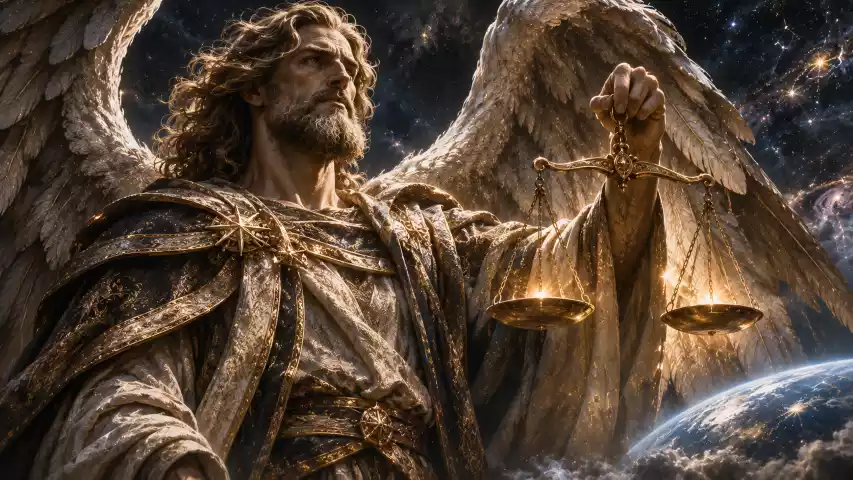
The two principal Enochic passages name Raguel and record a statement by him, but provide no specific facial features, bodily height, skin color, clothing, wings, or personal insignia. It would therefore be misleading to describe a canonical ancient portrait as though a surviving text prescribed it. An illustration may depict a luminous angel accompanying Enoch, yet that is an artistic reconstruction. For GRIMORIUM, iconography should be distinguished from textual evidence, especially when later angel cards attach standardized colors, numbers, or gems to a name scarcely described in its earliest source.
The western fire as contextual imagery
Fire and the western horizon are the most distinctive visual details in Raguel's narrative setting. They belong to the phenomenon he explains, not to his body. A serious visual interpretation might place the angel near the restless fire of 1 Enoch 23, emphasizing the seer's bewilderment and the angel's measured response. Representing the fire as a magical weapon wielded by Raguel would reverse the narrative: the chapter says he interprets a sight, not that he hurls flames. The distinction preserves both drama and source fidelity.
Wings and the conventions of angel art
Winged human figures are familiar in Christian and modern images of angels, but that convention does not establish how Raguel was pictured in the Jewish apocalyptic setting that names him. Ancient heavenly beings have highly varied literary appearances, and a general association with angels is not a license to combine every iconographic trait into one figure. Wings, armor, a halo, and a ceremonial staff may serve an artist's chosen style, but they should not be captioned as attributes explicitly granted to Raguel in 1 Enoch.
Scales, swords, and judicial symbols
The scales of justice and the sword of punishment are understandable modern emblems for an angel interpreted as guardian of fairness. They are not specified in the Enochic scenes. A scale may derive from broader artistic traditions of judgment, and a sword from military imagery applied to other heavenly figures. Calling these personal objects of Raguel would merge artistic allegory with primary history. If such objects appear in a commissioned image, a precise caption can identify them as contemporary symbolic choices rather than textual relics.
The danger of standardized correspondences
Contemporary handbooks sometimes assign Raguel a particular candle color, crystal, weekday, chakra, planet, musical tone, or numbered ray. These systems are neither part of 1 Enoch 20 and 23 nor demonstrated by surviving manuscripts of the Book of the Watchers. They are practices and symbolic taxonomies with their own histories. To avoid confusing readers, the dossier does not use any one modern correspondence as an ancient identification. Such details can be discussed as present-day reinterpretations only when a specific source and context are named.
A responsible visual brief
For a historically informed illustration, show Raguel as a distinct celestial interpreter within a Second Temple Jewish apocalyptic vision: Enoch as a human witness, a western boundary, and a mysterious persistent fire linked to the lights of heaven. The ancient text leaves his personal anatomy undefined, so a creative rendering should admit its speculative dimension. Avoid portraying him as a demon, inventing a named weapon, or reproducing the visual design of another archangel as proof of identity. The ideal scene communicates revelation and cosmic order rather than arbitrary fantasy armor.
1 Enoch 20:4: primary designation
The single most important citation is 1 Enoch 20:4, where Raguel is listed among the holy watching angels and assigned a role tied to retribution and the luminaries. R. H. Charles translates the clause in terms of vengeance upon the world of the luminaries, marking textual difficulty; other modern versions differ in nuance. The location and its uncertainty should be provided whenever a short summary says merely “angel of justice.” This verse is evidence of a named angelic office, not a narrative describing the creation, family, or entire career of its bearer.
1 Enoch 23:1–4: the only extended scene
In chapter 23 Enoch travels toward the western extremity and encounters a fire that does not cease its motion by day or night. He asks about it, and Raguel identifies the phenomenon with the luminaries. Different textual traditions render the final expression in substantially different ways: in some English versions the fire pursues the luminaries, while other translations make it the luminaries' own course. The shared narrative core is secure enough: Raguel appears, is recognized as holy, and interprets a celestial wonder. The disagreement advises against constructing a complicated cosmic punishment mechanism from one uncertain verb.
1 Enoch 6–16: context of the rebellious Watchers
The earlier narrative of the Watchers' descent, illicit unions, giant offspring, violence, and judgment supplies the moral background for chapter 20. Yet these chapters should not be cited as if Raguel personally speaks or commands their punishments. The names and direct assignments must be kept in their actual passages. The contrast between rebellious angels and holy messengers helps explain why retribution is a significant theme, but it does not automatically prove any later claim that Raguel serves as executioner of each condemned Watcher.
The Book of Tobit: another Raguel
Tobit 7–8 introduces a human Raguel, Sarah's father and Tobias's relative by marriage. This Raguel welcomes the travelers and participates in the marriage arrangements. The accompanying supernatural figure in Tobit is Raphael, not the father named Raguel. The shared personal name can produce serious cataloguing errors, especially when databases collect all appearances under one heading. The proper solution is to distinguish the human father-in-law from the angel in 1 Enoch, using the relevant verses and never creating an invented identity between them.
Exodus and the other biblical Reuels
The Hebrew Bible includes persons whose names are written Reuel or in related forms, among them a figure associated with Moses's Midianite family in Exodus 2:18, and other genealogical bearers. These are human characters in separate literary and historical contexts. The presence of a familiar sounding name is not a textual reference to the Enochic angel. When tracking names for research, a philological cross-reference is helpful; when building a character biography, conflating them is misleading. Neither a common spelling nor an etymology overrides the identity defined by each source.
Greek, Ethiopic, and Aramaic witnesses
The textual transmission of 1 Enoch is multilingual. The Ethiopic tradition preserves the complete collection; Greek fragments and quotations, along with Aramaic Enoch materials from Qumran, illuminate portions of its earlier history. No claim about Raguel should pretend that a single modern English translation transparently reproduces every ancient witness. Editors compare manuscripts and sometimes mark disputed expressions with critical symbols. The differing interpretations of the fire in chapter 23 offer a concrete example of why translation choice matters for theology, cosmology, and artistic portrayal.
Second Temple Jewish apocalypticism
Raguel is best anchored in Jewish apocalyptic literature of the Second Temple era, not in a single uniform body of Jewish angelology. Such writings explore hidden heavenly chambers, angelic intermediaries, the consequences of rebellion, and the approaching restoration of justice. The Book of the Watchers participates in this intellectual landscape, but its ideas cannot automatically be assigned to all ancient Jews. Groups read different texts and understood divine messengers in different ways. The dossier therefore uses the more precise label Enochic Jewish apocalyptic tradition for the earliest explicit witness.
Ethiopian Orthodox reception
The Ethiopian Orthodox Tewahedo Church preserves 1 Enoch as part of its scriptural heritage. That reception gives passages naming Raguel a different canonical setting from the one they occupy in many Western churches. Yet scriptural reception alone does not mean that every later internet claim about the angel reflects official Ethiopian teaching. Theology, liturgy, local art, and particular interpretations still require separate documentation. It is accurate to note that the book is canonical in this tradition; it would be inaccurate to turn that fact into proof of a universal prayer, feast, or approved portrait of Raguel.
Western Christian limitations
Most familiar Roman Catholic lists of named archangels emphasize Michael, Gabriel, and Raphael; Raguel does not occupy the same universally recognized liturgical position. Some late antique and medieval texts transmit further angelic names, and individual traditions can vary substantially. A general statement that the Catholic Church has a standard feast of Raguel would require exact liturgical evidence rather than repetition of web summaries. His reception in Christian culture should be described as uneven: known through Enochic materials and later lists, but not equivalent to the central canonical messengers named in ordinary Western worship.
Judaism after the Second Temple
The survival of Enochic writings and motifs does not mean all later Jewish movements accepted Raguel as a named liturgical protector. Rabbinic Judaism develops its own patterns of discussion about angels, divine sovereignty, and the limits of invocation. Medieval mysticism adds still other arrangements, not all compatible with earlier sources. Raguel appears in certain transmitted lists, but a historian should avoid calling him a required object of Jewish prayer. His strongest continuous identity is literary: a holy named angel in Enochic traditions rather than an obligatory component of everyday Jewish devotion.
Esoteric and New Age reinterpretations
Modern angel manuals often describe Raguel as overseeing relationships, resolving quarrels, restoring fairness among colleagues, and encouraging personal harmony. Such applications draw a moral analogy from the name's alleged meaning and from the language of justice in 1 Enoch. They are historically interesting as reception, but their specificity greatly exceeds the ancient scenes. A reader should be able to distinguish the publication of a modern devotional claim from an apocalyptic manuscript. The dossier records these reinterpretations without endorsing them as clinical advice, historical facts, or guarantees of supernatural intervention.
Respectful comparison without forced synthesis
Raguel's passage through different settings illustrates a larger editorial rule: related religious vocabularies do not erase real differences between communities. An Ethiopian biblical reception, a Jewish apocalyptic narrative, a medieval Christian list, and a contemporary spiritual exercise cannot all be called the same doctrine. Even within a community, texts may disagree or remain marginal. A comparative entry should preserve attribution and chronology, letting readers understand why the same name carries divergent levels of authority. This approach respects the religious material more than an imagined unanimous consensus.
Enoch: the visionary who questions Raguel
Enoch is Raguel's clearest individual counterpart. In 1 Enoch 23 the human seer asks about an unceasing western fire, and Raguel responds as the interpreter of a heavenly mystery. The relationship is that of visionary and guide, not father and son, master and disciple in a permanent school, or rival princes. Genesis 5 records Enoch without naming Raguel; the association is specific to the Enochic apocalyptic journey. A structured link to Enoch is useful only if a dedicated Enoch entity exists or is explicitly planned; otherwise the relationship remains fully intelligible in the text.
Uriel: another Enochic guide
Uriel appears alongside Raguel among the named angels of 1 Enoch 20 and provides instruction elsewhere in the journeys. Their connection consists in service within the same visionary cosmos, not in a documented family bond. Unlike Raguel's brief explanation of the western fire, Uriel is associated with other revelations, including descriptions connected with celestial phenomena. The parallel makes sense for internal navigation because readers may wish to compare their distinct explanatory roles. It does not justify labeling Raguel subordinate to Uriel or assigning them a shared invented mission.
Michael, Gabriel, and Raphael: fellow holy angels
Michael, Gabriel, and Raphael appear in Raguel's immediate literary company and possess independently important narrative or scriptural histories. Their relation to Raguel in 1 Enoch 20 is membership in a list of holy watchers, rather than a dramatic encounter among the four. Since GRIMORIUM already maintains dedicated dossiers for these angels, cross-links can help readers compare what each passage actually attributes to each name. The labels should remain neutral: “listed together in 1 Enoch,” not “brother,” “enemy,” or “commander” without specific evidence.
Saraqael and Remiel: names in a variable roster
Saraqael, often rendered Sariel, and Remiel appear in forms of the angelic roster transmitted with 1 Enoch 20. Their spellings and inclusion can vary across witnesses and editions. They are relevant comparanda for the textual history of the list, but neither is assigned a special family relationship with Raguel. A responsible future directory could create their own fichas with clear source criticism; until then, a paragraph is sufficient. Inventing a complete council of seven with fixed seats, colors, and duties from every modern list would conceal the variation of the ancient evidence.
Raguel of Tobit: namesake, not the angel
The Raguel who gives his daughter Sarah in marriage to Tobias in Tobit 7 is a human father. He must not be linked as an alternate incarnation of the Enochic angel. The actual angel in the Tobit narrative is Raphael, who accompanies Tobias under a human disguise. This is an important negative relation for a multilingual encyclopedia: spellings can coincide while identities remain distinct. A future entity index may cross-reference the homonym as a disambiguation note, but the structured angelic relationship list should not mark him as the same person or a supernatural kin.
The divine authority and the limit of relationship lists
Raguel's fundamental theological relation is service to the God whose order governs the Enochic universe. This is a statement of religious narrative, not a reason to invent a separate entity profile for an abstract divine concept. Relations tools are most valuable when they represent documentable links between identifiable characters. Where a source provides only institutional association, the wording should say so; where it provides a speaking scene, that more direct connection may be emphasized. This discipline prevents the common error of treating shared mythology tags as evidence of intimate personal relationships.
 UrielListed with Raguel among the holy angels in 1 Enoch 20; a distinct guide in Enochic visions.
 MichaelListed with Raguel in 1 Enoch 20; no specific familial tie is documented.
 GabrielFellow holy angel in the roster of 1 Enoch 20; separate narrative functions.
 RaphaelFellow holy angel in 1 Enoch 20; distinct from the human Raguel in Tobit, where Raphael is the angel.
Primary text: 1 Enoch 20:1–8
The fundamental roster is 1 Enoch 20:1–8, especially verse 4. Consult a critical translation that identifies the textual tradition being translated. R. H. Charles, The Book of Enoch (1912; later editions), provides an influential English rendering, with marks indicating uncertainties in the phrase about vengeance and the luminaries. A comparison with E. Isaac's translation in James H. Charlesworth, The Old Testament Pseudepigrapha, volume 1 (1983), shows why the English wording should not be treated as a transparent, unanimously settled ancient statement.
Primary text: 1 Enoch 23:1–4
Raguel's spoken encounter is recorded in 1 Enoch 23:1–4, especially verse 4. The passage describes Enoch's western journey, an unceasing fire, a question, and the angel's explanation concerning the luminaries. Charles's version can be checked in public-domain transcriptions, including the Christian Classics Ethereal Library and Project Gutenberg. The differences between renderings that describe a fire pursuing the lights and versions that equate the phenomenon with their course should be noted rather than silently harmonized.
Context: 1 Enoch 6–16 and 21–25
For the judgment of the Watchers consult 1 Enoch 6–16; for the broader sequence of Enoch's journey examine 21–25. These references establish thematic context but do not increase Raguel's speaking appearances. Chapter 22 chiefly involves explanation of the chambers of the dead by another angel; chapters 24–25 likewise move to different scenes and guides. A source list should state clearly when a chapter documents an environment instead of a personal act. This avoids the common habit of attributing every nearby episode to the best-known name in a summary.
Disambiguation: Tobit 7–8 and Exodus 2:18
Tobit 7:1–17 and 8:1–21 concern the human Raguel, his daughter Sarah, Tobias, and their household. The narrative's named heavenly companion is Raphael, as established by Tobit itself. Exodus 2:18 names Reuel within the Midianite family tradition associated with Moses. These passages are useful not because they add powers to the Enochic angel but because they prevent false identification of homonyms. The New Oxford Annotated Apocrypha, on Tobit 7, explicitly notes the onomastic connection without collapsing the characters into one being.
Studies of textual transmission and Enochic literature
For the history of 1 Enoch consult George W. E. Nickelsburg, 1 Enoch 1: A Commentary on the Book of 1 Enoch, Chapters 1–36; 81–108 (Fortress, 2001), and the continuation with James C. VanderKam, 1 Enoch 2 (Fortress, 2012). Also useful are Michael A. Knibb, The Ethiopic Book of Enoch (Oxford, 1978), and scholarly discussions of Aramaic Enoch fragments and Greek witnesses. These studies distinguish composition, redaction, translation, and surviving manuscripts. Their task is not to provide a single devotional portrait but to control the historical claims being made about each passage.
Angel lists and comparative scholarship
John Carey's study of angelology in medieval Irish and related materials discusses divergent lists and the problems of comparing Greek and Ethiopic versions of 1 Enoch. It is useful for establishing that later seven-angel schemes are not uniform. Broader background can be found in studies of Second Temple apocalypticism, including work by John J. Collins, and in critical editions of relevant pseudepigrapha. The responsible research procedure is to record what each witness actually names, mark missing or variant names, and avoid importing the fully systematized classifications of much later manuals.