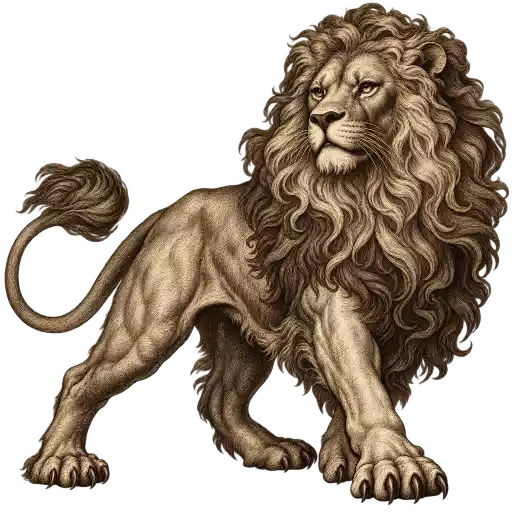
Marbas, the lion who reveals hidden things
Marbas, also called Barbas in the earlier demon catalogue of Johann Weyer, is the fifth spirit of the Ars Goetia and bears the rank of Great President. The text credits him with governing thirty-six legions of spirits. He first appears as a great lion and assumes the form of a human when requested. Unlike a number of Goetic figures whose offices revolve around treasures, affection or military command, his principal powers concern difficult knowledge: discovering secrets, understanding mechanical arts, changing forms and both causing and curing illnesses. These are descriptions made by historical magical books, not claims supported by medical or empirical evidence.
What makes Marbas distinctive
The apparent contradiction between producing illness and reversing it is central to Marbas’s identity. Within a short description, the spirit is imagined as controlling opposing outcomes in the same field. The grimoire does not give him a detailed medical theory, list of diseases or verifiable treatment, and modern claims about particular diagnoses should not be retroactively attached to it. His office is an example of the double-edged power frequently assigned to supernatural beings in historical magical literature.
Origins in written demonology
Marbas is not known through a securely documented independent ancient cult or a canonical biblical biography. The clearest sources belong to sixteenth- and seventeenth-century European catalogues of spirits. Weyer records Barbas as the third entry of his Pseudomonarchia Daemonum; the later Goetia places Marbas fifth. The change in catalogue position must not be misrepresented as two demons or as evidence for separate ancient traditions. Historical spelling and ordering variation is typical of these texts.
How to read the profile
A faithful account separates the early modern sources, their editorial variants, later systems of angelic correspondences and the modern artistic afterlife. Marbas can be studied as a historical character of books without presenting the texts as a universal religion. The ars goetica is a grimoire tradition, not a mythology or religion to be assigned as a taxonomy term. Because his secure origin is the European spirit catalogue, Grimorium gives him the independent Folklore designation rather than inventing a pagan pantheon.
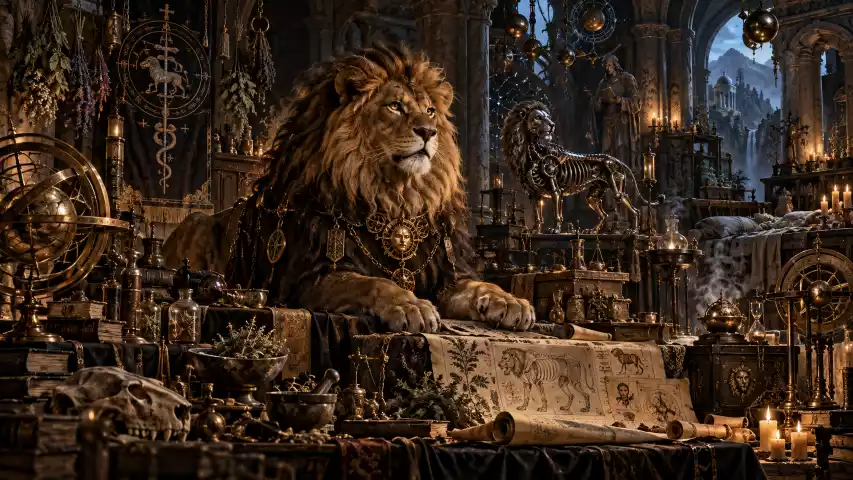
President, not duke or king
In the Ars Goetia Marbas holds the office of Great President. This is the source-specific infernal rank and must be preserved rather than replaced with labels given to other demons. The same passage gives him thirty-six legions, which function as a conventional sign of authority in the magical hierarchy. No named members of those legions are supplied in the core account; a legion is a collective and not an individual entity.
A great lion before all else
The most important anatomical detail is simple and specific: Marbas initially takes the appearance of a great lion. The text does not require a lion with a human face, elaborate horns, multiple heads or wings. Those features may arise in later illustrations, but they should not be passed off as original. As a creature, the lion form should remain genuinely leonine if depicted in source-faithful art. The power of this appearance comes from its clarity: a powerful animal suddenly acting as an articulate ceremonial spirit.
A change to human form
The same sources say Marbas can take the form of a man at the operator’s request. This makes transformation an integral aspect of his characterization rather than an incidental visual variation. The source does not provide a fixed human age, costume, hair color, face or ethnicity. Artistic treatments may invent such details, but a reference article should mark the boundary between manuscript description and creative interpretation.
Truthful answers about secrets
Weyer and the Goetia describe a being that answers truly concerning things hidden or secret. This is a reputation for uncovering concealed information rather than evidence that the demon was an oracle in an ancient public cult. It also distinguishes him from figures whose prophecies concern the future: the Marbas paragraph stresses concealed matters rather than an unlimited vision of time.
The mixed character of his offices
Marbas combines seemingly beneficial functions—knowledge, wisdom and cures—with threatening ones—disease and alteration of persons. This blend is not an editorial mistake that should be smoothed away. It reflects the moral ambiguity of spirit-office catalogues, where supernatural service was represented as useful but potentially destructive.
Causing and curing illnesses
The most famous office of Marbas is his claimed ability to cause diseases and cure them again. Both halves appear together in the historical passage. This formula makes him different from an exclusively healing figure: the same source imagines harmful and beneficial outcomes under his control. There is no scientific evidence that a demon causes or removes disease, and Grimorium treats these as assertions of early modern occult literature. They must not be translated into medical instructions or promises of healing.
Mechanical arts and crafts
Marbas grants wisdom and knowledge in mechanical arts. In the historical vocabulary of the grimoires, mechanical arts encompass practical crafts, construction, devices and forms of applied skill. They do not specifically predict modern electronics, robotics or engineering degrees; those are modern reinterpretations. The source places him in a tradition in which spirits were imagined as instructors of useful technical knowledge otherwise difficult to obtain.
Disclosure of hidden things
The claim that Marbas answers truthfully about hidden and secret things makes him a spirit of disclosure. This can mean uncovering information within the magical narrative, but the text does not provide a detailed taxonomy of mysteries. Modern lists sometimes credit him with every kind of psychic perception. A historically responsible description keeps the stated power narrow and attributes it to the catalogue.
Altering human form
Marbas is also said to change people into other shapes, one of his most remarkable powers. The passage does not specify whether the transformation is physical, perceptual or allegorical; later readers and illustrators interpret it differently. The profile should preserve the exact uncertainty instead of selecting a sensational explanation unsupported by the source.
Authority over thirty-six legions
The thirty-six legions mentioned in the Goetia establish the scale of the spirit’s supposed court. They are not named individuals, do not justify invented genealogies, and do not provide a route to link anonymous subordinates in related.entities. The number can be recorded as a textual attribute while keeping structured relations limited to actual identifiable beings.
Johann Weyer and the name Barbas
Johann Weyer’s Pseudomonarchia Daemonum, printed with editions of De praestigiis daemonum and available in a notable 1577 form, names the spirit Marbas or Barbas. It places the entry third and describes him as a great president manifesting as a powerful lion, assuming human form when commanded, answering secrets, causing and healing disease, granting understanding of mechanical arts and changing people’s forms. The passage states that he governs thirty-six legions. This earlier witness is essential for assessing the continuity of his profile.
Ars Goetia, spirit number five
The first book of the Lemegeton Clavicula Salomonis, commonly known as the Ars Goetia, lists Marbas as its fifth spirit. The entry calls him a Great President and preserves almost all the offices just described. His first form is a great lion; he later takes human shape upon request. The text speaks of secrets, sickness and cure, mechanical arts, shape-changing and thirty-six legions. It also includes a specific seal in the manuscript and printed traditions.
From Weyer to Scot and English Goetia
Reginald Scot’s Discoverie of Witchcraft (1584) helped transmit demonological material in English, including catalogues connected with Weyer. Later manuscript and printed versions of the Goetia rearranged and adapted the inherited entries. Comparing witnesses is more useful than treating one popular internet paraphrase as a complete original. For Marbas the core office is relatively stable even though his place in the ordered list changes.
Mathers and Crowley in 1904
A frequently consulted modern presentation is S. L. MacGregor Mathers and Aleister Crowley, The Goetia: The Lesser Key of Solomon the King (1904), which helped fix the sequence familiar today. Its fifth entry should be cited as a printed witness, not as the invention of Marbas. Editorial plates and seals may diverge from manuscripts; a scholarly entry distinguishes the text, the graphic tradition and later digital redrawings.
What the books do not say
The core texts do not give Marbas an ancient Egyptian or Mesopotamian origin, a partner, offspring, a named adversary in an actual myth, or a detailed sacred calendar. Nor is Marbas a biblical physician or an official saint. Later attributions of planets, dates, elements and ritual directions belong to specific later correspondence systems and should not be silently inserted into the original Goetic description.
A short entry, not an ancient saga
Marbas does not have an independently attested ancient epic or a large body of premodern folktales. His narrative identity begins with brief spirit-office passages: the great lion, the human transformation, the promise of knowledge and the simultaneous power over sickness and cure. Later demonology amplifies this material, but it is not a continuous record of a historical cult.
The paradox of a supernatural physician
The striking claim that the spirit can both inflict and reverse disease inspired a later picture of Marbas as a sinister physician. That is a reasonable interpretive image, but it must not replace what the books actually claim. The source does not list a medical specialization or reliably attested healing miracles. The paradox belongs to demonological imagination, in which one power can be directed toward opposite results.
The lion as a transforming figure
The lion-to-human sequence provides the closest thing to a recurring miniature legend of Marbas. It suggests that the spirit’s animal appearance conceals a capacity for human communication. Artistic depictions sometimes exaggerate that transition by combining human and animal anatomy into a chimera. Such images are modern interpretations, not the only form authorized by the text.
Later tales of skill and forbidden knowledge
Modern occult writing sometimes presents Marbas as a master of medicine, anatomy, alchemy, engineering or clandestine technologies. These themes extend the older mechanical-arts and healing offices, but the extent of each claim varies widely by author. A reference article should identify this as reception history rather than retroactively attribute a complete modern scientific curriculum to Weyer.
No specific prophecy attached to Marbas
Unlike apocalyptic figures, Marbas is not assigned an end-times prediction in the primary passages. His lore centers on offices rather than prophecy. References to cosmic wars, impending catastrophes or personal destiny should therefore require an explicit later source before being reported as part of his historical tradition.
Historical Context
Mainstream Christianity does not prescribe invocation of Marbas.
Goetic Context
The Ars Goetia places Marbas within a ceremonial system of conjuration and spirit constraint.
Traditional Offices
Historical occult texts associate him with disease, healing, mechanical knowledge, secrets and transformation.
Documentary Approach
GRIMORIUM treats this material historically and does not provide operational summoning instructions.
Christian Context
Christian traditions respond to demons through prayer, repentance, scripture, sacramental practice and regulated exorcism.
Medical Caution
Historical claims that Marbas can cause or cure disease belong to occult literature and should never replace evidence-based medical care.
Goetic Protective Framework
Goetic manuscripts contain ritual boundaries and protective conventions distinct from mainstream Christian worship.
Historical Caution
These practices belong to religious and magical history and should not be presented as scientifically demonstrated mechanisms.
Mahasiah: later angelic correspondence
Marbas’s most defensible structured relation is with Mahasiah, the fifth angel in the Shem HaMephorash sequence, in the later Goetic correspondence system associated with Thomas Rudd. This pairs the fifth Goetic spirit with the fifth angel. The link is a specific textual correspondence between two individually identifiable beings; it does not mean that the core Ars Goetia tells a story of the two fighting or communicating.
Why Barbas is an alias
Barbas is an alternative form of Marbas’s name in early demonological catalogues, not an independently established second demon. It belongs in the aliases field. Creating a separate Barbas entity link would produce a duplicate rather than a real inter-entity relation.
Why similar powers are insufficient
Buer is also credited with healing or knowledge, and other Goetic beings are assigned shape-changing or secret revelation. Such overlap does not by itself demonstrate a direct relationship, nor does sharing a rank or appearing close by in the catalogue. Those spirits remain individual entities, but they are not automatically direct relations of Marbas.
Preserving a pending counterpart
If Mahasiah has not yet been entered into the same-language directory, Grimorium’s JSON should still retain its slug in related.entities. The import process can then register the missing entity as Pending Entities and resolve the connection later. Availability of a published profile is not a criterion for deleting a valid historical correspondence.
Primary: Ars Goetia, number V
Lemegeton Clavicula Salomonis, book I, Ars Goetia, spirit 5 (Marbas); compare S. L. MacGregor Mathers and Aleister Crowley, The Goetia: The Lesser Key of Solomon the King (1904), entry 5. Supports the Great President title, lion and human manifestations, hidden secrets, disease and cure, mechanical arts, alteration of shape and thirty-six legions.
Primary comparison: Johann Weyer
Johann Weyer, Pseudomonarchia Daemonum, entry 3, Marbas/Barbas, especially the 1577 Latin edition. This earlier witness supports the same core offices and provides a different placement in the sequence. It should be distinguished from later editions of the Lemegeton.
Transmission: Reginald Scot
Reginald Scot, The Discoverie of Witchcraft (1584), is important for early English transmission of spirit-catalogue materials connected with Weyer. Relevant differences in terminology and order should be assessed by textual comparison rather than invented harmonization.
Later angelic system: Thomas Rudd
The Mahasiah pairing belongs to the later Goetic material associated with Thomas Rudd, where spirits are paired with angels according to their respective positions among seventy-two names. This is a later correspondence, not a claim in the core description of Marbas.
Limits of historical sources
The sources document what European magical writers asserted about Marbas. They do not establish the existence or efficacy of a spirit, the effectiveness of supernatural healing, or a speculative ancient religious origin. Folklore describes the textual and cultural tradition in which Marbas circulates.