The thirty-eighth spirit
Halphas is spirit number thirty-eight in the Ars Goetia, the first book of the Lemegeton. The text calls him a Great Earl and assigns him twenty-six legions of spirits. His powers are unusually concentrated: he raises towers, supplies them with weapons and ammunition, and sends soldiers to locations specified by the operator. This is a military and logistical office, not a general claim to preside over every form of warfare.
A bird with a hoarse voice
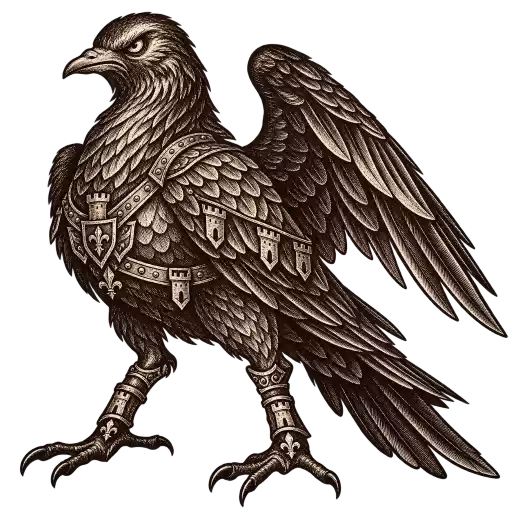
The printed Goetia describes Halphas as appearing in the form of a stock-dove and speaking with a hoarse voice. The combination of an ordinary-looking bird and a rough voice distinguishes him from the crowned humanoid figures and imposing beasts found elsewhere in the catalogue. The identification of the bird, however, is not unanimous across historical witnesses.
The stork in Weyer
Johann Weyer presents Halphas as a great earl resembling a stork, using the Latin term ciconia. His entry additionally describes building large, well-armed towns and stirring up war. The distinction between stork in Weyer and stock-dove in the Goetia is a meaningful feature of textual transmission, not evidence of two different demons.
A specialist in preparing conflict
Halphas embodies the preparation and provisioning of war. He does not merely destroy what stands before him: he builds defensive structures, equips them, and supplies the movement of armed men. He is best understood as a figure of fortification and martial organization in early modern grimoire literature.
Historical classification
No independent ancient cult, sacred genealogy or stable mythology of Halphas is established by the Goetic and Weyer material. Accordingly, this entry treats him as a demonological being of the European grimoire tradition. Folklore can be enabled without inventing a religious tradition or mistaking the Ars Goetia itself for a mythology.
Great Earl and twenty-six legions
Halphas is styled a Great Earl. The Ars Goetia attributes twenty-six legions to his command, a figure also found in the Weyer description. Rank and legion count are part of the spirit-catalogue framework and should not be treated as independent records of a historical army.
Stock-dove according to the Goetia
The familiar English Goetia describes a stock-dove. In modern visual work this implies an avian body, not a man with symbolic bird wings or a humanoid soldier disguised as a pigeon. The original office text does not require armour, a helmet, a crown or human anatomy on the manifestation.
Stork according to Pseudomonarchia
Weyer gives a different bird: a stork. The Latin ciconia is explicit, as is the roughness of the voice. This is one of the clearest iconographic differences between two major witnesses to Halphas. A historical article may show either version, but must state which witness it follows instead of conflating them.
The voice as a distinctive marker
A hoarse voice appears in the old descriptions. The rough sound is a more securely attested identifying characteristic than many modern visual additions. Although several demons have unusual voices, this detail matters because it survives alongside the bird-form tradition.
Military specialization
Unlike spirits famous for divination, language learning, romance or hidden wealth, Halphas is described principally through construction, provisioning and the deployment of fighting men. The narrowness of his offices is precisely what makes him distinctive: the grimoire presents a supernatural quartermaster and engineer, not a universal lord of destruction.
Raising towers
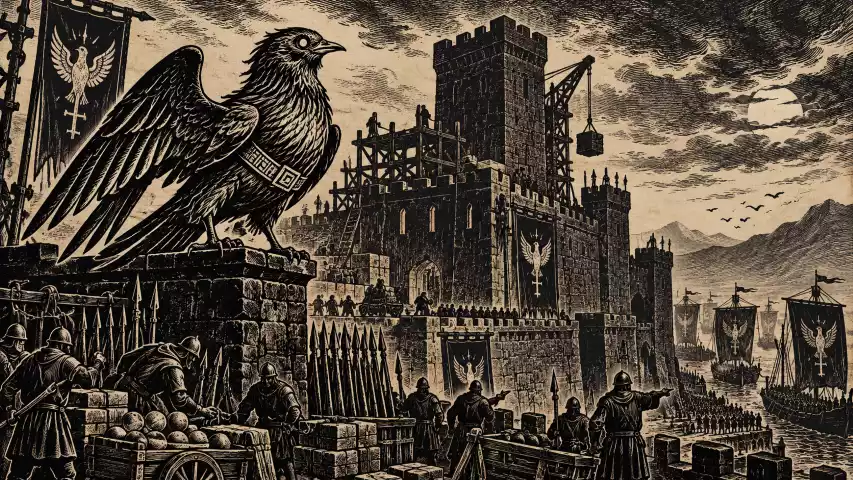
The Ars Goetia states that Halphas builds towers. This is a concrete architectural power rather than an abstract association with buildings. Towers were markers of defense, surveillance and martial readiness. For Halphas, they are instruments of organized force, not simply monuments or places of residence.
Stockpiling ammunition and weapons
The towers are furnished with ammunition and weapons. This second part of the office is essential: Halphas does not merely create strongpoints but makes them militarily serviceable. The term ammunition reflects the language of transmitted English texts; it should be interpreted historically as materiel and supplies appropriate to the textual period, not modern firearms logistics imported into an older source.
Dispatching armed men
Halphas sends men of war to places appointed. This points to deployment rather than spontaneous battlefield magic. The operator names the destination in the account, and the demon is credited with sending the fighting force there. The historical passage does not provide a narrative about which historical campaign or kingdom these troops served.
Building armed towns in Weyer
The Pseudomonarchia Daemonum broadens the construction motif to substantial towns filled with weapons and stores. Weyer also says Halphas stirs up war. These are source-specific details that deepen the martial aspect without erasing the distinct wording of the Goetia.
Limits of the attested office
The principal texts do not independently identify Halphas as a master of prophecy, healing, romantic attachment, treasure finding or spirit familiar distribution. Nor do they provide a catalog of named soldiers under his command. These omissions matter for a disciplined entity record: military preparation is the documented center.
Ars Goetia, spirit XXXVIII
In the Lemegeton catalog, the thirty-eighth spirit is Halphas, also printed under forms such as Malthus or Malthas. He is a Great Earl appearing as a stock-dove, with a hoarse voice. He builds towers, furnishes them with ammunition and arms, sends men of war to appointed places, and commands twenty-six legions. The official identity for this entry follows the Goetic numbering, not the earlier order of Weyer.
Johann Weyer, Pseudomonarchia Daemonum
Weyer places Halphas later in his own catalogue and calls him a Great Earl in the form of a stork. His Latin description emphasizes large armed towns, the stirring up of war and the sending of warlike men to a designated place. The twenty-six-legion count remains recognizable across the traditions. The change of bird is not a trivial stylistic flourish, because it changes the animal being depicted.
Reginald Scot and translation history
The Goetia catalog developed through earlier books of spirit offices, Weyers printed demonology and English transmission associated with Reginald Scot. Different translators and copyists could preserve or change words for animals, buildings and martial offices. This chain of transmission is more defensible than describing Halphas as a single authoritatively fixed image unaffected by copying.
Names: Halphas and Malthus
Malthus, Malthas, Malthous and Halpas are associated with the same grimoire figure in variant sources and modern bibliographies. They are to be treated as alternate names, not independent relatives. Their occurrence can help readers recognize references in editions that do not use the now-standard form Halphas.
Seal and editorial boundaries
Like other Goetic spirits, Halphas has a seal associated with the Lemegeton transmission. A visual comparison of seals belongs to manuscript study, while the core record should keep the offices, rank, form and legions anchored in actual text. Later occult planetary correlations and artistic interpretations must be presented as later frameworks, not words attributed to Weyer.
No separate epic narrative
Halphas does not arrive in the surviving source passages with a birth story, a named dynasty, a personal prophecy or a public cult history. His persona emerges from the short catalogue description. That limits what Grimorium can responsibly call a legend: the most historically secure material consists of attributed offices and variants in their telling.
The construction-before-battle motif
The towers and armed towns make Halphas unusual because the supernatural act precedes conflict. The text imagines war as a problem of preparation: erect places of defense, fill them with supplies, and direct the people who will fight. The demon is thus a character of planned rather than purely chaotic violence.
The paradox of avian manifestation
A stock-dove or stork might not be the first creature readers expect from a militarized demon. The contrast between understated bird-form and large-scale fortification is part of Halphas’s literary distinctiveness. Such a contrast supports original artistic interpretation, provided it does not disguise which animal the source actually names.
Weyer and the escalation of war
Weyers account states that Halphas stirs up warfare in addition to provisioning fortified settlements. Read historically, this intensifies the sense that the demon is linked with conflict rather than with peaceful civic construction. It should not be recast as an attested prediction of a specific earthly war.
Avoid invented prophecies
No reliable statement in the central passages ties Halphas to a promised return to heaven, a thousand-year deadline, or a named apocalyptic event. Those motifs belong to entries for other spirits, including Focalor and Phenex. They should not migrate into a profile of Halphas merely because these figures appear in the same catalogue.
Historical ritual context
The Ars Goetia embeds its list of spirits within a ritual framework of names, seals, circles, commands and religious authority. References to a seal attached to Halphas's entry are evidence of that textual setting. They do not constitute verification that a being responds to the described practices.
Documenting rather than performing
A history of ritual should distinguish what historical practitioners believed from what can be established about the manuscript. Different modern groups interpret goetic ceremonies in diverse ways. This article records literary features and does not promise results or reproduce a procedure for summoning or directing supernatural forces.
Protective language in grimoires
Historical ceremonial texts surround spirit catalogues with protective prayers, sacred names, ritual boundaries and prohibitions. Those practices express the fears and assumptions of their compilers; they are not proven protection against supernatural threats. Halphas's entry itself does not supply a special defense unique to him.
Folklore versus evidence
Modern claims that a particular object or emblem wards off Halphas should not be mistaken for manuscript testimony. His seal is part of the ritual apparatus, not a documented household amulet with an established historical cult.
Haamiah: a later angelic pairing
Halphas, as Goetic spirit number thirty-eight, corresponds to Haamiah, angel number thirty-eight in the later Shem HaMephorash pairing associated with Thomas Rudd. This is a historically meaningful reception-layer association, not a personal relationship reported by Weyer. The structured related entity is therefore Haamiah, with an explicit note that the correspondence is later.
Malthus is an alias
The names Malthus, Malthas and Malthous refer to textual naming variants of Halphas. They are not children, siblings or separate infernal commanders. They belong under other names and in explanatory historical prose, not as independent linked entities.
Malphas and Sabnock: comparison only
Malphas can build houses and high towers; Sabnock builds towers, castles and fortified cities. Halphas has similar architectural offices, but the principal catalog passages do not declare a family, military alliance or superior-subordinate relationship between these demons. A comparative article may discuss them, while related.entities should not claim a bond absent from the evidence.
No fictitious personnel
The unnamed men of war supposedly dispatched by Halphas are not identifiable personal entities. Nor are towers, ammunition, cities, weapons or the concept of war beings suitable for structured relations. Their proper place is in the descriptive tabs.
Pending entity note
If Haamiah does not yet have an entry in the English or Spanish directory, the same-language slug can be retained as a documented missing relation for the sites pending-entities workflow. This should not become an invented generic angel or be redirected to the unrelated archangel Michael.
Ars Goetia, entry 38
The Lemegeton, book I, Ars Goetia, spirit XXXVIII: Halphas or Malthus, a Great Earl appearing as a stock-dove, speaking with a hoarse voice, building towers, furnishing them with ammunition and weapons, sending men of war to named places, and governing twenty-six legions. See Joseph H. Peterson, Lemegeton Part 1 transcription, https://www.esotericarchives.com/solomon/goetia.htm, and the Mathers-Crowley printed tradition.
Johann Weyer, Pseudomonarchia Daemonum
Weyer, Pseudomonarchia Daemonum, entry on Halphas, available with Latin and historical English at https://www.esotericarchives.com/solomon/weyer.htm. The Latin term ciconia means stork, not stock-dove; the text also references large well-armed towns, warfare, and dispatched fighting men.
Reginald Scot and catalog transmission
Reginald Scot, The Discoverie of Witchcraft (1584), transmitted demonological office material in English. Modern editorial comparisons explain how the Lemegeton catalog draws on Weyer and earlier books of spirit offices. Ordering and vocabulary are not uniform across versions.
Mathers and Crowley edition
S. L. MacGregor Mathers and Aleister Crowley, The Goetia (1904), spirit 38, circulated the stock-dove description and variant names Malthus and Malthas in a widely cited English text. Compare https://hermetic.com/norton/classics/goetia/halphas.
Thomas Rudd and later correspondence
The Haamiah correspondence is a later arrangement of the seventy-two Shem angels alongside the seventy-two Goetic spirits, associated with the Rudd tradition and discussed in modern scholarship such as Stephen Skinner and David Rankine, The Goetia of Dr Rudd (2007). It is separate from the original Halphas office in Weyer.
Limits of documentation
Neither the Goetia nor Weyer supplies Halphas with a verified ancient origin, genealogy, historical campaign or independent religious cult. Art, astrology and additional names derived from later interpretations should be labeled accordingly rather than presented as primary facts.