
Chamuel as a later angelic name
Chamuel is an angelic name found in later Western angelology and modern devotional literature rather than a named character of the Hebrew Bible or New Testament. The name is frequently grouped with Camael, Kamael, Camiel and Kemuel in reference books, although those spellings do not guarantee that every source describes the same figure. The most familiar modern portrayal identifies Chamuel with compassionate love, reconciliation and peaceful relations.
Scripture and named angels
The canonical Christian texts name Gabriel and Michael, while Raphael is identified in the Book of Tobit, accepted as scripture in Catholic and Orthodox traditions but not in the Jewish or most Protestant canons. Chamuel is not named in those passages. The seven angels listed in 1 Enoch 20 likewise do not supply a secure scriptural biography of Chamuel. Some later writers attach the name to anonymous heavenly visitors in Genesis or Luke, but the biblical narratives do not make that identification.
The Camael problem
Early modern occult literature provides a firmer dated anchor for the similar name Camael. Heinrich Cornelius Agrippa in Three Books of Occult Philosophy associates Camael with the sphere of Mars and, elsewhere, with Geburah, the fifth enumeration of a Christianized account of Jewish mystical concepts. In that framework Camael represents severity and martial strength rather than the gentle pink imagery of contemporary Chamuel devotion. Printed angel dictionaries sometimes combine the names, but the contrast between the two portraits is evidence of historical development. The presence of one spelling in Agrippa does not establish that modern descriptions of Chamuel were already current in the sixteenth century.
Scope of the figure
Chamuel has no universally fixed rank, feast, iconography or narrative cycle shared across Judaism and Christianity. In some contemporary spiritual movements the name appears among seven archangels, often alongside Michael, Gabriel, Raphael, Uriel, Jophiel and Zadkiel. Those groupings vary with author and school. The Roman Catholic Directory on Popular Piety and the Liturgy, paragraph 217, discourages assigning names to angels apart from Michael, Gabriel and Raphael, a meaningful distinction between private angel devotion and official Catholic practice.
Archangel as a later classification
Chamuel is commonly called an archangel in popular spiritual manuals, but the title is not accompanied by a universal ecclesiastical list establishing him as one of seven. The word archangel has a specific life in Christian scripture and later theological arrangements, while named catalogues of heavenly princes proliferated in apocryphal, liturgical and esoteric texts. Counting seven named archangels is not itself proof that a particular set of seven was accepted by every church. Chamuel appears prominently in certain recent enumerations; other enumerations omit him and introduce different names. His claimed rank is therefore evidence of a community’s classification, not an independently documented office in the biblical narrative.
Camael and the fifth sefirah
In Agrippa, Camael is linked to Geburah, interpreted as force, judgement, discipline and the sphere of Mars. Book III presents this relationship within an elaborate correspondence between divine names, angelic orders, heavenly bodies and attributes. This is a Renaissance synthesis of materials attributed to Hebrew authorities, not a quotation from the Book of Genesis or an official Jewish definition of Chamuel. The name Camael participates in a system where powers are arranged according to cosmic and spiritual hierarchies.
Mars is not Venus
Conflicting planetary attributions are a particularly revealing feature of this figure. In the early modern Martian lists Camael is associated with Mars, a planet of conflict and decisive action in traditional astrology. Modern popular texts sometimes give Chamuel a pink ray, a heart motif or an affinity with love. These associations belong to a different symbolic system from the planetary correspondences in Agrippa, who explicitly associates Camael with Mars.
Institutional status
Eastern Christian lists of named angels and Western medieval catalogues differ across manuscripts and local traditions. The official Roman Catholic restriction in the Directory on Popular Piety and the Liturgy, paragraph 217, is especially relevant because it names only Michael, Gabriel and Raphael as exceptions to its discouragement of naming angels. No equivalent universal rank for Chamuel follows from that document. Some modern authors call Chamuel a member of the Powers or a leader within celestial orders, but those statements require their own source and cannot be projected onto the biblical canon. The most secure historical classification is a named angel of later esoteric and devotional traditions.
Reconciliation in modern devotion
The best-known contemporary function of Chamuel is reconciliation: the healing of quarrels, development of empathy and cultivation of peace between people. Spiritual guides commonly call him an angel of unconditional love, forgiveness or inward calm. These descriptions tell us about the needs and aspirations of modern devotional communities, rather than demonstrating an intervention narrated by an ancient witness. Chamuel is also said in such literature to assist with self-acceptance and a more compassionate view of others. Those ideas can be discussed as devotional interpretations without claiming that an angel’s existence or supernatural power has been historically verified.
Finding what is lost
A second popular attribution makes Chamuel an aid in finding lost possessions, opportunities or even a person’s sense of direction. The symbolism is broad: what has been lost may refer to a misplaced object, a damaged relationship or an abandoned hope. No authoritative biblical passage recounts a named Chamuel recovering property, and the role does not derive from the Martian office given to Camael by Agrippa. Its value for cultural history is that it shows how an angel of reconciliation may acquire a more general function of restoration. In accounts of personal experience, the reported result belongs to the testimony of the devotee rather than to a documentable ancient miracle.
Severity in the Camael tradition
The older occult image of Camael differs in temperament. Agrippa’s language surrounding Geburah includes judgement, force, courage and war; the sphere is connected with Mars. These associations explain why some esoteric compendia describe Camael as formidable, disciplined or fierce. These adjectives derive from planetary correspondences, unlike the imagery of modern Chamuel. An angelic name can accumulate contrary characteristics when later writers bring independent traditions together.
Limits of the attributed abilities
Neither historical chronology nor religious comparison allows a fixed list of personal miracles to be extracted from the name Chamuel. Claims that he brings romantic partners, guarantees forgiveness, changes another person’s will or resolves every conflict are devotional promises found in particular books or online practices. They are not securely attested ancient doctrines. The distinction is especially significant when love is interpreted as control over another person: the usual charitable readings emphasize compassion, voluntary reconciliation and respect for agency. Within the historical record, the demonstrable facts are the texts and traditions that assign these attributes, not the claimed outcomes of invoking the angel.
Absence of a canonical portrait
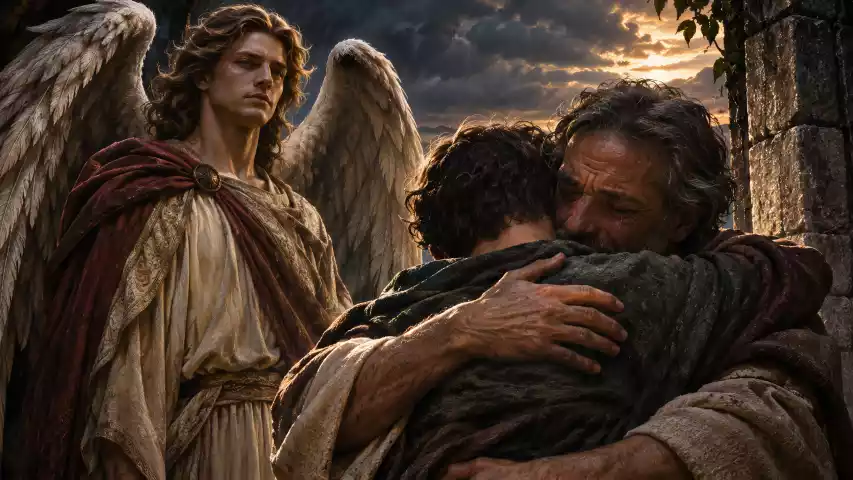
Chamuel has no portrait specified in biblical scripture. Unlike the four living creatures of Ezekiel or the richly described visionary beings of other biblical scenes, he is not given a body, number of wings, clothing, weapon or facial expression in an authoritative narrative. Paintings and illustrations labelled Chamuel therefore represent later artistic choices. A generic winged human figure is a convention for representing angels; it is not evidence that an ancient author supplied that exact appearance. This absence matters because modern images often look deceptively traditional even when their colors, gestures and attributes originate in recent devotional culture.
Pink light and the heart
Contemporary angel spirituality frequently depicts Chamuel with rose or pink radiance, a gentle expression, light clothing and motifs of hearts or blossoms. These colors express the themes of love, compassion and emotional peace assigned to him in that setting. They are particularly prominent in teachings about spiritual rays and coordinated groups of seven archangels. No passage of the Hebrew Bible, New Testament or Agrippa’s Martian register establishes a pink garment as a historical attribute of Chamuel. The symbol belongs to a recognizable modern system of visualization, and its meaning is clearer when the period and devotional context are identified.
The older martial palette
Images based on Camael may instead employ the sword, iron, red light, military attire or a severe stance. The connection follows the Renaissance alignment of Camael with Geburah and Mars, and from broader European conventions that represent celestial warriors with arms. Such imagery is not a portrait of a personally witnessed angel. It visualizes a set of astrological and occult relationships. The sword may symbolize judgement or discernment in one source and combat in another. Later artists can blend the martial and loving versions, but no ancient source requires the combination of pink wings, a sword and a heart.
Names and visual labels
The same image may be catalogued under Chamuel, Camael, Kamael or Camiel. In books about angelic names these spellings are sometimes treated as variants, while other studies reserve them for divergent strands of literature. Transliteration alone does not settle the issue because language, manuscript transmission and later editorial decisions all affect spellings. Kemuel is additionally the name of biblical men, not an angel identified in the relevant biblical verses. The appearance of the letters in an image caption cannot establish the figure’s antiquity.
Biblical passages often misattributed
Genesis 32 recounts Jacob wrestling an unnamed figure and receiving the name Israel. Later interpretations identify the opponent in various ways, but the biblical narrative does not call him Chamuel. Luke 22:43, in textual traditions that contain the verse, describes an angel from heaven strengthening Jesus at Gethsemane; again the angel is unnamed. Assigning Chamuel to either scene is a subsequent interpretation. Because the Luke verse also has a known textual-critical history in manuscript discussion, neither its presence nor its omission can establish Chamuel’s name.
The Book of Enoch and seven names
First Enoch 20 presents a list of seven holy angels with specific tasks, commonly including Uriel, Raphael, Raguel, Michael, Saraqael, Gabriel and Remiel, although spellings vary by edition. Chamuel does not securely occur in that roster. The book’s reception also varies: it is scripture within Ethiopian Orthodox Christianity, while other Christian traditions regard it differently. Modern lists replacing some of those names with Chamuel are not quotations from First Enoch 20. The distinction separates an ancient apocalyptic witness from later systems of seven rays or seven archangelic offices. The seven names in First Enoch and the members of later seven-ray systems do not form an identical list.
Agrippa as a dated witness
Heinrich Cornelius Agrippa’s Three Books of Occult Philosophy is a principal early modern witness for Camael, a spelling frequently linked to Chamuel. Book III chapter 10 places Camael in the discussion of Geburah, the fifth divine name and its influence through the sphere of Mars. Chapter 24 provides a list of planetary angels in which Camael again appears over Mars. In the same work other catalogues use different names for certain planetary offices, underscoring the variability of compilations. These passages attest an occult arrangement in the sixteenth century; they do not supply the angel of modern romantic reconciliation with a biblical pedigree.
Early modern and modern reference works
Thomas Heywood’s The Hierarchie of the Blessed Angells, published in 1635, is another documented example of early modern English interest in named angels; the angelic name Camael appears among its broader names and orders. Gustav Davidson’s A Dictionary of Angels, published in 1967, groups Camael with several alternative forms including Chamuel, demonstrating how reference literature consolidates spelling traditions. Neither fact makes every modern attribute ancient. The modern association with compassionate love is documented in the Summit Lighthouse movement: an address attributed to Chamuel and delivered through Elizabeth Clare Prophet on 18 August 1975 was printed in Pearls of Wisdom in 1976, while another text attributed to Chamuel appeared in November 1982. These publications associate the figure with divine love and the third ray; they are modern devotional testimonies, not ancient scripture.
Jewish textual background and its limits
Jewish tradition contains rich angelological material, ranging from biblical messengers to later mystical writings, liturgy and tales of heavenly courts. The name Kemuel appears in Jewish legendary contexts as a guardian or gatekeeper in stories concerning Moses, while Camael appears in Western esoteric presentations of the sefirot. Those strands are not automatically identical to modern Chamuel. Kemuel in the Hebrew Bible can refer to human individuals, a further reason not to use a name match as proof of angelic identity. The influence of Jewish vocabulary in Renaissance Christian occultism is historically significant, but that influence does not make every subsequent angelic catalogue an expression of normative Jewish theology.
Christian devotion and official teaching
Popular Christian and Christian-influenced angel devotion sometimes honors Chamuel as one of seven archangels of compassion. His name is absent from the biblical texts normally used to establish the named messengers Michael and Gabriel, as well as from Tobit’s account of Raphael. The Roman Catholic Directory on Popular Piety and the Liturgy, number 217, specifically discourages giving angels additional personal names. That document does not deny that angels beyond the named three exist; it sets a boundary for popular devotion. Images, prayers and claims about Saint Chamuel circulating outside such an official framework are examples of devotional diversity, not evidence of universal Catholic or Orthodox recognition.
Renaissance cosmology
Renaissance occult authors integrated planetary astrology, Christian theology and adapted Jewish mystical language into elaborate charts. Camael is one of the names situated in these correspondences. In Agrippa, the Martian connection is not incidental decoration; it belongs to an ordered structure that relates the fifth divine name, the virtue of judgement and a planetary sphere. The language is far removed from a contemporary promise of romantic healing. Later occult works and ceremonial manuals can transmit or modify the same name, but their tables differ. The historical development is visible in the differing arrangements rather than in an imagined unchanging tradition extending back to biblical times.
Contemporary spiritual currents
In late modern angel spirituality Chamuel frequently appears in meditation guides, angel-card systems, prayers for emotional peace and teachings on colored rays. These practices often give a sympathetic, nonmilitary meaning to the name. Some writers use a sevenfold structure that includes Jophiel and Zadkiel; others vary the set and its colors. Devotees may understand these associations as lived religious experience, while historians document the texts, images and communities that preserve them. The phrase archangel of love is a descriptive label within these currents, not an ancient title established in scripture.
The unidentified visitor to Jacob
The narrative of Genesis 32 centers on Jacob’s struggle during the night near the Jabbok. The mysterious opponent blesses him, and Jacob receives the name Israel. In Jewish and Christian interpretation the wrestler has been described in differing ways, including as an angelic figure. Some modern accounts identify this being with Chamuel, but Genesis does not give that name. The episode therefore belongs to Chamuel’s later reception, not to a recoverable primary biography of him. Its thematic connection with transformation or struggle may have made the scene appealing to authors combining different angelic traditions, even though the textual identification is absent.
The unnamed angel at Gethsemane
Luke 22:43 portrays an angel strengthening Jesus in the garden during his anguish in manuscript traditions preserving the verse. The angel is not named. Later devotional interpretations have sometimes proposed Chamuel or another archangel for the role, but there is no naming statement in Luke. Because the passage concerns divine assistance amid distress, it readily attracts interpretive associations with consolation, compassion and courage. These associations reveal the interests of subsequent interpreters. They do not support a claim that a biblical evangelist taught the identity of Chamuel or described his pink light, powers of reconciliation or membership among a fixed group of seven archangels.
Kemuel and the heavenly gate
Accounts about a heavenly guardian named Kemuel appear in later Jewish legendary and midrashic retellings involving Moses and ascent through the heavens. Some compilations merge Kemuel with Chamuel or Camael because of the similarity of the forms. The gatekeeping role, however, belongs to a particular narrative strand, not to the canonical account of Moses receiving the law. The story contributes a contrasting portrayal of heavenly authority and access: a guardian of thresholds rather than a messenger of romantic peace.
Experiences in contemporary testimony
Modern stories about Chamuel generally take the form of personal testimony rather than an ancient legend with a fixed plot. A devotee may describe peace after a quarrel, comfort during grief or the unexpected recovery of an object, and interpret the experience as an answer to prayer. These reports explain why the name remains meaningful in contemporary spirituality. They do not provide independently verified evidence for an angel’s intervention, nor do they authorize promising the same result to everyone. Their narrative structure is also different from an epic, an apocalyptic journey or a medieval miracle collection: the speaker’s experience, rather than a stable inherited episode, gives the story its authority.
Camael and the disputed identity
Camael is the closest historically relevant parallel to Chamuel. Agrippa’s sixteenth-century Camael belongs to Mars and Geburah, while Chamuel in contemporary devotional literature belongs predominantly to love and reconciliation. Some reference books treat them as alternative spellings of one angelic name; others distinguish their roles in practice. The Martian attributes of Camael in Agrippa contrast with the loving attributes of Chamuel in modern devotion. Neither source offers an angelic family tree or a human genealogy. The relationship is primarily between names and transmitted systems of angelology.
Michael, Gabriel and Raphael
Michael and Gabriel are named in Christian biblical texts; Raphael identifies himself in Tobit. They are often placed beside Chamuel in popular lists of archangels, but that juxtaposition is an arrangement made by particular authors. No ancient canonical episode narrates Chamuel fighting at Michael’s side or carrying Gabriel’s messages. The contrasts are more informative than invented collaborations: Michael is associated with conflict and protection in named scriptural passages, Gabriel with announcement and interpretation, and Raphael with healing in Tobit. Chamuel’s familiar role emerges from a later body of devotion. The presence of these established names within a modern list gives that list a recognizable religious vocabulary without conferring equal textual status on every member.
Uriel and other expanded rosters
Uriel appears in apocalyptic and other noncanonical or differently canonical texts, making him important in the history of expanded angelic catalogues. Modern seven-archangel lists sometimes place Uriel with Chamuel, Jophiel and Zadkiel. Membership and order vary from one source to another. The relation between these figures is therefore chiefly classificatory: they share space in a constructed spiritual system, not an attested common mission in scripture. No reliable evidence establishes a personal alliance or rivalry between Chamuel and Uriel. Their juxtaposition can illuminate how later communities select, rename and arrange heavenly intermediaries.
Samael and Kemuel are not automatic synonyms
Samael has a distinct and sometimes adversarial role in strands of Jewish angelology and in magical literature, while Kemuel is encountered in narratives of a heavenly guardian. Confusion arises because of similar sounding names and because planetary tables may place different angel names in adjacent functions. The early modern Heptameron, for example, names Samael in connection with Tuesday and Mars, whereas Agrippa includes Camael over Mars in a particular list. Those are two textual facts, not proof of an identical being. For Chamuel, genealogical relationships such as spouse, child or parent cannot be responsibly supplied from these sources; the meaningful links are textual and historical.
Scripture and manuscript boundaries
Genesis 32:22–32 provides the encounter between Jacob and the unnamed wrestler. Luke 22:39–46 includes the Gethsemane episode, with the angel in verse 43 in textual traditions that transmit it. Neither narrative names Chamuel. First Enoch 20 lists seven holy angels under several names, but does not securely identify a Chamuel. Tobit 12:15 identifies Raphael; Daniel 10 and 12 and Luke 1 name Michael or Gabriel in their own narrative settings. The differences between biblical canons also matter: Tobit and First Enoch do not enjoy identical canonical status across Jewish, Protestant, Catholic and Ethiopian Orthodox communities.
Heinrich Cornelius Agrippa
Three Books of Occult Philosophy, Book III chapter 10, connects the angelic name Camael to Geburah and Mars in a graded account of divine names and celestial powers. Book III chapter 24 explicitly names Camael among planetary angels. These are sixteenth-century witnesses to the name Camael. In the discussion of the planetary catalogues, the presence of alternative names in other lists is itself historically revealing. The work belongs to Renaissance occult philosophy rather than canonical scripture; its cosmological classifications are not shared doctrines of all Jewish or Christian communities.
Later printed angelology
Thomas Heywood, The Hierarchie of the Blessed Angells (London, 1635), documents seventeenth-century English interest in named heavenly orders. A Dictionary of Angels by Gustav Davidson (1967) is a modern reference work that collects alternative angelic names, including the Camael/Chamuel cluster, while requiring care about the very different dates of its component testimonies. A dictionary collecting synonyms is not proof that every textual tradition understood them in the same way. For the contemporary association with divine love and the pink or third ray, the Summit Lighthouse publications provide dated firsthand evidence of what that movement taught. A discourse attributed to Chamuel was delivered through Elizabeth Clare Prophet on 18 August 1975 and printed as Pearls of Wisdom, 1976, chapter 24; another attributed discourse was printed as Pearls of Wisdom, 1982, chapter 47. These are primary testimonies for the movement’s beliefs, not independently verified angelic revelations or ancient Christian doctrine.
Institutional and historical evidence
The Vatican’s Directory on Popular Piety and the Liturgy, paragraph 217, supplies a precise modern Catholic position on naming angels. It discourages names other than Michael, Gabriel and Raphael, identifying an official boundary without determining what every private devotee believes. Scripture, apocalyptic literature, Renaissance occult philosophy and modern spiritual movements provide evidence from different periods and communities. None of the ancient sources cited here documents a birthplace, an established early iconography or a universal feast day for a biblical angel named Chamuel.
Primary texts and reference editions
- Agrippa, Three Books of Occult Philosophy, Book III (ch. 10)
- Agrippa, Book III (ch. 24)
- Vatican, Directory on Popular Piety, §217
- Vaticano, Directorio sobre la piedad popular, §217
- Thomas Heywood (1635), Wellcome Collection
- Gustav Davidson, A Dictionary of Angels (1967)
- Elizabeth Clare Prophet / The Summit Lighthouse, Pearls of Wisdom (1976), chapter 24; discourse of 18 August 1975
- The Summit Lighthouse, Pearls of Wisdom (1982), chapter 47; Chamuel, 21 November 1982