Who is Bifrons?
Bifrons is spirit forty-six of the Ars Goetia, the first section of the Lesser Key of Solomon. The text classifies him as an Earl and credits him with command of six legions. He first appears in an unspecified monstrous form, subsequently adopting the appearance of a man when directed by the exorcist. His office combines two apparently disparate fields: the teaching of learned arts and the unsettling manipulation of burial places. These specific, documented characteristics define Bifrons better than later inventions about an elaborate demonic genealogy.
A peculiar mixture of learning and the grave
The description first associates Bifrons with astrology, geometry, and other arts and sciences. It then names the virtues or attributed properties of precious stones and woods. Finally, it shifts to the dead: Bifrons moves corpses into other places and makes seeming candles appear above graves. The startling contrast between scholarly instruction and funerary disturbances is not a modern interpretation; it is built into the primary catalog entry.
What the monster looks like
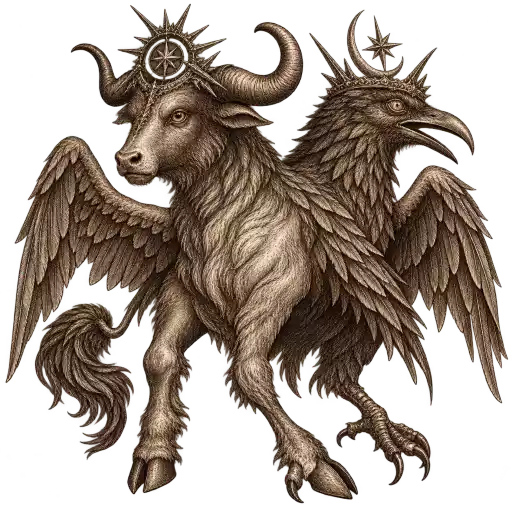
No anatomical description of the original monster is supplied in the standard numbered text. It does not prescribe two faces, horns, wings, a skeleton or any specific animal parts. The later human transformation is explicit, but an artist who assigns distinctive physical features to the initial form is interpreting a gap rather than reproducing documented detail. This difference between source and illustration is crucial for a reliable entry.
Name and historical setting
The printed Goetia gives the variants Bifrous and Bifrovs alongside Bifrons. Latin bifrons means two-fronted or two-faced and can recall Janus Bifrons in Roman literature. Nevertheless, resemblance of a name is not evidence that the Goetic Earl is identical with Janus, has a Roman cult, or is a continuation of the ancient deity. His securely documented setting is early modern European demonology and the Solomonic grimoire tradition.
Editorial classification
Bifrons belongs to the grimoire record rather than to a verified independent mythology or historical religion. This entry accordingly uses the Folklore flag without assigning a specific mythological or religious tradition. Its links focus on named beings with documented relationships, while subjects such as grave lights, geometry, woods and stones remain topics within the explanatory text.
An Earl of six legions
Bifrons carries the rank of Earl, sometimes translated Count, and commands six legions in the standard Ars Goetia description. The small total should not be silently replaced by larger modern figures such as twenty-six or sixty, which sometimes circulate in derivative lists. The documented six remain the editorial baseline, with discrepancies mentioned only where an identifiable source warrants them.
A monster, then a man
At first Bifrons appears in the form of a monster; after a while and at the command of the exorcist, he takes human shape. The sequence is more important than any imagined anatomy. Unlike several other Goetic beings, the text provides no named animal or hybrid body for him. A faithful icon or representational image should not be passed off as an exact reconstruction of an unspecified monster.
Intellectual range
Bifrons is an instructor in astrology, geometry, and other arts and sciences. Geometry implies measured space and mathematical demonstration, while astrology belongs to the historical study of celestial influences. Both belonged to overlapping worlds of medieval and early modern learning, though their methods and modern scientific standing differ. The catalogue gives a set of subjects, not a curriculum, treatise or named school.
Precious stones and woods
Bifrons explains the virtues of precious stones and woods. The term virtues means qualities and powers historically attributed to materials; it is not a modern laboratory claim. Some derivative summaries add herbs, but the standard Mathers/Crowley sentence expressly names precious stones and woods. Preserving the actual wording helps distinguish Bifrons from Stolas, whose comparable office explicitly names herbs.
A funerary role
The same Earl is assigned the removal or relocation of dead bodies and the appearance of seeming candles on graves. These features give Bifrons a funerary association, but the catalog does not establish him as a sovereign of the underworld, a psychopomp, or ruler of disembodied souls. Those would be additional assertions requiring separate evidence.
Not a two-faced portrait from the text
Although the Latin form of his name lends itself to a two-faced visual interpretation, the Goetia itself does not instruct that he literally has two faces. Bifrons may be explored as a name parallel to Janus Bifrons; he should not, however, be credited with a proven Janus identity, kinship or cultic history.
Astrology and celestial interpretation
The catalog explicitly says that Bifrons can make someone knowledgeable in astrology. In early modern European writing astrology was often discussed beside astronomy and mathematical arts, but the wording here is specifically astrology. It should not be silently changed to astronomy; distinguishing the terms preserves what the source actually attributes to him.
Geometry and the learned arts
Geometry is the second explicitly named discipline. The extension to other arts and sciences suggests a broad educational function, without defining every subject involved. It is inappropriate to construct an exhaustive list of seven liberal arts or advanced occult techniques and present them as Bifrons’s personal syllabus. His expertise is clear; its precise boundary is not.
The virtues of stones
The virtues of precious stones belong to traditional lapidary knowledge, in which gems were assigned medicinal, protective, astrological or symbolic qualities. Such claims reflect the intellectual world of older compendia and should be reported as historical beliefs, not endorsed as established effects. Bifrons is cast as an interpreter of that inherited material lore.
The virtues of woods
The source also singles out woods rather than providing a general inventory of plants. Wood could carry symbolic, practical and occult associations in early natural philosophy. The text does not name particular trees, prescribe recipes or identify supernatural effects for individual species. Accordingly, this entry leaves those details unstated rather than inventing them.
Moving dead bodies
The description says Bifrons changes dead bodies and places them elsewhere. This is a claim of physical relocation of remains in the grimoire narrative, not proof of an observed event. The exact mechanism is not described. It also does not say he raises the dead to life or commands their souls, which are separate concepts commonly merged in popular summaries.
Seeming lights above graves
Bifrons is said to light seeming candles on graves. The adjective seeming matters: it can indicate a visual appearance or phantom illumination without asserting ordinary physical candles. Later imagery of cemetery lights can be evocative, but the source supplies no witness account, location, date or explanation of the effect.
Limits of his office
The original list does not grant Bifrons unqualified power over all ghosts, resurrection, plague, the Roman god Janus or a kingdom of necromancers. These topics might appear in modern fiction or speculative interpretation, but his documented offices are education in specific disciplines, material virtues, relocation of bodies and apparent grave lights.
The Ars Goetia, entry XLVI
The forty-sixth office in the Ars Goetia names Bifrons, with Bifrous and Bifrovs as variants. He is an Earl, initially a monster and later a man. The passage assigns astrology, geometry and other arts and sciences, the virtues of precious stones and woods, the relocation of dead bodies and seeming candles above graves, along with six legions. This numbered passage is the foundational source for the present entry.
The Lesser Key and manuscript tradition
The Goetia forms part of the Lemegeton, a larger compilation transmitted in early modern manuscripts and subsequently printed. Editions may differ in spellings, punctuation and the treatment of manuscript readings. Those differences require comparison rather than treating every modern web summary as equivalent to a manuscript witness. The spelling Bifrovs in particular reflects historic textual presentation.
Mathers and Crowley’s edition
The influential 1904 English edition by S. L. MacGregor Mathers and Aleister Crowley preserves the thirty-sixth? No: Bifrons is explicitly the forty-sixth spirit. Its description states that Bifrons has six legions and presents the puzzling grave-candle imagery. The edition is a modern publication of older material, not an independent eyewitness account of supernatural occurrences.
Earlier demonological context
Johann Weyer’s Pseudomonarchia Daemonum belongs to the preceding European literature of catalogued spirits and provides useful context for how such lists developed. Editorial comparison should establish exactly which wording belongs to which witness. It would be misleading to transfer every difference or interpretation into the core Goetia description without a distinct reference.
Sigil and documentary evidence
A seal accompanies Bifrons in the Goetic diagram tradition. A seal is documentary evidence for how the spirit was represented in the ritual manuscript, not proof that a particular depicted monster or two-faced being was historically witnessed. Copies and engravings can vary in line weight or detail; such variation does not multiply the entity.
Later angelic pairing
In the later correspondence scheme associated with Thomas Rudd, the Goetic spirit numbered forty-six is paired with the Shem angel Ariel. This is relevant as a documented later interpretive relationship, but Ariel is not called a family member or ancient counterpart in the standard Ars Goetia office itself.
The funerary disturbance
Among Bifrons’s attributed acts, the relocation of bodies and seeming lights on graves supplies the most evocative legendary material. Such images resonate with early modern fears of disturbed burial, hidden work in churchyards and uncertain phenomena observed near graves. The numbered source presents them as powers, however, not as a dated story about a named cemetery or identifiable historical victim.
Apparent candles and phantom-light lore
A light apparently burning upon a grave can evoke ghost lights and other funeral folklore. That resemblance is a comparison, not a proof that all grave-light traditions originated with Bifrons. The phrase seeming candles supports an interpretation involving deceptive or visionary lights, but does not tell the reader what observers would physically see.
No ancient Janus legend is established
Because Bifrons is a Latin epithet historically associated with the two-faced Janus, writers sometimes imagine the Goetic spirit as a disguised Roman god. The name invites study, but no primary Goetic passage establishes that identity. It is an editorial mistake to translate a verbal resemblance directly into a shared biography, theology or mythology.
A scholar in a cemetery
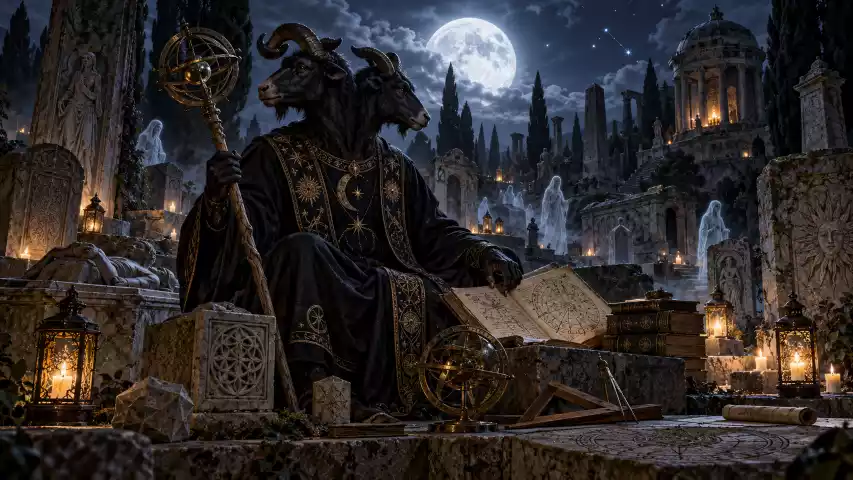
The juxtaposition of mathematical knowledge and disturbed graves may seem contradictory. Rather than inventing a missing narrative, it is better to recognize that early modern spirit catalogues frequently combine learned and unsettling offices without explaining their connection. This mismatch is part of what makes the entity distinctive and appropriate for a careful source-based article.
No separate prophecy
The usual description does not assign to Bifrons an eventual return to heaven, a specified future apocalypse or a prophecy about particular rulers. Unlike some Goetic spirits, Bifrons has no explicit Seventh Throne story in the standard entry. Adding such an episode would confuse him with another being.
Modern expansion and boundaries
Modern demonographies may add necromantic hierarchies, personal alliances, faces and detailed backstories. These can be discussed as reception or fiction if independently sourced; they must not be silently inserted into a historical reconstruction of the Ars Goetia.
Historical Solomonic setting
Bifrons is catalogued within the Ars Goetia, whose larger ceremonial context speaks of seals, divine names, diagrams and the command of spirits. This section documents how the tradition situated the Earl; it is not an operational guide. The relevant historical fact is that Bifrons’s transformation into human form occurs by command within that literary framework.
What the operator was said to seek
The offices offer two different aims in the language of the grimoire: instruction in astrology, geometry and material virtues, and intervention in burial places. The book does not record any authenticated operation performed by a named historical operator. A responsible treatment distinguishes what the text promises from what can be established to have happened.
Transformation and control
The movement from a monster to a man illustrates a common motif in the Goetic catalogue: the operator exercises formal authority over an initially uncanny apparition. The source does not state how the first form looks, nor does it provide an individualized invocation story for Bifrons. The wording is therefore evidence of ritual ideology, not a full biographical scene.
The seal as an identifier
The seal presented with the forty-sixth office functions as a means of identifying the spirit within the grimoire tradition. Historical study can compare the forms preserved in manuscript and print. Its inclusion here does not require reproducing instructions for making, deploying or using it.
The cemetery material in context
Claims about changing bodies and placing seeming candles on graves appear among the spirit’s offices. They should be understood in a historical and literary context rather than as encouragement to interfere with actual graves. There is no need for the entry to present procedures, recipes or experimental verification of such claims.
The protective logic of the text
Like other Goetic entities, Bifrons belongs to a ritual literary setting in which spirits are controlled by authority rather than approached as ordinary companions. The protective apparatus of the larger grimoire reflects the authorial assumption that infernal beings should be constrained. This section records that assumption without claiming the techniques possess demonstrated supernatural effects.
The human form is commanded
The command that makes Bifrons take the shape of a man is part of the entry’s internal system of control. It should not be embellished into a specific protective rite unique to Bifrons, because no such separate rite appears in the standard brief office.
Folklore and burial anxiety
Bifrons is readily situated alongside folklore concerning cemeteries, corpse displacement and mysterious lights. Those associations are valuable for interpretation, but a comparison with a folk motif should not be treated as proof that a particular local custom or burial legend names him.
No supernatural medical or forensic claims
The descriptions of dead bodies and lights are textual attributions. They are not forensic observations, medical explanations or verified paranormal evidence. Grave disturbances have ordinary physical and social explanations, and the entry should keep the distinction between historical belief and empirical claim explicit.
Classification without invented worship
Bifrons is set under Folklore as a grimoire entity, with no assigned mythology or religion. There is no secure basis for describing him as a worshipped Roman god, a biblical character or a member of an independent ancient cult. Editorial precision is a stronger safeguard than a fabricated lineage.
Ariel, the later angelic counterpart
Ariel is the forty-sixth angel in the later Shem HaMephorash correspondence scheme associated with Thomas Rudd. Because Bifrons is likewise the forty-sixth spirit of the Goetia, this later matching creates a historically intelligible angelic counterpart relationship. It is appropriate to include Ariel as the single structured entity relation, explicitly marked as later rather than original to the numbered office.
Bifrous and Bifrovs are spellings
Bifrous and Bifrovs belong in alternative names because they are variants of Bifrons itself. Their inclusion as independent related beings would duplicate the same subject and confuse the directory.
Janus is not identified with Bifrons
The epithet Janus Bifrons provides an interesting linguistic comparison but not a documented entity relationship. Without source evidence identifying the Earl and the Roman god, Janus should remain a point of textual analysis, not a parent, equivalent or structured relation.
Related functions are not genealogies
Bune and Murmur may be compared with Bifrons because other Goetic entries have funerary or necromantic themes. Shared domains, however, do not make these spirits relatives or allies. Such comparisons should occur in explanatory prose or editorial articles, not in the structured list of documented relations.
Missing-entity policy
If Ariel is not yet available in the same-language directory, the relation may appear in the pending-entities review workflow. The correct action is to preserve a grounded named relation without fabricating extra entities or linking to a page in the wrong language.
Primary grimoire: Ars Goetia, XLVI
The numbered entry gives the core: Bifrons, an Earl of six legions, monstrous before becoming human; a teacher of astrology, geometry, other arts, precious stones and woods; a mover of corpses and producer of seeming candles on graves. Readable text: Joseph H. Peterson, Lemegeton / Goetia transcription, Esoteric Archives, https://www2.esotericarchives.com/solomon/goetia.htm .
Historical printed edition
S. L. MacGregor Mathers and Aleister Crowley, The Goetia: The Lesser Key of Solomon the King (1904), office 46. A readable transcription appears in the Internet Sacred Text Archive at https://original.sacred-texts.com/grim/lks/lks05.htm and the Hermetic Library at https://hermetic.com/norton/classics/goetia/bifrons .
Earlier demonological comparison
Johann Weyer, Pseudomonarchia Daemonum, in the sixteenth-century European demonological tradition. Its witnesses provide comparative context for naming and catalogued offices; differences should be attributed to each witness rather than harmonized without notice.
Later correspondence
The Goetia of Dr Rudd, edited by Stephen Skinner and David Rankine (2007), documents the later tradition pairing spirits with angels of the Shem HaMephorash. Ariel is the corresponding angel at number 46. This material is secondary to the older Ars Goetia office.
Limits of the record
Neither the Goetia office nor its better-known textual witnesses demonstrate that Bifrons and Janus are the same being, that the monster has exactly two faces, or that the reported grave lights constitute observed physical events. These claims require separate evidence and are not asserted as primary-source facts.