
Asmodeus: Demon of Lust, Wrath and Destructive Desire
Identity and historical background
Asmodeus is one of the most famous demons in Jewish, Christian and later occult tradition. Unlike many demons known primarily from one medieval grimoire, Asmodeus has a long and layered history. His roots are often traced to the Iranian or Avestan demon Aēšma daēva, a spirit associated with rage, violence and uncontrolled impulse. Through cultural transmission and reinterpretation, this background contributed to the figure known in later Jewish tradition as Asmodeus or Ashmedai. Because of this history, Asmodeus belongs to a broad arc that includes ancient Near Eastern religion, Second Temple and rabbinic Judaism, Christian demonology and later ceremonial magic.
From destructive spirit to named demon
Asmodeus becomes especially prominent in the Book of Tobit, where he is portrayed as the demon who kills the husbands of Sarah before their marriages can be consummated. This story establishes him as a demonic force linked with jealousy, lust, obstruction of marriage and violent hostility. Later rabbinic literature expands his personality, sometimes presenting him with a mixture of menace, cunning and even dark humor. Medieval and early modern occult tradition then amplifies him further, transforming him into a king or prince of hell with authority over infernal legions and with influence over desire, gambling, vengeance, luxury and hidden knowledge.
Why Asmodeus matters
Asmodeus matters because he sits at the intersection of several major themes in demonology: the corruption of love, the distortion of desire, the danger of passion without restraint and the transformation of a destructive spirit into a major infernal ruler. He is neither merely a biblical footnote nor only a grimoire spirit. He is one of the clearest examples of how a demon can evolve across traditions and genres.
Scope for Grimorium
For Grimorium, Asmodeus must be presented carefully as a layered figure. The Asmodeus of Tobit is not exactly the same as the Ashmedai of rabbinic lore, nor is either identical to the king Asmodeus of the Ars Goetia or the elaborate demonologies of early modern Europe. These historical layers overlap, but they should not be collapsed without explanation. Treating them distinctly makes the profile more accurate and much more useful.
Demonic appetite and excess
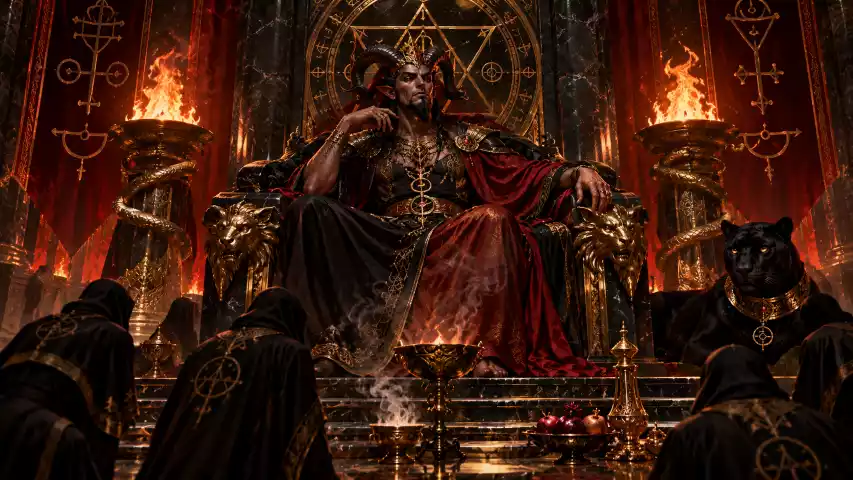
One of Asmodeus’ defining characteristics is excess. He is associated with lust, appetite, anger, jealousy, revenge and the destruction that follows when desire becomes tyrannical. He is not simply a demon of sensuality in a superficial sense, but of desire turned predatory, possessive and ruinous.
Cunning, mockery and intelligence
Later stories, especially in rabbinic tradition, often portray Asmodeus as clever, manipulative and darkly ironic. He can deceive, test human weakness and exploit pride. This makes him a far more psychologically interesting figure than a simple brute destroyer. In some accounts he behaves like a trickster-demon who reveals human folly even while embodying danger.
Violence toward marriage and order
The Tobit tradition makes Asmodeus a demon who attacks the threshold of marriage. His violence is aimed at union, household stability and sexual order. He therefore becomes an enemy not only of chastity, but of lawful relationship itself when desire is corrupted by envy and domination.
Infernal nobility in later demonology
In medieval and early modern demonological catalogues, Asmodeus is frequently described as a king, prince or great ruler among demons. These portrayals give him a quasi-royal infernal dignity and often connect him with legions, occult knowledge and elite vice. This later image strongly shaped his afterlife in literature and occultism.
Variable tone across sources
Asmodeus is particularly interesting because the tone of his portrayal changes from source to source. He can appear as a murderous demon, a cunning supernatural opponent, a folkloric trickster, a king of hell or a symbolic figure of lust and vengeance. All of these traditions matter, but none should be mistaken for the only authentic version of the demon.
Lust and erotic disorder
Asmodeus is most famously associated with lust and the corruption of erotic desire. In later Christian and demonological classification, he is often counted among demons connected with the deadly sin of lust. Yet his power is not limited to simple seduction; it includes obsession, possessiveness, jealousy and destructive sexual fixation.
Anger, wrath and violent impulse
His older Iranian background in Aēšma daēva links him strongly with wrath, frenzy and violent disturbance. This dimension remains important even when later traditions place greater emphasis on sexuality. Asmodeus is not only sensual but incendiary—one who turns impulse into ruin.
Obstruction of marriage and domestic harmony
The Book of Tobit gives Asmodeus a defining role as destroyer of conjugal union. Because he kills Sarah’s husbands before the marriage can be consummated, he becomes a demon associated with interference in marriage, fertility and household stability. This is one of his oldest and most historically grounded domains.
Gaming, luxury and hidden vice
Later demonologies frequently attribute to Asmodeus influence over gambling, luxury, overindulgence and corrupt pleasures. These are historical attributions from later tradition rather than early scriptural facts, but they became central to his image in occult and moral literature.
Knowledge and revelation in grimoire tradition
In some magical catalogues, Asmodeus is credited with revealing hidden treasures, answering questions about astronomy, geometry or craftsmanship and granting secret knowledge. This may seem paradoxical for a demon of lust, but it reflects the tendency of grimoires to ascribe specialized powers and skills to infernal rulers.
Book of Tobit
The Book of Tobit is the most important early textual witness for Asmodeus. In this narrative, Asmodeus kills seven prospective husbands of Sarah before they can consummate marriage with her. Tobias, guided by the angel Raphael, defeats the demon by burning the heart and liver of a fish, whose smoke drives Asmodeus away. Raphael then binds him in Egypt. This episode is fundamental for understanding Asmodeus’ historical role as a demon of obstructed marriage, violence and lustful jealousy.
Talmudic and rabbinic tradition
Rabbinic literature knows a figure usually called Ashmedai. In passages such as Gittin 68a–b, Ashmedai appears in relation to King Solomon and the building of the Temple. These traditions portray him as powerful, intelligent and sometimes ironically revealing of human vanity. He is not merely a destroyer but a narrative agent through whom wisdom, mockery and disorder interact.
Medieval demonology
In medieval and Renaissance demonological compilations, Asmodeus grows into a major infernal power. Writers assign him ranks such as king or prince and place him among important demonic hierarchies. He may be linked to specific sins, especially lust, and sometimes depicted with bizarre composite forms that underscore his monstrous power.
The Ars Goetia
In the Ars Goetia, Asmoday appears as one of the named spirits, often numbered as the thirty-second spirit. He is usually described as a great king with multiple heads, breathing fire and riding a dragon, and as ruling seventy-two legions. He is said to teach arts, arithmetic, astronomy and geometry, and to reveal treasures. This Goetic form of the demon is highly influential, though it represents a later ceremonial-magical layer rather than the earliest understanding of Asmodeus.
Broader occult and literary tradition
Beyond the Goetia, Asmodeus appears in other demonologies, occult manuals and literary works. These sources helped consolidate the image of Asmodeus as both a demon of lust and an infernal nobleman of cunning intelligence.
Sarah and the seven husbands
The most famous legend surrounding Asmodeus is the Tobit narrative in which he slays seven men who attempt to marry Sarah. The story presents him as a jealous destroyer of marriage and one whose violence is intimately tied to frustrated desire. This is not just a stray anecdote; it is the narrative foundation of his later reputation.
Raphael’s defeat of Asmodeus
Equally important is the story of his defeat. Tobias, instructed by Raphael, burns the fish organs, and the smoke drives Asmodeus away to Egypt, where Raphael binds him. This scene made Asmodeus a major figure in traditions about angelic protection and demonic expulsion.
Solomon and Ashmedai
Later Jewish legend, especially in rabbinic tradition, associates Ashmedai with King Solomon. These stories frequently explore pride, kingship, wisdom and reversal. In some versions Ashmedai tricks or humiliates Solomon, temporarily taking his place. Such legends reveal a demon who is not merely lustful but intellectually dangerous and symbolically subversive.
Asmodeus and infernal courts
In demonological literature, Asmodeus becomes part of the royal imagery of hell. He is not treated only as a rogue spirit but as a ruler with authority, legions and an infernal sphere of influence. This regal image becomes especially important for occult and literary portrayals.
Prophetic and moral interpretations
Though not a prophetic figure in the strict sense, Asmodeus is often used morally in later Christian and Jewish interpretation as a warning about lust, disordered passion and the collapse of household order. He becomes a narrative embodiment of desire severed from virtue and discipline.
Historical Accounts of Conjuration
The Testament of Solomon and early-modern grimoires depict demons questioned, constrained or commanded within literary and ritual frameworks. Asmodeus receives a seal and rank in the Goetic manuscripts. These writings are relevant to the history of religion, magic and demonological classification, but they do not verify the supernatural powers they describe.
Source Boundaries
Tobit is a story of divine aid through Raphael, not a manual for summoning Asmodeus. The Talmudic Ashmedai story is also a narrative rather than a standard Jewish invocation. Modern claims about universally required tools, colors or contracts do not follow directly from these ancient texts.
Raphael and the Fish in Tobit
The best-documented protective episode is Tobit 6–8: Raphael explains a method involving fish heart and liver, whose smoke drives Asmodeus away, and the angel later binds the spirit. This is a description of what the narrative reports, not medical guidance or a universal prescription for modern ritual use. The story combines practical-looking motifs with trust in divine intervention.
Prayer, Amulets and Later Practice
Prayer and divine protection are integral to Tobit's plot. Some later magical and religious texts name angelic forces opposed to demons, but practices differ across time and region. No one historical item can be established as the mandatory Asmodeus ward across all Jewish, Christian and grimoire traditions.
Sarah and Tobias
Sarah and Tobias are essential narrative relations because the Book of Tobit is the foundational text for Asmodeus. Sarah is his victim within the story, while Tobias—guided by Raphael—becomes the human agent through whom the demon is driven away.
Raphael
Raphael is one of the most important figures associated with Asmodeus because he provides the means of defeat and personally binds the demon. Any serious profile of Asmodeus should note this relationship.
Solomon
In rabbinic legend, Solomon is closely tied to Ashmedai. Their relationship explores power, wisdom, kingship and humiliation, and it strongly influenced later magical narratives.
Lilith and Samael
In broader Jewish and occult demonological networks, Asmodeus is frequently discussed alongside Lilith and Samael as part of a larger infernal landscape involving sexuality, temptation and destructive desire.
Belial, Satan and Lucifer
In later Christian demonology, Asmodeus is often grouped among major infernal rulers with figures such as Belial, Satan and Lucifer. These associations belong chiefly to later classificatory systems rather than to the earliest textual layer.
 RaphaelAngel who instructs Tobias and binds Asmodeus
 LilithRelated demonological figure in broader traditions of sexual danger and infernal disorder
 SamaelRelated adversarial figure in Jewish and occult demonological networks
 BelialMajor demon associated with infernal hierarchy in later demonology
 SatanCentral infernal figure with whom Asmodeus is grouped in later Christian demonology
Primary source framework
Major sources for Asmodeus include the Book of Tobit, rabbinic passages such as Gittin 68a–b, and later demonological works including the Ars Goetia. The broader background includes the Iranian demon Aēšma daēva, whose name and characteristics illuminate the older prehistory of the figure.
Interpretive note
Asmodeus should be understood as a figure with several historical lives: an ancient spirit linked to destructive impulse, the demon of Sarah in Tobit, the Ashmedai of rabbinic legend, and the infernal king of later grimoires. These identities overlap and inform one another, but they should not be collapsed into a single simple portrait. Preserving these distinctions makes the profile historically stronger and much more useful for readers.