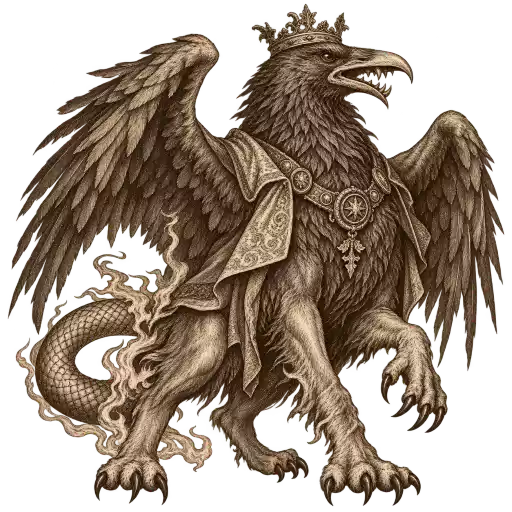
Amon in the grimoire tradition
Amon, also called Aamon, is a marquis of spirits in European ceremonial demonology. His profile is established principally through Johann Weyer’s sixteenth-century Pseudomonarchia Daemonum and the later Ars Goetia within the Lesser Key of Solomon. He is not presented there as a major character of the Hebrew Bible or as an ancient god with a securely documented independent cult. The descriptions are catalog entries about a spirit’s appearance, reputed offices and infernal rank, not historical evidence that such a being appeared.
Number and rank
The Ars Goetia places Amon seventh among its seventy-two spirits, calls him a powerful and stern marquis, and credits him with command of forty legions. Weyer’s earlier catalogue lists him fifth. This difference is caused by the arrangement of the catalogues, not by a change in the character’s supposed power. The rank, military metaphor and number belong to early modern demonological classification; the legions are not independently identified individual entities.
Name and the Egyptian problem
Amon can resemble the Greek and Latin renderings of Amun, the ancient Egyptian deity, but similarity of spelling alone does not establish a line of transmission. No passage in the standard Amon entries of Weyer or the Ars Goetia says that this marquis is the Egyptian god. The possible identification is a later hypothesis or popular conflation. Grimorium keeps the demonological Amon separate from the Egyptian deity unless an explicit historical connection is demonstrated.
A distinctive contradictory spirit
Amon has a particularly paradoxical portfolio. He knows or reveals the past and future, and is credited with influencing personal relations. Weyer emphasizes favor and reconciliation, but the Ars Goetia says that he can both procure feuds and reconcile disputes among friends. The contradiction is worth preserving because it reflects the development of the textual tradition rather than a single fixed legend.
Method and historical scope
This entry distinguishes the Latin wording of Weyer, the English mediation of Reginald Scot, the manuscript Goetia and influential later printed editions. It treats appearances, knowledge and powers as assertions made by books. Modern internet descriptions that give Amon biographies, royal pedigrees, invented seals, elemental domains or connections to every famous demon must be checked against those books before they become reference information.

The wolf with a serpent tail
Amon’s first appearance in the Ars Goetia is that of a wolf with the tail of a serpent and flames issuing from his mouth. This is not an ordinary animal description: the composite body combines predatory mammalian anatomy with reptilian imagery and an uncanny fiery exhalation. It is distinctive enough to identify the figure without adding wings, crowns, human torsos or ornaments not present in this version of the text.
The second, human form
At the command of the conjurer in the grimoire narrative, Amon assumes a human form. This body has doglike teeth and a head described through comparison with a raven or similar dark bird. The printed English wording allows a head like a raven or simply a raven’s head, creating variation in later illustrations. These are descriptions within the text, not zoological claims and not evidence for a universally standardized physical anatomy.
The bird-name translation issue
Weyer uses the Latin term nycticorax for the birdlike head. Translations have rendered it as raven or a nocturnal bird, but the historical zoological referent of the Latin term can be more complicated than a straightforward modern raven. Consequently, drawings depicting a raven head should be described as a prominent reception of the source, rather than unquestioned proof of the exact species imagined by Weyer.
Severity and dignity
The Goetia characterizes Amon as stern and unusually powerful for his rank. Weyer speaks of his greatness among the princes of his catalogue. Neither assertion needs to be reconciled with some external universal hierarchy of hell. Marquis and prince are part of the political vocabulary early modern writers applied to the world of spirits.
Visual differentiation
Amon’s signature remains the hybrid wolf-serpent body and the canine-toothed bird-headed man. It should not be mistaken for the Egyptian ram-headed Amun, for a generic horned devil or for a lion-headed goetic president. Later engravings sometimes combine forms, but the two-stage transformation of the texts is the most reliable iconographic starting point.
Knowledge of past and future
Both Weyer and the Ars Goetia attribute to Amon knowledge of what has happened and what is yet to occur. The claim belongs to divinatory language, not to a verifiable ability. Because no reliable tradition assigns him universal scientific knowledge, prophecy about every era or control of time, his domain should be described narrowly as disclosure of past and future within grimoire literature.
Reconciliation
One of Amon’s best documented offices is to restore favor or reconcile people in conflict. Weyer mentions both friends and enemies, making his role broader than romantic reunion. The figure represents an interest common in ceremonial magic: repairing hostile relationships and changing the attitude of people with whom a practitioner must live or negotiate.
Discord and the textual tension
The Ars Goetia says Amon can procure feuds as well as reconcile controversies among friends. That juxtaposition creates an apparent double capacity, aggravating and healing conflict. Weyer’s Latin wording instead emphasizes obtaining goodwill and reconciliation. A historically sound account names which work supports which formulation; it should not pretend that every early witness attributes a power to create feuds.
Fire as an attribute, not a kingdom
The flames that emerge from the wolf-shaped apparition are a visual feature. They do not establish that Amon is monarch of the element of fire or rules volcanoes, dragons or the underworld. Such elaborate elemental classifications belong to later speculation unless supported by a specified primary passage.
Legions and authority
The number forty is stable in the prominent early catalogues. A legion here is a conventional unit of imaginary infernal hierarchy, not a collection of individually named entities available for relationship links. The figure’s marquisate signals a place in the literary structure of the catalogue; no reliable primary source provides a census of soldiers, commanders or a physical territory under him.
Weyer: Pseudomonarchia Daemonum, entry 5
In his Pseudomonarchia Daemonum, printed within editions of De praestigiis daemonum, Johann Weyer lists Amon or Aamon as a great marquis. The Latin description supplies the wolf, serpent tail, flames, canine teeth and birdlike head. It also attributes knowledge of past and future, favor between friends and enemies, and forty legions. The work is an anti-witch-hunt polemic that nonetheless preserves a demonological catalogue; its context should not be mistaken for the author’s endorsement of occult practices.
Reginald Scot: The Discoverie of Witchcraft
Reginald Scot transmitted a version of Weyer’s list in his 1584 The Discoverie of Witchcraft. This English channel influenced later readers and helps explain particular wording choices in popular descriptions of Amon. Scot’s work likewise criticized witchcraft accusations and credulity. Amon’s appearance in it is evidence of the circulation of demonological writing, not of an actual witnessed manifestation.
Ars Goetia: spirit number seven
The Ars Goetia, first book of the composite Lesser Key of Solomon, makes Amon the seventh spirit and calls him a great marquis. It describes the wolf with serpent tail vomiting fire, then a man with dog teeth and a raven-like head. It adds the specific juxtaposition of procuring feuds and reconciling disputes, and retains forty legions. The Lemegeton is a composite early modern grimoire, not a document authored by the biblical Solomon.
Printed editions and source variants
S. L. MacGregor Mathers and Aleister Crowley popularized a printed version of the Goetia in 1904, making its spelling and images influential well beyond manuscript culture. These editions are valuable witnesses to modern reception but should not erase the difference between Weyer, Scot and earlier manuscript traditions. Seal illustrations, orthography and bird imagery can differ across witnesses.
Rudd and later angelic correspondences
In the tradition attributed to Thomas Rudd, the spirits of the Goetia are placed alongside the seventy-two Shem angels according to their positions. Amon, seventh in the Goetic numbering, is thereby paired with Achaiah, seventh in the angelic series. This is an explicit correspondence within a later ritual framework, not a story about the two meeting, fighting or having a family relationship. It provides a legitimate structured entity connection when the source attribution is stated.
What the sources do not establish
Amon is not assigned a separate canonical biblical episode, a fixed temple, a lost Egyptian royal genealogy or a unique Egyptian cult in these sources. The numbered Goetic entry does not authorize attaching other demons merely because they are adjacent in the list. Nor does a modern chant, asserted zodiac birth date or newly invented visual seal become an early modern fact because it is repeated online.
The mediator and the instigator
Amon’s most compelling narrative quality is the tension between causing enmity and ending it. Later retellings readily turn that into a personality capable of destroying friendship in one scene and restoring peace in the next. In the documentary record, however, the contrast belongs to differences in wording and transmission. Describing the source contrast is stronger than creating an unsupported legend of a cosmic guardian of harmony.
The two transformations
The transition from a fiery wolf with a serpent tail to a bird-headed man offers an unusual small-scale transformation myth. The first form is feral, the second more articulate and humanoid, but no early source describes the change as a moral purification. It is a transformation of appearance within ritual description, not a redemption narrative.
Legions and feudal imagination
Forty legions, a marquisate and references to great power evoke the feudal courts and armies familiar to European readers. The result is a demonology organized through recognizable social ranks. These devices do not prove a literal infernal army or political office. They are part of the historical grammar of grimoire catalogues.
The Egyptian identification as modern story
Some later popular accounts treat Amon as a corrupted version of Egyptian Amun. That is an interesting question in religious reception, but it should be treated as an argument to investigate rather than a verified legend in Weyer or the Goetia. Amun was an important Egyptian deity with his own history, while Amon the marquis is attested in European demonological lists.
Absence of a stable prophecy
Unlike apocalyptic figures assigned a final battle, Amon has no widely attested individual prophecy in his main historical descriptions. The texts give offices and visual traits, not a narrative of a destined war, heavenly fall or judgment unique to Amon. Any such story should be linked to a specifically named later work and labeled accordingly.
Historical Context
Mainstream Christianity does not prescribe invocation of Amon.
Goetic Context
The Ars Goetia places Amon within a ceremonial system of conjuration and spirit constraint.
Typical Offices
Historical occult texts associate him with questions of past and future, affection and reconciliation.
Documentary Approach
GRIMORIUM treats this material historically and does not provide operational summoning instructions.
Christian Context
Christian traditions respond to demons through prayer, repentance, scripture, sacramental practice and regulated exorcism.
Grimoire Protective Framework
Goetic texts include ceremonial boundaries and protective conventions for spirit work, distinct from mainstream Christian practice.
Discernment
Christian moral traditions emphasize discernment and caution toward supernatural claims.
Historical Caution
These practices belong to religious and magical history and should not be presented as scientifically demonstrated mechanisms.
Achaiah: documented later correspondence
The primary structured relationship for this profile is Achaiah. The angel is the seventh in a Shem-angel numbering adopted by the Rudd correspondence scheme, and Amon is the seventh Goetic spirit. Their association is therefore explicit within that later scheme; it is not a claimed family tie, a scripture narrative, or a personal combat. If Achaiah has no current profile, the relationship should still be retained so the importer can record a pending entity.
Entities deliberately excluded
The Egyptian Amun is not included as a formal relation because the origin of the Goetic name has not been demonstrated by Weyer or the Ars Goetia. Nearby Goetic spirits such as Valefor and Barbatos are not related simply because their entries come before and after Amon. Named infernal figures from later pop culture are likewise excluded unless an identifiable text establishes a direct relationship.
Catalogues are not kinship networks
Shared membership in a demonological catalogue does not establish friendship, rivalry, descent, allegiance or historical encounter. The number of legions also does not create individual entities. Amon’s connection to Achaiah is justified as a specifically documented ceremonial pairing, not because they occur in the same tradition in a general sense.
Primary: Weyer, Pseudomonarchia Daemonum §5
Johann Weyer, Pseudomonarchia Daemonum, section five in the standard Latin arrangement: Amon or Aamon as powerful marquis; wolf with serpent tail, flames and birdlike human form; knowledge of past and future; reconciliation and forty legions. Consult in the context of De praestigiis daemonum and its later editions, especially the 1577 expanded form.
Primary: Scot, The Discoverie of Witchcraft (1584)
Reginald Scot’s English rendering of demonological material derived from Weyer provides an important bridge to the wording familiar in later English references. It is also essential to the history of skepticism toward witchcraft prosecutions.
Primary: Ars Goetia, entry 7
The Lesser Key of Solomon, Ars Goetia, spirit seven: marquis Amon, the wolf-serpent and raven-headed descriptions, foreknowledge, the distinctive combination of feuds and reconciliation, and forty legions. Compare extant manuscript forms with the Mathers–Crowley edition of The Goetia of Solomon the King (1904), page for entry seven.
Later: Rudd correspondence manuscripts
The goetic materials attributed to Thomas Rudd, especially the tradition preserved in British Library Harley MS 6483 and modern scholarly discussions of it, pair the numbered spirits with the corresponding seventy-two angels. Amon’s seventh-position counterpart is Achaiah. Label this a later association, not an element of the original Weyer text.
Critical reading and limits
Use the source texts to distinguish number five in Weyer from number seven in the Goetia, the translation of nycticorax from later raven iconography, and speculative Egyptian etymology from established identity. Modern encyclopedias should cite the primary passages rather than reproduce unverified lists of extra powers.