
Who is Agares?
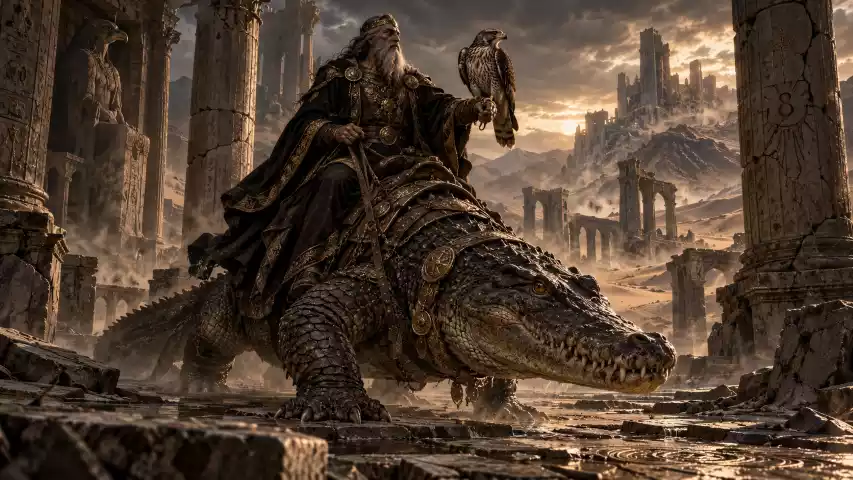
Agares, also called Agreas, is a duke of the early modern European spirit catalogues who appears as the second spirit of the Ars Goetia, the first division of the Lemegeton or Lesser Key of Solomon. The text places him under the power of the East, gives him command over thirty-one legions and describes him as a seemingly gentle old man riding a crocodile with a goshawk resting on his fist. The striking image combines a dignified human rider with two dangerous animals, and it is one of the most recognizable portraits in Solomonic demonology.
A demon of movement and reversals
The offices attributed to Agares are unusually diverse: he teaches all languages, causes those who stand still to run, brings back fugitives, overturns spiritual and temporal dignities and causes earthquakes. The list suggests a being who unsettles established conditions. Stillness becomes flight, exile becomes return, authority loses its title and even the earth fails to remain steady. These are powers attributed by manuscripts, not verified effects in the physical world.
Origin in grimoire literature
Unlike gods from established ancient pantheons, Agares has no securely demonstrated cult, temple or independent pre-Christian myth. His attested historical identity belongs to late medieval and early modern lists of spirits, especially the traditions transmitted by Johann Weyer and the Goetia. The name and its variants are not enough to reconstruct an ancient religion; assigning him an invented Mesopotamian, Egyptian or biblical origin would confuse the evidence.
Method and historical layers
A complete account must distinguish the older spirit-office catalogues, the Latin and English formulations of Weyer, the seventeenth-century Goetia manuscripts, the printed version edited by Mathers and Crowley in 1904 and nineteenth-century demonological illustration. These witnesses overlap but are not identical. Grimorium records Agares as a grimoire demon whose modern folklore and occult reception arose from this textual history, not as a historical deity.
Rank and legion count
The standard Ars Goetia calls Agares a duke and states that thirty-one legions of spirits are under his government. A duke is a courtly rank imposed by the catalogue, not evidence of a historical feudal office or a measurable supernatural army. Other early spirit lists preserve different counts, including a tradition of thirty-six legions associated with the Livre des Esperitz; the count must therefore be tied to the source cited.
Appearance of the elderly rider
The grimoire calls him an old fair man, mild in appearance. Unlike many later images of devils, this description contains no horns, bat wings or monstrous human features. His age and composure contribute to a deceptively ordinary dignity. Modern illustrations may make him grotesque, but that change belongs to artistic interpretation and is not required by the written source.
The crocodile
His mount is explicitly a crocodile in Weyer and the standard Goetia. Interpreters can read the animal as a sign of dangerous hidden force or mastery over a powerful creature; however, such symbolic readings are modern inferences unless a historical commentator states them. The animal is part of the source description, whereas any detailed theology of crocodiles requires separate proof.
The goshawk
The raptor perched on his fist is a goshawk, an identifiable bird of prey associated with trained hunting. It distinguishes Agares from demons shown only with swords, staffs or seals. The image may suggest controlled speed, pursuit and return, fitting his alleged power over fugitives, but the grimoires do not explicitly explain the bird through that symbolism.
The former order of Virtues
The Ars Goetia states that Agares was of the order of Virtues. This is a claim within later Christianized spirit hierarchies about a former angelic condition; it is not independent documentary evidence of a biography before the fall. It should not be transformed into an invented genealogy, nor does it establish a personal relationship with any individual angel.
Languages and rapid learning
The Goetia says that Agares teaches all languages or tongues presently. The adverb stresses the speed and completeness of the supposed instruction. This is an office claimed by the book, not proof that language acquisition can be produced through supernatural intervention. The theme nevertheless explains why Agares became associated in later occult literature with communication and the overcoming of linguistic barriers.
Flight and the return of fugitives
Agares is credited both with setting motionless people running and with bringing back those who have fled. The apparent contradiction is central to his characterization: he controls displacement in either direction. Some later summaries extend the theme to runaway servants or escaped people, but the base description does not give detailed case histories or define a legal class of fugitive.
Overthrowing dignities
His alleged power to destroy dignities applies to both spiritual and temporal stations. The distinction implies religious office and secular rank alike. It should be read in the context of a grimoire that imagines social positions as vulnerable to spirit intervention, not as evidence that identifiable clerics or monarchs were historically deposed by Agares.
Earthquakes and moving ground
The standard Goetia credits Agares with causing earthquakes. In an important related wording, Weyer speaks of making the spirits of the earth dance; editions and translations preserve differences that affect interpretation. A careful reader should avoid presenting every phrasing as if it were verbatim in every source.
Eastern jurisdiction
Agares is said to be under the power of the East. The phrase locates him within the directional language of grimoire hierarchy; it does not provide a geographical address, a named ancient kingdom or evidence that he was worshipped in an eastern religion. Claims that his “East” refers to a particular country go beyond the plain source.
Johann Weyer and the Pseudomonarchia Daemonum
Johann Weyer included Agares in the Pseudomonarchia Daemonum, transmitted as an appendix to editions of De praestigiis daemonum in the sixteenth century. The entry describes a duke of the East, an elderly rider on a crocodile, a hawk on his fist and powers involving languages, returning fugitives, disturbing status and moving earthly spirits. Weyer published the catalogue in a wider polemic on deceptive demonological claims and witch persecutions; quoting the list does not imply his endorsement of every supernatural attribution.
The Ars Goetia, second office
The first book of the Lemegeton lists Agares as the second spirit, after Bael and before Vassago. The standard English text calls him Agreas or Agares, assigns him thirty-one legions, notes his earlier association with the order of Virtues and supplies a specific graphic seal or character. Its fullest printed dissemination came through the 1904 Mathers and Crowley edition, but the underlying manuscript tradition is earlier.
Older spirit-office witnesses
The wider office-of-spirits tradition contains related names and descriptions under variant spellings. Some textual witnesses use a cockatrice-like mount instead of a crocodile, while other lists preserve different numbers of legions. Because the family of manuscripts is complex, a single late printed picture should never be treated as the unique ancient original.
The seal and its manuscripts
The Ars Goetia associates Agares with a seal that appears in printed and manuscript reproductions. Graphical details can differ across witnesses and editorial redrawings. A seal is evidence of the manuscript or printed magical tradition, not evidence that the depicted entity existed, nor a license to assign an unrelated seal copied from another demon.
Thomas Rudd and angelic correspondences
In the Goetia tradition associated with Thomas Rudd, the seventy-two spirits are paired with the seventy-two angels of the Shem ha-Mephorash. Agares, as the second spirit, is paired with Jeliel, the second angel. This is a genuine correspondence within a particular later system. It does not establish a literal combat, family bond or personal encounter between Agares and Jeliel in the older spirit catalogue.
The noble old rider
The central narrative image of Agares is a dignified elder riding an unlikely crocodile while handling a hunting bird. This memorable combination functions almost as a miniature legend, although the Goetia does not supply a long story of his birth or deeds. Later artists enlarged the scene with robes, deserts, ruined cities and dark heavens; those background details are creative additions rather than stable source attributes.
The runaway brought home
The assertion that Agares brings fugitives back has encouraged countless modern retellings about disappearances, pursuit and compelled homecoming. The historical grimoire itself gives a concise office, not a named story about a particular fugitive. Inventing an episode about an identifiable ancient king or runaway prince would convert a brief catalogue statement into fabricated mythology.
Shaking established authority
The ability to topple dignities creates a second narrative theme: the humiliation of those who seem secure in rank. This fits the catalogue’s fascination with titles and powers. But no canonical prophecy says that Agares will overthrow a particular church, government or dynasty, and such predictions should not be assigned to him without named evidence.
Earthquakes and apocalypse
Because Agares is linked with ground-shaking in one important textual formulation, modern occult fiction sometimes recasts him as a force of global catastrophe. The Ars Goetia does not supply a universal end-times prophecy about him. The difference between a listed power and a complete apocalypse myth must remain explicit.
Modern artistic reception
Agares has appeared in illustrated demon catalogues, games and digital occult reference works, often as an elderly sorcerer, a crocodile-mounted noble or a monstrous figure. These transformations document the modern cultural afterlife of the Goetia, not independent confirmation of ancient worship or new historically attested powers.
Historical Context
Mainstream Christianity does not prescribe invocation of Agares.
Goetic Context
The Ars Goetia places Agares within a ceremonial system for conjuring and constraining spirits.
Traditional Offices
Historical occult texts associate him with languages, movement, fugitives, earthquakes and changes of status.
Documentary Approach
GRIMORIUM treats this material historically and does not provide operational summoning instructions.
Christian Context
Christian traditions respond to demons through prayer, repentance, scripture, sacramental practice and regulated exorcism.
Goetic Protective Framework
Goetic literature contains ceremonial boundaries and protective conventions distinct from mainstream Christian practice.
Discernment
Christian moral traditions emphasize caution toward alleged supernatural promises of power or knowledge.
Historical Caution
These practices belong to religious and magical history and should not be presented as scientifically demonstrated mechanisms.
Jeliel: a source-specific angelic correspondence
Agares has one especially defensible cross-entity relationship in the system traditionally associated with Thomas Rudd: the second Goetic spirit corresponds to Jeliel, second of the seventy-two Shem angels. This is an attested system of paired entries. The relationship is a formal correspondence, not an ancient personal rivalry, an exorcism narrative or genealogical bond.
The order of Virtues is not one individual
Agares is described as having belonged to the angelic order of Virtues. The order itself is a collective class, not a single being, so it does not qualify for a related-entity entry under Grimorium’s strict policy. It remains an important statement within the characteristics and textual-history sections.
Neighboring entries are not relationships
Bael appears immediately before Agares and Vassago immediately after in the standard Goetia list, but adjacency in a numbered catalogue is not sufficient evidence of a personal connection. Neither should be inserted into related.entities merely because the reader might navigate from one to the next.
Pending entities preserved
If the Jeliel profile has not yet been created, the relationship remains recorded under its language-specific slug. This allows the importer to flag the missing profile in Pending Entities instead of silently discarding a legitimate documented connection.
Ars Goetia, entry II
Primary source: Lemegeton Clavicula Salomonis, book I, Ars Goetia, spirit 2, Agreas/Agares; see S. L. MacGregor Mathers and Aleister Crowley, The Goetia: The Lesser Key of Solomon the King (1904), entry 2. This source supports the title of duke, eastern jurisdiction, 31 legions, old man, crocodile, goshawk, languages, fugitives, dignities, earthquakes and the order of Virtues.
Johann Weyer, Pseudomonarchia Daemonum
Primary early modern comparison: Johann Weyer, Pseudomonarchia Daemonum, Agares entry, included with editions of De praestigiis daemonum (notably the 1577 Latin text). Compare the wording concerning the spirit’s functions and the dancing of earthly spirits to later Goetia translations.
Older office-of-spirits traditions
For the textual genealogy consult the Livre des Esperitz and the Liber Officiorum Spirituum or Book of the Office of Spirits traditions. Variant spellings, mounts and legion counts should be reported only with explicit reference to the witness involved, not smoothed into an artificial single original.
Thomas Rudd attribution
The later pairing with Jeliel belongs to the Goetia tradition represented by the manuscript material associated with Dr. Thomas Rudd, as edited and discussed in modern scholarship on the Goetia of Dr Rudd. This correspondence is not a statement of the standard Mathers–Crowley spirit entry.
Historical limits and interpretation
The grimoires are the primary evidence that Agares was imagined and described in early modern magic; they do not independently establish the factual existence of spirits or the efficacy of the powers listed. Literary motifs, modern occult practices and game designs should always be identified as later reception.