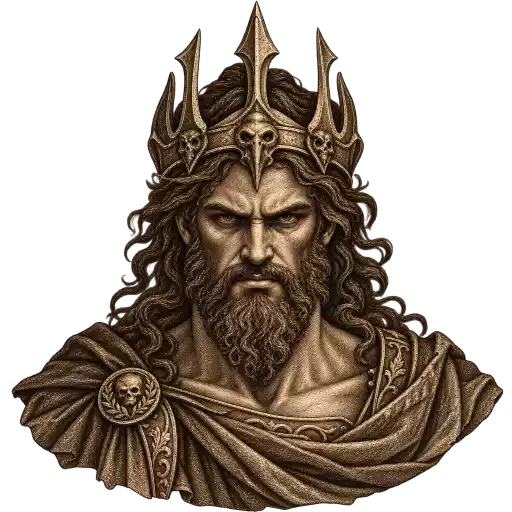
Hades is one of the major gods of Greek mythology and the ruler of the Underworld, the realm of the dead. He is the son of the Titans Cronus and Rhea and the brother of Zeus, Poseidon, Hera, Demeter and Hestia.
Unlike many of the Olympian gods, Hades is primarily associated with the world beneath the earth rather than Mount Olympus. His name can refer both to the god himself and, in many ancient contexts, to the realm he governs.
Origins
Hades belonged to the generation of gods born to Cronus and Rhea. According to one of the central Greek traditions, Cronus swallowed his children because he feared being overthrown by one of them.
After Zeus escaped this fate and later challenged Cronus, Hades and the other swallowed siblings were released. Together they became part of the younger divine generation that fought against the Titans.
The Titanomachy
Hades took part in the Titanomachy, the great conflict between the younger gods and the Titans. During this war, supernatural weapons were given to the three divine brothers.
Zeus received the thunderbolt, Poseidon received the trident and Hades received a helmet or cap that granted invisibility. This object became one of the most distinctive attributes associated with him.
Division of the Cosmos
After the Titans were defeated, Zeus, Poseidon and Hades divided major portions of the cosmos among themselves by lot. Zeus obtained the sky, Poseidon the sea and Hades the realm of the dead.
Hades therefore became sovereign of the Underworld and the dead who entered it.
Ruler of the Underworld
Hades is not generally portrayed as a god of death in the same sense as the personification Thanatos. Instead, he is the king and administrator of the realm where the dead reside.
His role emphasizes permanence, boundaries and the inevitability of death. Once souls entered his kingdom, leaving it was normally difficult and could require divine intervention or extraordinary circumstances.
Hades and Persephone
One of the most important myths involving Hades concerns Persephone, daughter of Demeter. Hades took Persephone to the Underworld and she became his queen.
The myth of Persephone’s descent and return became closely associated with seasonal cycles, agriculture, death and renewal. Different ancient sources preserve variations of the story and its theological meaning.
The Wealth Beneath the Earth
Hades was also connected with the riches found beneath the earth. Minerals, precious metals and agricultural fertility all emerged from the ground, contributing to his association with hidden wealth.
This aspect of the god was reflected in the title Plouton or Pluto, a name emphasizing wealth and abundance rather than death alone.
Hades in Greek Religion
Hades was respected and feared, but his cult differed from that of many other major gods. Ancient Greeks could avoid speaking his name directly and instead use alternative titles or euphemisms.
He was nevertheless an important religious figure, especially in traditions related to the dead, the afterlife, the earth and mystery cults.
Legacy
Hades became one of the most recognizable figures associated with the ancient Greek afterlife. Later Greek, Roman and modern traditions often merged the god with broader ideas of death, hell or the devil, although these concepts are not equivalent to the ancient Greek Hades.
The Underworld
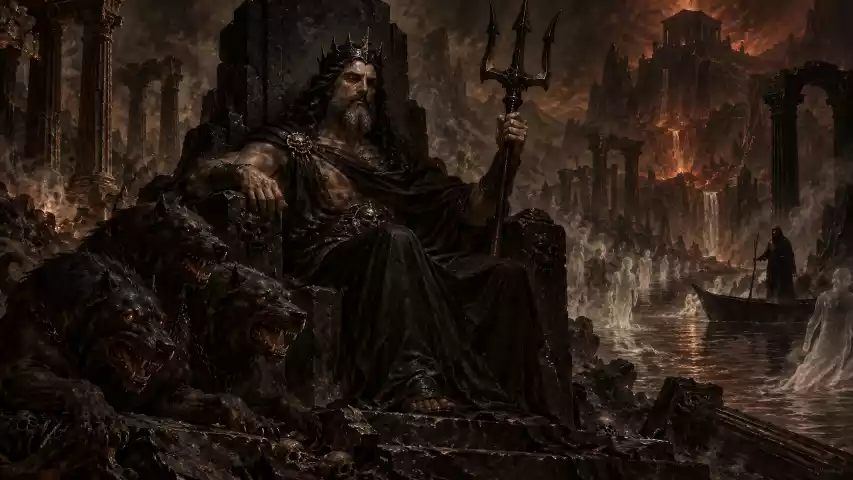
Hades holds sovereignty over the Underworld and the dead who inhabit it. His authority concerns the structure and boundaries of the realm rather than the actual process of causing death.
Authority Over the Dead
As ruler of the dead, Hades possesses authority over souls within his realm. The dead normally remain there permanently unless a special mythic exception is granted.
Invisibility
The Helmet of Hades grants invisibility. In Greek mythology, this magical object is used not only by Hades himself but occasionally by other divine or heroic figures.
Subterranean Wealth
Hades is connected with precious metals, minerals and other resources hidden beneath the earth. This association contributed to his identification with Plouton, the wealthy one.
Fertility and the Earth
Although primarily associated with death, Hades also belongs to a broader chthonic sphere connected with the earth. The ground receives the dead but also produces crops, minerals and new growth. This dual relationship between death and fertility becomes especially important in myths involving Persephone and Demeter.
Maintaining Boundaries
One of Hades's most important mythological functions is preserving the boundary between the living and the dead. Myths in which heroes enter the Underworld are notable precisely because such journeys violate the normal order of existence.
Divine Authority
Within his own realm, Hades possesses immense authority. Even gods and heroes must respect the laws and dangers of the Underworld when entering his domain.
Judgment and the Dead
Although later traditions often associate Hades directly with judging souls, Greek mythology more commonly assigns judgment to figures such as Minos, Rhadamanthus and Aeacus. Hades remains the sovereign over the wider system in which these judgments occur.
Binding and Restraint
Myths concerning the Underworld frequently involve themes of binding, permanence and confinement. Hades represents the force that keeps the dead within their proper realm and preserves cosmic separation.
Hesiod
Hesiod's Theogony is one of the major sources for the genealogy of Hades, his relationship to Cronus and Rhea, and the division of the cosmos among the divine brothers.
Homer
The Iliad and Odyssey contain important references to Hades and the realm of the dead. The Odyssey is especially important for ancient Greek ideas about journeys to the Underworld.
Homeric Hymn to Demeter
The Homeric Hymn to Demeter is one of the most important surviving sources for the myth of Hades and Persephone. It describes Persephone's abduction, Demeter's grief and the eventual arrangement governing Persephone's movement between the Underworld and the world above.
Greek Tragedy
Greek tragic poets frequently refer to Hades both as a god and as the realm of death. These works preserve important cultural attitudes toward mortality, burial and the afterlife.
Apollodorus
The mythographic tradition attributed to Apollodorus preserves accounts involving Hades, Persephone, Heracles, Theseus and other figures who interact with the Underworld.
Pausanias
Pausanias records sanctuaries, local traditions, artworks and cult practices related to chthonic deities, including Hades and Persephone.
Archaeology and Funerary Evidence
Funerary inscriptions, grave goods, vase paintings, reliefs and archaeological remains provide important evidence for ancient Greek beliefs concerning the dead and the Underworld.
Mystery Traditions
The Eleusinian Mysteries and other mystery traditions provide important context for beliefs surrounding Persephone, Demeter, death and possible hopes concerning the afterlife. Because many mystery rites were secret, surviving evidence is incomplete and must be interpreted carefully.