
Satan: Adversary, Accuser and Prince of Demons in Western Religious Imagination
Identity and historical complexity
Satan is one of the most influential and controversial figures in the religious history of the West. Unlike many mythological or demonological beings who appear in only one stable narrative form, Satan develops across centuries and across several traditions. In the Hebrew Bible, the term ha-satan often functions less as a proper personal name and more as a title meaning “the adversary” or “the accuser.” In that earlier setting, Satan can appear as a being within the divine court whose role involves testing, opposition or prosecution rather than serving as the fully independent rebel-king of evil imagined in later Christian theology.
From adversary to cosmic enemy
Over time, especially during the Second Temple period and in later Christian interpretation, Satan becomes increasingly individualized and morally radicalized. He is no longer understood merely as an accuser or tester under divine permission, but as the great enemy of God, tempter of humankind, deceiver of the nations and ruler of demonic powers. This long development means that any serious profile of Satan must distinguish between Hebrew biblical usage, apocalyptic and intertestamental developments, New Testament theology, patristic interpretation, medieval demonology and later folklore.
Not a single tradition, but a layered figure
Satan is therefore not a simple figure with one fixed origin. He stands at the intersection of Judaism, Christianity, later demonological speculation and broad folklore. Islamic tradition also uses the category of shaytan for satanic or demonic tempters, while Iblis becomes the most prominent specific rebel figure. Although Satan and Iblis are often compared, they should not be collapsed into a single identical being without noting the theological differences between traditions.
Theological importance
The figure of Satan matters because he becomes the primary personification of opposition: opposition to divine order, obedience, truth, righteousness and spiritual safety. In later Christian imagination especially, he functions as the tempter in Eden, the power behind idolatry, the ruler of hell, the dragon of Revelation and the chief antagonist in the cosmic struggle between good and evil. Not all of these identifications belong equally to the earliest biblical texts, but together they form the historical image by which Satan became the best-known demonic figure in Western tradition.
Why Satan matters in Grimorium
For a demonological encyclopedia, Satan must be treated with historical discipline. He is not simply “a demon among others.” In many traditions he becomes the symbolic summit of rebellion and corruption, while in earlier sources he may appear in more restrained roles. This layered evolution is precisely what makes Satan essential: he is both a scriptural figure and a later theological construction that shaped literature, folklore, exorcism, occultism and popular imagination for centuries.
Names, not automatic identities
In the Hebrew Bible the ordinary noun satan can describe human opponents, as in 1 Kings 11:14, and even the angel blocking Balaam in Numbers 22:22. Thus the word is not a single personal name wherever it occurs. The expression with the definite article in Job and Zechariah is especially important for understanding the accuser within a heavenly scene. Later theology assembles these passages into a biography of the Devil, but that synthesis must not erase differences among the original genres and contexts.
Islamic comparison
The Qur’an speaks of al-shayṭān, the tempter, and of Iblis, who refuses the command involving Adam (Qur’an 2:34; 7:11–18; 18:50). In many Islamic interpretations the two names designate the same rebel in different narrative situations, but the Qur’anic characterization of Iblis as a jinn and the Hebrew Bible’s accuser belong to distinct theological systems. Satan is therefore a useful comparative name, not a license to claim every text depicts an identical biography.

Adversarial nature
The core characteristic of Satan is adversarial opposition. Even when the figure is not yet the absolute embodiment of evil, Satan functions through accusation, challenge, testing, temptation and obstruction. He is the one who opposes, contests and seeks to expose weakness.
Intelligence, cunning and persuasion
Later religious and literary traditions emphasize Satan’s subtlety more than brute force. He deceives, persuades, whispers, distorts and exploits pride, despair, desire and ambition. This makes him not merely a monster of violence, but a strategist of corruption.
Spiritual hostility
Satan is marked by hostility toward divine purposes and human moral flourishing. In Christian theology especially, he appears as the tempter who seeks alienation from God, while in broader folklore he becomes a figure associated with pacts, deception, possession and ruin.
Ambiguity across sources
One of Satan’s defining characteristics is that his portrayal changes drastically depending on the source. In Job, he appears as an accuser permitted to test; in Zechariah he stands to accuse the high priest Joshua; in the Gospels he tempts Jesus; in Revelation he is the dragon, the ancient serpent and the deceiver of the whole world. These are not identical literary moments, but a historical progression of meanings.
Supreme demonic authority in later demonology
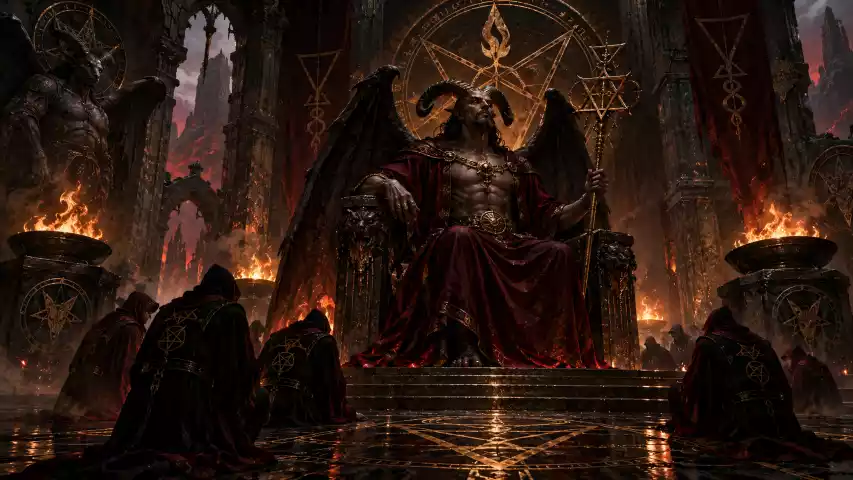
In medieval and later demonological systems, Satan is frequently imagined as the chief of devils, emperor or prince of hell, or supreme adversarial power standing above infernal hierarchies. Not every grimorio or theologian organizes infernal ranks in the same way, but Satan is often the central or highest hostile figure.
Limits of the accuser’s authority
In Job 1:12 and 2:6, the accuser cannot act without permission and receives defined limits; this matters because the early narrative does not picture an independent counter-god. Zechariah 3:1–2 also portrays an accusation checked by a divine rebuke. These details complicate the simplistic idea of an eternally autonomous evil monarch.
Temptation and moral corruption
Satan’s most famous domain is temptation. He is associated with the corruption of moral judgment, the incitement of sin and the exploitation of human weakness. Pride, envy, greed, despair and rebellion are all commonly linked to his influence in later theology.
Accusation and testing
In earlier biblical contexts, Satan’s sphere includes accusation and testing rather than autonomous evil in its most developed sense. This role is particularly visible in the Book of Job, where Satan challenges the sincerity of Job’s righteousness and becomes an instrument of trial under divine permission.
Deception and falsehood
Later Christian texts and interpretation strongly associate Satan with deceit. He is the liar, the deceiver, the tempter and the power behind counterfeit appearances. This makes false prophecy, spiritual confusion and manipulation central to his legendary powers.
Possession and oppression in later belief
In post-biblical demonology and folklore, Satan becomes connected with demonic oppression, infernal contracts, black magic panics and possession narratives. Historically, these attributions belong to the expanding cultural image of Satan and not always to the earliest scriptural strata.
Rule over demons in later theology
Many Christian demonological systems present Satan as ruler or commander of demons. In this capacity, he is less a minor spirit with specialized powers and more the overarching hostile authority presiding over a corrupted spiritual kingdom.
Testing rather than unlimited control
Job explicitly restricts the adversary’s power and depicts testing as a narrative question about human integrity. Revelation 12:9–10 instead presents Satan as the deceiver and accuser in an apocalyptic conflict. The scope of power therefore varies by source; descriptions of command over every demon, absolute rule of hell or arbitrary magical power are later extrapolations rather than universal scriptural claims.
Hebrew Bible and early scriptural usage
Important early textual witnesses include Job 1–2, where Satan appears among the “sons of God,” Zechariah 3, where he accuses Joshua the high priest, and 1 Chronicles 21:1, where Satan incites David to number Israel. These passages are foundational but must not be read anachronistically as if they already contained the full medieval Devil.
Second Temple and apocalyptic developments
Between the Hebrew Bible and the New Testament, Jewish apocalyptic and related literature intensify the image of cosmic evil. Figures such as Belial, Mastema and demonic adversaries in broader Second Temple tradition help form the interpretive environment in which Satan becomes increasingly personalized as a hostile supernatural opponent.
New Testament
The Gospels portray Satan as the tempter of Jesus in the wilderness. Other New Testament books speak of Satan as enemy, deceiver, tempter and ruler of hostile spiritual forces. Revelation 12 and 20 identify the dragon, the ancient serpent, the Devil and Satan in explicitly cosmic terms, powerfully shaping later Christian imagination.
Patristic and medieval theology
Church Fathers and medieval theologians developed doctrines of angelic fall, demonic hierarchy, temptation and diabolical rebellion that contributed enormously to the later figure of Satan. This is the period in which many motifs now considered “standard” became systematized.
Grimoires and demonology
Satan is not simply a Goetic spirit in the way that many named demons are. He usually stands above such catalogues as an overarching infernal figure. Grimoires, demonologies and occult compendia may invoke his authority symbolically, classify him as emperor or chief, or treat him as the infernal pole around which lesser demonic systems are organized. He is therefore central to demonological literature even when not listed as just one entry among seventy-two spirits.
Precise scriptural sequence
Numbers 22:22–35 uses an adversarial term for the angel in Balaam’s path, not for the later Devil. Job 1:6–12 and 2:1–7 place the accuser in the divine assembly. Zechariah 3:1–2 has the accuser oppose Joshua the high priest. Compare 2 Samuel 24:1 with 1 Chronicles 21:1: the incitement of David is assigned differently, an instructive witness to changing accounts of divine agency.
The Gospels and Acts
Matthew 4:1–11 and Luke 4:1–13 narrate the testing of Jesus in the wilderness. Mark 3:22–26 and Matthew 12:24–26 bring Beelzebul and Satan into a closely connected argument about exorcism. Luke 10:18 and Luke 22:31 preserve additional images of defeat and testing. Acts 5:3 represents satanic influence through the language of deception, not through a medieval infernal census.
Epistles and Apocalypse
Second Corinthians 11:14 imagines Satan disguised as an angel of light; 1 Peter 5:8 compares the Devil to a prowling lion. Revelation 12:7–12 identifies the dragon with the ancient serpent, Devil and Satan, and Revelation 20:1–10 narrates binding and final judgment. These are the principal passages supporting the mature New Testament portrait.
The fall of Satan
One of the most famous legends associated with Satan is the story of the rebellious angel cast from heaven because of pride. This narrative is built from several scriptural passages interpreted together over time, including Isaiah 14, Ezekiel 28, Luke 10:18 and Revelation 12, though not all of these originally refer directly to Satan in their primary historical contexts. The legendary synthesis, however, became enormously influential.
The serpent and Eden
Later Christian tradition frequently identifies Satan with the serpent in Genesis, even though the Hebrew text itself does not explicitly name the serpent as Satan. This identification became one of the defining threads in later theology and art.
The temptation of saints and the faithful
Christian hagiography, monastic literature and later folklore abound with stories of Satan tempting saints, monks, hermits and ordinary believers. These tales emphasize deception, despair, lust, blasphemy, fear or false visions as his favored weapons.
Apocalyptic enemy
In later eschatological interpretation, Satan becomes the final adversary whose defeat marks the triumph of divine justice. Revelation is especially important here, portraying his binding, release and ultimate condemnation.
Popular folklore and diabolic bargain
European folklore often expands Satan into the horned Devil who offers bargains, appears at crossroads, claims souls, mocks the proud and punishes the foolish. This folkloric Satan is not identical to every theological definition, but it is one of the most culturally influential forms of the figure.
Isaiah and Ezekiel in context
Isaiah 14:4–21 is explicitly a taunt against the king of Babylon, while Ezekiel 28:11–19 laments the king of Tyre. Christian exegetes later connected their celestial and Edenic imagery with the fall of Satan. The resulting tradition is important, but neither passage begins as a straightforward independent biography of an angel named Lucifer.
The problem of the Edenic serpent
Genesis 3 names a serpent, not Satan. Revelation 12:9 later combines dragon, ancient serpent, Devil and Satan. The theological identification thus belongs to interpretation across texts, not to an explicit statement in Genesis alone. This distinction is central for anyone comparing Jewish biblical exegesis and subsequent Christian readings.
Historical Context
Mainstream Jewish and Christian traditions do not prescribe devotional invocation of Satan. Accounts of summoning or pact-making belong primarily to polemics against sorcery, witchcraft literature, folklore and later occultism.
Grimoire Context
Some later magical manuscripts contain names or conjurations involving infernal rulers, but their systems vary greatly and do not represent one ancient tradition.
Documentary Approach
GRIMORIUM treats invocation material historically and descriptively, not as practical ritual instruction.
Jewish Traditions
Historical Jewish protective practice includes prayer, psalms, sacred names and apotropaic customs, but there is no single universal anti-Satan rite.
Christian Practice
Prayer, repentance, faith and resistance to temptation are central responses to Satan in Christian teaching.
Scripture and Symbols
Ephesians 6:10–18 and James 4:7 became influential texts, while the cross, holy water, relics and blessed objects became protective elements in several Christian traditions.
Exorcism
Formal exorcism developed as a regulated rite in several churches. Procedures and theological assumptions differ by denomination.
Michael
Michael the Archangel became especially important as Satan's heavenly opponent in Christian tradition.
Historical Caution
These are religious and historical traditions, not scientifically demonstrated mechanisms.
Literary Evidence versus Universal Practice
The New Testament describes resistance through faith and steadfastness rather than presenting a universally valid technical formula. Catholic, Orthodox, Protestant and Jewish approaches vary substantially, and later folklore adds prayers, inscriptions and household customs. Historically reported protective practices are evidence for religious communities and their fears, not proof that a supernatural intervention took place.
Lucifer
Later Christian and literary tradition often links Satan with Lucifer, especially through interpretations of Isaiah 14 and the myth of the proud fall from heaven. Historically, the identification is influential but interpretive rather than a simple equation in the earliest biblical layer.
Beelzebub
Beelzebub appears as a major demon or infernal prince and is frequently associated with Satan in Christian demonology and New Testament polemic.
Belial
Belial is an important figure in Jewish and Christian demonological development and sometimes overlaps conceptually with Satan as a power of lawlessness and corruption.
Leviathan
Leviathan becomes associated in later demonology with infernal power, cosmic chaos and the monstrous dimensions of evil, making it a natural related entity in Satanic traditions.
Azazel, Samael and Lilith
These names belong to overlapping but distinct currents of Jewish, folkloric and occult demonology. They are not identical with Satan, but they often appear in the broader network of adversarial and infernal beings later associated with him.
Iblis and Abaddon
Iblis is the major rebellious tempter figure in Islam and is often compared with Satan, though the traditions are not identical. Abaddon, meanwhile, appears in apocalyptic contexts and later demonological interpretation as another major infernal being associated with destruction.
Direct identities and narrative connections
Two individual figures have especially defensible cross-links here. Lucifer became an interpretive name for Satan within later Christian accounts of angelic rebellion, but this is not the initial sense of Isaiah 14. Beelzebul is explicitly placed next to Satan in the Gospel controversy over accusations against Jesus’ exorcisms (Mark 3:22–26). Other demons may belong to a shared tradition yet lack a direct historical relation, and are therefore discussed in the narrative without being inserted as linked entities.


Primary source framework
Key sources include Job 1–2, Zechariah 3, 1 Chronicles 21:1, the Synoptic temptation narratives, 2 Corinthians 11:14, 1 Peter 5:8, Revelation 12 and 20, and later interpretive traditions shaped by patristic, medieval and apocalyptic theology. Related Second Temple developments may also be considered through the broader environments that produced figures such as Belial and Mastema.
Interpretive note
Satan should be approached as a layered historical figure rather than a flat stereotype. The adversary of Job, the tempter of the Gospels, the dragon of Revelation, the Devil of medieval theology and the horned tempter of folklore belong to one broad history, but they are not all the same at every stage. Treating these distinctions carefully produces a much more accurate and valuable demonological profile.
Passage-level references
Hebrew Bible: Numbers 22:22–35; Job 1:6–12 and 2:1–7; Zechariah 3:1–2; 1 Chronicles 21:1 compared with 2 Samuel 24:1; Isaiah 14:4–21; Ezekiel 28:11–19. New Testament: Matthew 4:1–11 and 12:24–26; Mark 3:22–26; Luke 4:1–13 and 10:18; 2 Corinthians 11:14; 1 Peter 5:8–9; James 4:7; Revelation 12:7–12 and 20:1–10. Comparative Islamic passages: Qur’an 2:34; 7:11–18; 18:50.
Source criticism
Patricia L. Day, An Adversary in Heaven: Satan in the Hebrew Bible (1988), analyzes the early heavenly-adversary passages. Modern textual scholarship likewise warns against reading a single unchanged Satan biography backward through every biblical reference. Claims about infernal rank and folkloric appearance must be assigned to their later authors rather than called biblical facts.