The name and its question
Michael is a named heavenly figure of the Hebrew Bible whose name, Hebrew Mikha’el (מִיכָאֵל), is commonly interpreted as “Who is like God?” The expression is a question affirming the incomparability of the divine rather than a declaration that the angel is himself divine. Greek Mikhaēl, Latin Michael, Spanish Miguel and Arabic Mīkāʾīl or Mīkāl are historical linguistic forms; spelling does not create distinct beings. In the Book of Daniel he is a princely protector, in Jude an archangel, and in Revelation the commander in conflict with the dragon.
Emergence in the textual record
The earliest secure scriptural contexts for Michael as a named angel are the apocalyptic sections of Daniel, notably 10:13, 10:21 and 12:1. These passages arise from the distinctive literary world of late Second Temple Judaism: empires appear alongside heavenly princes, history is interpreted through visions, and the fate of the people is bound to cosmic conflict. Dating an individual celestial being is not possible; the relevant historical claim concerns surviving texts and their composition, not the actual age of an angel.
An identity shared, not a uniform biography
Judaism, Christianity and Islam recognize an angel bearing this name, yet their scriptural and interpretive corpora differ. The Qur’an explicitly names Mīkāl alongside Jibrīl in 2:98; it does not narrate Michael fighting the dragon. Christian traditions read Revelation 12 through the figure of Saint Michael; Daniel understands him in relation to Israel. A responsible entry does not stitch every medieval legend into an imagined continuous autobiography.
A model of delegated authority
What holds the various portraits together is not independent godhood but a role carried out under divine authority. Daniel describes Michael defending a people; Jude portrays restraint in dispute; Revelation depicts a victorious heavenly struggle. Interpretations concerning guardianship of souls, the weighing of souls, healings, earthquakes or rain belong to different textual traditions and require separate attribution. The figure should not be assigned Goetic legions, infernal titles or a fabricated celestial birth.
Limits of classification
Michael is an angel, not a demon and not a pagan deity whose cult can be reconstructed as a separate mythology. Some ecclesiastical traditions honor him with titles such as archangel and commander of the heavenly hosts; these titles are theological and liturgical claims rather than civil ranks. His name has also been used by human beings throughout history. That commonplace does not warrant confusing named mortals with the angelic figure.
One of the chief princes in Daniel
Daniel 10:13 calls Michael one of the chief princes, and 10:21 refers to him as the prince associated with the people addressed by the vision. Daniel 12:1 calls him the great prince who stands over the children of the people. These are the original categories of the passage. The chapter does not supply a full ladder of nine angelic choirs, nor does it rank Michael numerically against every other angel. The “prince” language participates in an apocalyptic representation of earthly powers and their heavenly counterparts.
The title archangel in Jude
Jude 9 explicitly calls Michael “the archangel.” That is the clearest direct New Testament source for his familiar title. Revelation 12:7 states that Michael and his angels fought the dragon and its angels, implying leadership without describing a detailed internal chain of command. It is important not to turn “archangel” into a measurable military grade or to assume that all traditions have exactly seven members of the same class.
Enochic lists and variation
First Enoch 20 lists seven holy angels with duties, including Michael, Raphael, Gabriel and Uriel. In 20:5, Michael is associated with the best part of humankind and, in the widely used Charles translation, chaos; textual witnesses and translations vary. In 1 Enoch 40, a group of four presences has a partially different membership and distribution of functions. Such variation is evidence of an evolving angelology, not an invitation to erase differences and manufacture one supposedly pristine system.
The nine choirs belong to later systems
Christian angelic hierarchies developed elaborated orders, especially through the writings attributed to Pseudo-Dionysius the Areopagite around late antiquity. Seraphim, cherubim, thrones, dominions, virtues, powers, principalities, archangels and angels form a familiar arrangement. Placing Michael in the order of archangels in this framework should not be projected back as if Daniel specified it. Eastern liturgical language sometimes calls him archistrategos, chief commander, emphasizing a function rather than an identical scholastic chart.
No universal census or legions
Unlike certain later grimoires, biblical sources do not give Michael thirty, forty or a hundred named legions. The phrase “his angels” in Revelation need not be numerically expanded. Claims that Michael is always the highest creature, that he is the only archangel, or that he inhabits a particular numbered heaven must be attached to their specific communities and sources, because historical Jewish, Christian and Islamic classifications are not identical.
Protection of a people
Daniel provides the essential evidence for Michael as guardian and advocate of Israel. In chapter 10 he helps in a conflict involving the prince of Persia, while in 12:1 he arises during extraordinary distress and the people whose names are written in the book find deliverance. The narrative reflects a vision of divine justice amid oppression; it does not promise an absence of suffering or give a technical recipe for gaining supernatural military assistance.
Conflict with the dragon
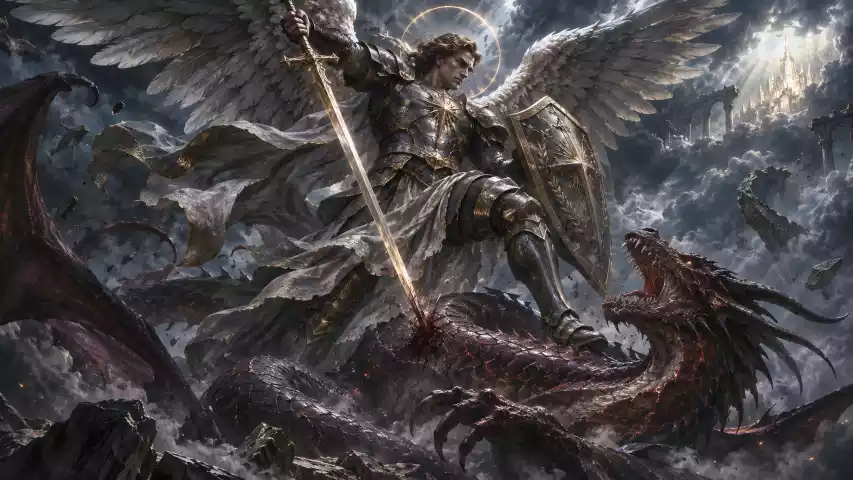
Revelation 12:7–9 presents Michael and his angels fighting the dragon, identified in the passage with the ancient serpent, the Devil and Satan. The scene belongs to apocalyptic symbolism: cosmic images interpret the struggle between evil and divine purposes. Many later paintings show a fully armored Michael stabbing a dragon. The biblical text, however, does not prescribe the exact sword, shield design, wing color or battlefield architecture shown by artists.
Restraint in the dispute about Moses
Jude 9 recounts Michael disputing with the devil over the body of Moses yet declining to pronounce his own abusive judgment, appealing instead to the Lord’s rebuke. The verse is short and its background is debated, frequently connected with a lost or transformed Moses tradition. It cannot justify detailed accounts of the exact burial place, a witnessed duel, or a long dialogue unless an explicitly identified later narrative is being cited.
Compassion and intercession
First Enoch 40 describes Michael in proximity to the divine presence, associated with mercy and patience in that passage’s grouping of four presences. Jewish liturgical and midrashic traditions later develop him as an advocate. Christian devotional language invokes his protection and intercession; these are historical acts of belief and worship practice rather than empirical demonstrations of intervention. Islam preserves distinct traditions in which Mīkāʾīl is associated with mercy, provision or rain, generally in commentary or reports rather than directly in Qur’an 2:98.
Care of souls as later development
In Western medieval art Michael can hold scales to weigh souls, receive the dying, or conduct souls toward judgment. These roles developed in the liturgy, apocryphal imagination and visual culture. They should be identified as later than the short references in Daniel and Jude. Equally, calling Michael a healer in connection with particular sanctuaries is defensible as cult history, but not as an office explicitly enumerated by Daniel.
Scripture offers no definitive portrait
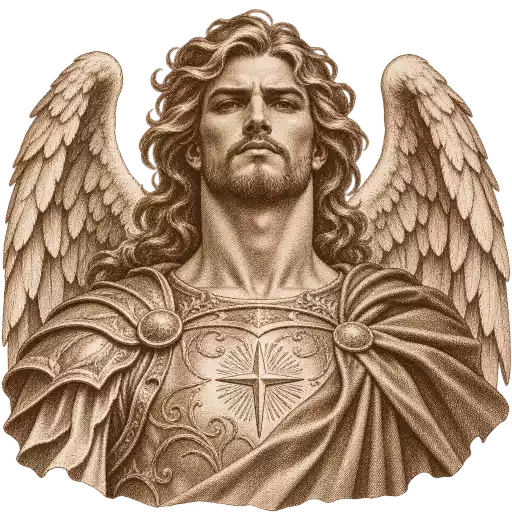
Daniel 10 describes a glorious visionary man, yet the text does not simply identify every feature of that unnamed figure as Michael. Jude gives no physical description of Michael, and Revelation focuses on conflict rather than body, hair, height or number of wings. Every fixed portrait therefore needs an art-historical label. The popular blond or brown-haired warrior with two white wings is a conventional image, not a preserved eyewitness account.
The armed commander in Byzantine art
Eastern Christian icons frequently depict the archangel in military dress, sometimes with a spear, sword, orb or banner. Byzantine court costume, military equipment and imperial symbolism informed these images over time. The orb may contain Christological signs or stand for divine rule; exact attributes differ from workshop to workshop. To say that Michael is represented in armor is historically sound; to claim that he always wore a specific Roman cuirass is not.
Sword, scales and dragon in Western art
The flaming sword expresses victory over evil, even though Revelation 12 does not say Michael wields that exact weapon. The dragon under his feet signifies the defeated adversary. Scales refer to the psychostasia, the weighing of souls, a motif developed in medieval Christian visual traditions. A lance, shield, banner and sometimes a cross are equally common. Their presence shows the imagery of protection and judgment rather than a literal physical inventory.
Wings, color and artistic period
Wings are conventional signs of angelic nature in Christian imagery. Artists have painted Michael as a youthful figure with multicolored wings, a Byzantine official, a late Gothic knight or a Renaissance warrior. The differences often tell us more about patrons, media and artistic conventions than about changing ancient descriptions. An icon intended for historical reference should identify its artistic tradition instead of claiming one timeless original face.
The name is not a sigil
The Hebrew spelling of Michael is a written name, not a magical seal by itself. Some late occult systems assign symbols, planetary colors, days or diagrams to archangels. Those assignments may be studied as dated Western esoteric reception, but they are not interchangeable with Daniel or Qur’anic testimony. In particular, a modern Michael sigil should not be described as an archaeological artifact from ancient Israel.
Daniel 10:13 and the prince of Persia
Daniel 10 describes a heavenly messenger delayed for twenty-one days by the prince of Persia until Michael, one of the chief princes, comes to help. This language places human imperial history and invisible opposition within a visionary account. Michael is not introduced as the author of Daniel or a divine equal. The chapter’s dramatic narrative does not reveal a named physical location for the conflict and leaves many interpretive questions open.
Daniel 10:21 and 12:1
Michael is described in Daniel 10:21 as the prince linked with the people of the visionary discourse. Daniel 12:1 returns to him during a time of unparalleled distress and anticipates deliverance for those written in the book. These passages decisively support the title protector of Israel and a role in eschatological hope. They do not establish that Michael independently performs resurrection; 12:2 speaks of awakening but does not assign the creative power of life to the angel.
Jude 9 and the body of Moses
The New Testament Letter of Jude, verse 9, calls Michael archangel and recounts contention with the devil over Moses’ body. This episode does not occur in the same form in Deuteronomy 34, which briefly notes Moses’ burial. Scholars debate the relationship to Jewish Moses-apocalypse traditions and the lost ending of the Assumption of Moses. It is essential to distinguish a possible literary source from a surviving, complete narrative that could be checked line by line.
Revelation 12:7–12
In Revelation, war breaks out in heaven and Michael’s angels oppose the dragon and its angels. The dragon is identified with Satan and the deceiver. The imagery has contributed profoundly to Christian warfare, martyrdom and exorcistic symbolism. Interpreters differ on whether the conflict refers chiefly to Christ’s triumph, a primordial event or a final apocalyptic struggle. The text should be described accurately without presenting a contested chronology as unanimous.
First Enoch and Qur’an
First Enoch 9 places Michael among angels responding to evil on earth; chapter 20:5 lists his charge, and chapter 40 belongs to the vision of heavenly presences. Their canonical status varies among Jewish and Christian communities, while 1 Enoch is scriptural in Ethiopian Orthodox tradition. Qur’an 2:98 names Mīkāl with Jibrīl as angels of God; later detailed duties concerning rainfall and provision are best attributed to tafsir or hadith literature, not silently inserted into that verse.
Jewish angelology and advocacy
Jewish reception of Daniel developed Michael as Israel’s protector and sometimes its advocate before the heavenly court. Rabbinic and medieval passages contain diverse pictures; there is no single unchanging “Jewish Michael” beyond the scriptural and liturgical threads. The Jewish Encyclopedia discusses the tutelary role, his name and later traditions. When comparing the four angels Michael, Gabriel, Raphael and Uriel, it is useful to specify which text supplies the grouping, because names and order vary.
Catholic veneration
In Catholic tradition Saint Michael is honored as an archangel, defender against evil and protector of the Church. The Roman liturgical calendar joins Michael, Gabriel and Raphael on 29 September. Older regional feasts, such as celebrations connected with Monte Gargano, have separate histories. His traditional association with the dying and the weighing of souls is reflected in prayers and art; it should not be presented as an added biblical chapter.
Eastern Orthodox worship
Eastern Orthodox Christians commemorate the Synaxis of Michael and the other bodiless powers on 8 November, often calling him archistrategos. Icons and hymns emphasize leadership under God, and Eastern calendars preserve regional miracle traditions. Orthodox sources may connect the commemoration with the Council of Laodicea and with theological teaching about proper veneration of angels rather than worship of angels as gods. Such institutional histories should be cited to their church tradition.
Islamic Mīkāʾīl
The Qur’an explicitly names Mīkāl in 2:98, pairing him with Jibrīl in a declaration of loyalty to God, His messengers and angels. Later Islamic exegesis and devotional literature commonly associate Mīkāʾīl with rain, vegetation and the distribution of provision, but the details and authority of individual reports must be assessed. These associations do not turn him into the dragon-slayer of Revelation within the Qur’anic narrative, and Muslim theology does not treat angels as independent divine powers.
Popular and esoteric reception
From protective medals and prayers to medieval pilgrim badges, Michael’s presence in popular religion has many historically distinct expressions. Early modern ceremonial magic sometimes incorporates archangelic names and planetary assignments. Those sources may be documented when relevant, but are not evidence of uninterrupted secret teaching from ancient Daniel. Even communities sharing the name can disagree about whether a particular image, prayer or feast is appropriate.
God and the limits of angelic status
Michael’s principal relationship is one of service to God. The Hebrew meaning of his name points to divine incomparability, and Jude attributes rebuke to the Lord rather than making Michael the ultimate judge. This distinction is important when encountering modern claims that Michael was a separate creator, a rival god or a sovereign force independent of the divine. Such claims are not supported by the core biblical passages.
Gabriel, Raphael and Uriel
Gabriel appears with Michael in several Jewish and Christian lists, though Daniel assigns them different narrative functions. Raphael is prominent in Tobit and 1 Enoch; Uriel appears in Enochic and other apocalyptic writings. Different canons and churches evaluate these texts differently. Their grouping is a network of angelological tradition, not a biological family and not a fixed four-person military command recorded identically in every ancient source.
Satan, the dragon and the devil
Revelation 12 identifies the dragon with the Devil and Satan; the account establishes the famous rivalry between Michael and the adversary in Christian iconography. Jude 9 presents a very different scene: a dispute about Moses’ body restrained by deference to God. These should not be collapsed into an invented single combat with a date, place and spoken incantations. The image of a dragon underfoot is an interpretation of Revelation’s apocalyptic action.
Moses and Israel
Jude mentions Moses as the subject of a dispute, not a brother, master or disciple of Michael. Daniel ties Michael to the people of Israel. These relations belong to different literary contexts and should be recorded with their exact passages. Later traditions that place Michael at patriarchs’ deaths or guide souls may have their own textual witnesses, but should not be silently included in the biblical narrative.
Distinct interpretations of identity
Some Christian denominations interpret Michael in relation to the pre-incarnate Christ, while most Catholic and Eastern Orthodox theology treats him as a created angel distinct from Christ. These differences must be attributed instead of converted into a claim about one uniform Christian doctrine. Similarly, the Islamic Mīkāʾīl is named in the Qur’an but is not thereby assigned every role from medieval European devotional art.


Hebrew Bible: Daniel
Book of Daniel 10:13; 10:21; 12:1–3. These passages establish Michael among heavenly princes, specifically linked to the people addressed by Daniel and to deliverance during a time of distress. For text comparison see https://www.biblegateway.com/passage/?search=Daniel%2010%3A13%3B%2010%3A21%3B%2012%3A1&version=NRSVUE and consult the underlying Hebrew/Aramaic tradition when assessing wording.
New Testament: Jude and Revelation
Letter of Jude 1:9 and Book of Revelation 12:7–12. Jude applies the title archangel and refers to the dispute over Moses’ body; Revelation recounts war in heaven and identifies the defeated dragon. The two passages are not identical episodes. Text access: https://www.biblegateway.com/passage/?search=Jude%201%3A9%3B%20Revelation%2012%3A7-12&version=NRSVUE .
Jewish apocalyptic literature
1 Enoch 9:1; 20:1–8, especially 20:5; 40:1–10; 71:1–9. Versions and translations vary, and the book is a compilation with different literary sections. A public-domain R. H. Charles translation of chapter 20 appears at https://en.wikisource.org/wiki/Book_of_Enoch/Chapter_20 . For historical interpretation consult a critical edition, not a modern harmonized chart alone.
Qur’an and Islamic commentaries
Qur’an, Surat al-Baqara 2:97–98, with Mīkāl explicitly named in verse 98: https://quran.com/2/98 . Accounts about rain, sustenance and allocation of duties should be attributed to identified tafsir or hadith literature; they are not direct quotations of 2:98. Translation choices may differ in rendering the proper name.
Reception: historical and ecclesiastical sources
Jewish Encyclopedia, “Michael,” https://www.jewishencyclopedia.com/articles/10779-michael ; Catholic Encyclopedia, “St. Michael the Archangel,” https://www.newadvent.org/cathen/10275b.htm ; Orthodox Church in America, Synaxis of the Archangel Michael, 8 November, https://www.oca.org/saints/all-lives/4464/11/08 . These are reference or denominational accounts and should not be confused with the earliest primary text.