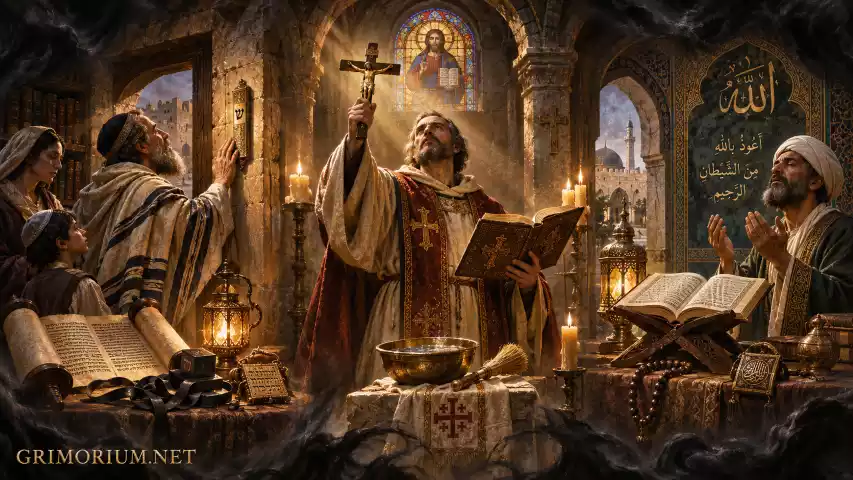
One question, three religious histories
Across centuries, Jewish, Christian, and Muslim communities have turned to prayer, sacred texts, and communal observance when confronting evil, temptation, or fears associated with unseen forces. From a distance these customs may resemble a shared collection of methods for warding off Satan. Their theological foundations, however, are not interchangeable. The biblical Hebrew term satan can denote an adversary or accuser in settings very different from the later Christian portrait of the Devil as a principal spiritual opponent. The Qur'an presents Iblis and al-Shaytan within its own account of disobedience and temptation. The historical question is therefore not simply which religion possesses the strongest protective formula. It is how particular texts and communities understood danger, divine power, and the human response to them. Any comparison must distinguish foundational scripture from rabbinic interpretation, Christian liturgical development, Islamic transmitted reports, and popular customs. The practices examined here are documented religious beliefs, not scientifically established techniques for preventing supernatural harm.
Why the identity of Satan matters
The Book of Job depicts the satan among heavenly beings, questioning the fidelity of a righteous man. Zechariah 3 presents an accuser confronting the high priest Joshua, while 1 Chronicles 21:1 places Satan in yet another narrative setting. These passages cannot simply be collapsed into a fully developed medieval demonology. In New Testament writings Satan appears as a tempter and adversary, yet the texts themselves range from narratives about Jesus to moral counsel addressed to believing communities. In the Qur'an, Iblis refuses the command associated with Adam, and the language of satanic whispering emphasizes the danger of being misled. These traditions share overlapping vocabulary without telling exactly the same story. Consequently, the religious meaning of protection also varies. Jewish observance often highlights loyalty to God's commandments; many Christian accounts emphasize steadfast faith and dependence on Christ; Islamic invocations seek refuge in Allah from temptation and harmful suggestion. Keeping those distinctions visible is the foundation of a responsible historical comparison.
Jewish prayer and the bedtime Shema
The Shema stands at the center of Jewish religious life, drawing its principal declaration from Deuteronomy 6:4–9. This passage calls Israel to acknowledge the unity of God, teach the divine words, and remember them in ordinary daily activities. It is not originally presented as a specialized formula against the Christian Devil. Yet its recitation came to hold protective associations in rabbinic teaching. Babylonian Talmud, Berakhot 5a, likens the Shema spoken at bedtime to a double-edged sword and describes harmful beings withdrawing from the person who recites it. That source documents a particular rabbinic interpretation rather than proving that identical ideas governed every biblical or Jewish community. The bedtime prayer combines religious remembrance with the act of entrusting oneself to divine care before sleep. Liturgical forms differ among communities and historical periods, so no single sequence of verses should be described as universally practiced by all Jews. What persists is the close relationship between sacred recitation, covenantal identity, and trust.
Psalm 91 and the meaning of the mezuzah
Psalm 91 has played a significant role in Jewish traditions of protection, speaking of shelter under divine care amid nighttime terror and other dangers. In some interpretive settings its language was associated with harmful supernatural beings. That later use does not establish that the psalm originally referred to Satan in a specifically Christian sense. A different but equally important example is the mezuzah, a small case containing passages from the Torah attached to the doorframe. Its normative background lies in Deuteronomy 6 and 11, where remembering the commandments is linked with one's home and entrances. Treating the mezuzah merely as an anti-demonic charm would obscure its central role as a sign of religious duty and remembrance. Nevertheless, material religious objects can acquire layers of protective significance in lived practice. Historical interpretation must separate the obligation found in scripture, later rabbinic discussions, and popular expectations surrounding household safety. The same visible object may thus carry legal, devotional, and cultural meanings without being reducible to one of them.
Christian resistance through faith and prayer

Early Christian writings frequently portray resistance to the Devil as a matter of perseverance rather than the manipulation of protective objects. James 4:7 calls believers to submit to God and resist the devil. First Peter 5:8–9 joins spiritual alertness to steadfast faith. Ephesians 6:10–18 develops the metaphor of spiritual armor: truth, righteousness, faith, salvation, the word of God, and continual prayer. Its vocabulary evokes conflict, but the practices it describes are primarily ethical and communal. The Lord's Prayer likewise includes a petition for deliverance from evil, interpreted differently across Christian translations and commentaries. Gospel narratives contain accounts of Jesus expelling unclean spirits, but those episodes do not constitute a uniform technical handbook for later generations. Nor should every illness or difficult experience described in ancient sources be understood through a single modern category. The developing Christian tradition would create elaborate liturgies and rules concerning exorcism. Reading those later developments directly back into first-century congregations would conceal the historical changes that made them possible.
The cross, baptism, and blessed objects
The sign of the cross became an enduring gesture of Christian confession and, in numerous communities, an expression of spiritual protection. Its significance depends upon the death and resurrection of Christ; within Christian theology it is not simply a mechanical technique. Baptismal traditions also developed prayers and renunciations associated with rejecting evil and entering the life of the Church. In Catholic teaching, blessings form part of the wider category of sacramentals, whereas exorcism is treated separately. The Catechism of the Catholic Church, paragraphs 1671–1673, explains these distinctions and places particular limits on solemn rites. Holy water, icons, crosses, and other religious objects may function as signs of blessing or devotion, but their theological significance differs across Catholic, Orthodox, Protestant, and other Christian communities. Some emphasize material expressions of worship; others prioritize scriptural reading and prayer without attaching special protective status to objects. A historical account should reflect these variations rather than treating Christianity as if it had maintained a single universal inventory of defenses against the Devil.
Exorcism and the importance of institutional limits
Popular depictions often reduce exorcism to a dramatic confrontation, yet historical rites are shaped by institutional authority and theological caution. Catholic teaching distinguishes a simple form connected with baptism from solemn or major exorcism. According to Catechism paragraph 1673, the latter requires an authorized priest acting with permission from the bishop. The same passage calls for prudence and for differentiating spiritual concerns from illness, which belongs within professional medical care. Other Christian churches have distinct practices, so Catholic rules cannot stand in for the entirety of Christianity. Reports of possession and release remain important historical sources because they reveal how communities interpreted distress, transgression, and restoration. They do not, by themselves, provide scientific confirmation of a supernatural explanation. Furthermore, presenting a historical rite must not imply that it should replace medical, psychological, or social assistance when appropriate. The most reliable historical approach investigates what participants believed a ritual accomplished, who was permitted to perform it, and how its meaning changed between communities and centuries.
Islam and seeking refuge in Allah
Within Islam, a response to satanic temptation is seeking refuge in Allah. Qur'an 16:98 instructs the believer to seek divine protection before reciting revelation; 23:97–98 contains a plea against the prompting and presence of the devils. The notion of waswasa, commonly rendered as whispering or insinuation, helps explain why temptation is often described as a disturbance of judgment and remembrance. Islam does not present Satan as an independent god equal in power to Allah. In Qur'anic accounts Iblis disobeys the divine command associated with Adam, while shayatin may refer to tempting agents or beings linked with error. Interpretations of their precise nature have developed in different schools, but the emphasis on divine sovereignty remains fundamental. Seeking refuge is consequently an act of dependence on God and an acknowledgment of human moral responsibility. Historical Muslim communities have expressed that principle in varied devotional and legal forms, yet the underlying invocation rests on explicit Qur'anic passages rather than merely on later folk custom.
Protective surahs and the Throne Verse

Surahs 113 and 114, al-Falaq and al-Nas, are among the best-known Qur'anic passages used for seeking protection. The former asks for refuge from diverse harms; the latter focuses on the whisperer whose suggestions draw people away from God. These chapters became closely associated with private recitation and devotional remembrance. Another important text is the Throne Verse, Qur'an 2:255, which proclaims divine sovereignty, life, and knowledge. A report in Sahih al-Bukhari 5010 connects its recitation before sleep with protection through the night from Satan. The distinction between Qur'anic revelation and a narrated hadith is essential: these sources possess different forms and occupy different roles in the tradition. Their historical reception also involves interpretation and communal habit. Muslims in many settings recite these passages at home or during anxious moments, but descriptions of such practices should not make universal promises about invisible dangers. The historian can establish that a protective belief is recorded without claiming to have verified its supernatural effects.
Ruqya, written amulets, and controversy
Ruqya refers to forms of recitation and supplication used in certain Muslim contexts when requesting relief or protection. Discussions of its permissibility frequently distinguish Qur'anic language and appeals directed to Allah from expressions considered incompatible with monotheism. Written amulets, sometimes called ta'wiz, have also appeared across Muslim societies, although their use is disputed. Some religious scholars accepted particular forms under conditions, while others rejected them because of the danger of assigning independent efficacy to an object. These disagreements make it inaccurate to say that Islam as a whole prescribes or prohibits every conceivable protective object in exactly the same way. The documentary record also varies by place and period, from household religious practice to learned theological debate. Accounts of ritual healing must not be used to discourage medical assessment of an illness or distressing experience. What they reveal historically is the negotiation between scripture, local custom, personal fear, and competing understandings of religious authority.
What the three traditions share—and what they do not
Jewish, Christian, and Islamic traditions all place great importance on turning toward God rather than granting Satan an independent power equal to the divine. Sacred recitation, prayer before sleep, and the discipline of communal religious life recur across the histories considered here. Yet these are not identical methods under different names. Rabbinic texts offer particular interpretations of the bedtime Shema; Christian writings emphasize fidelity to Christ and, in some churches, formal rites and sacramental signs; Qur'anic passages foreground seeking refuge in Allah, with hadith literature giving additional devotional detail. The satan of Job, the Devil of later Christian theology, and Iblis of Islamic scripture arise in related but distinct narrative worlds. Their treatment differs in the authorities that define practice: Torah and rabbinic interpretation, biblical scripture and church traditions, Qur'an and transmitted prophetic reports interpreted within legal scholarship. Comparison becomes useful only when these differences remain visible. Otherwise, a familiar word such as protection conceals rather than clarifies what communities believed.
Studying religious protection as history
Texts about divine shelter can help historians understand how people responded to uncertainty, danger, and moral struggle. They cannot alone establish that the supernatural threats they describe have been empirically demonstrated. The Shema in Deuteronomy must be distinguished from its later characterization in Berakhot; apostolic exhortations from medieval or modern exorcism regulations; and the Qur'anic summons to seek refuge from specific protective customs recorded in hadith and local devotional practice. Learned theology, everyday rituals, skepticism, and popular beliefs coexisted in many periods. Seen on their own terms, these practices disclose not a universal formula against Satan, but three evolving religious histories of trust, obedience, and the pursuit of spiritual security.
Related Entities




Sources and references
- Deuteronomio / Deuteronomy, Deuteronomio / Deuteronomy, 6:4–9; 11:13–21 View source
- Talmud babilónico / Babylonian Talmud, Berajot / Berakhot, 5a View source
- Biblia / Bible, Salmo / Psalm, 91 View source
- Biblia / Bible, Efesios / Ephesians, 6:10–18 View source
- Iglesia Católica / Catholic Church, Catecismo de la Iglesia Católica / Catechism of the Catholic Church, 1671–1673 View source
- Corán / Qur’an, Suras / Surahs, 16:98; 23:97–98; 2:255; 113–114 View source
- Al-Bujari / al-Bukhari, Sahih al-Bujari / Sahih al-Bukhari, 5010 View source